




Ebonised Breakfront Bookcase
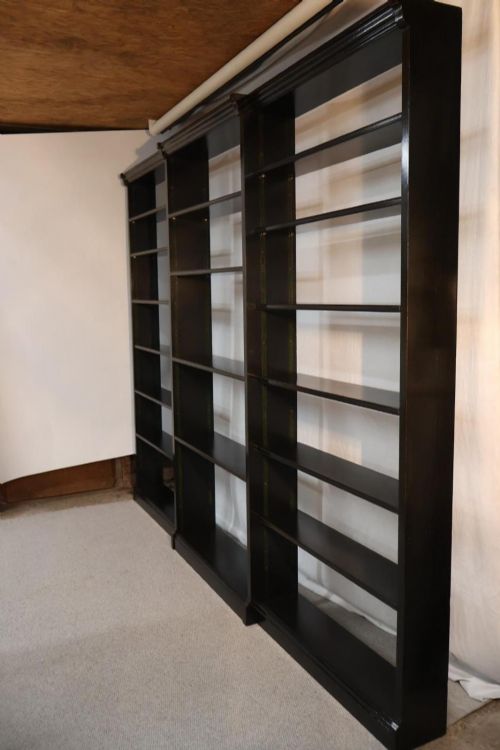
An ebonised breakfront bookcase commands the room with its darkened timber and stepped facade, offering serious presence for any serious library.
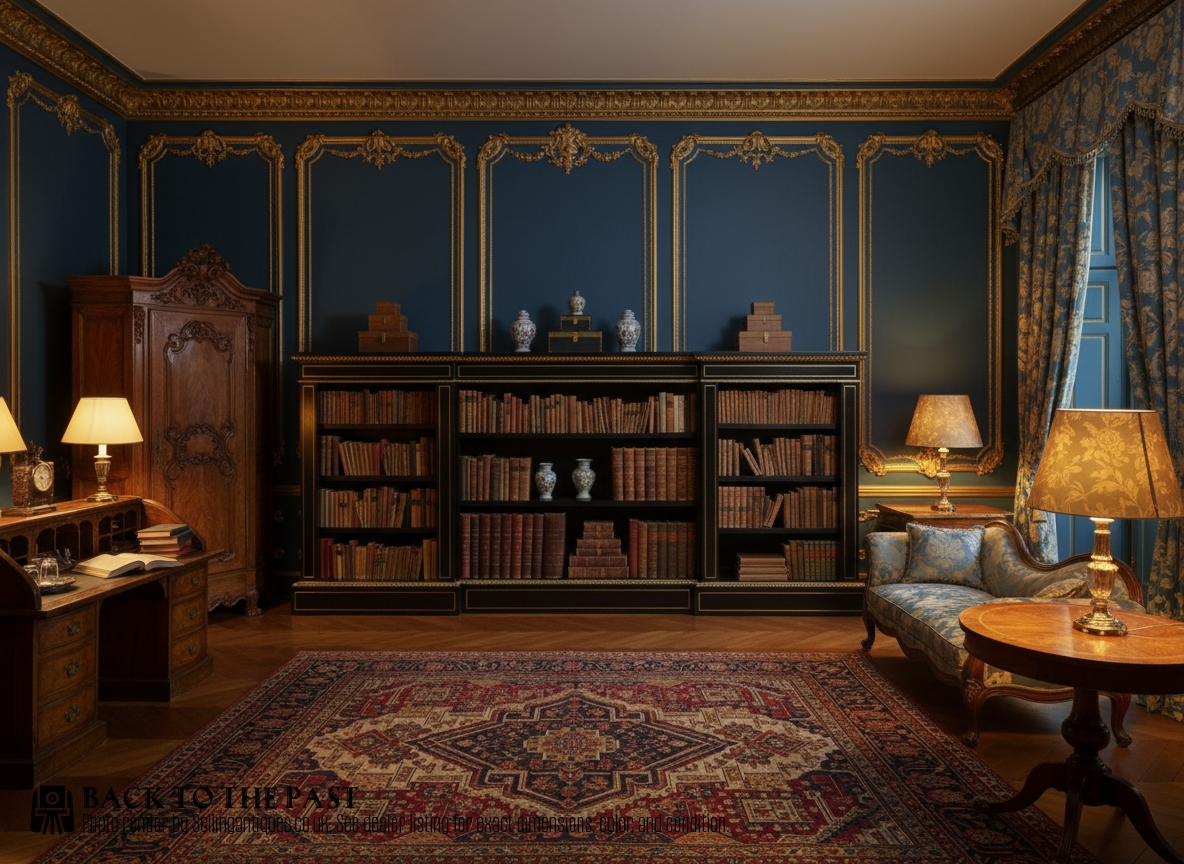
Ebonised Breakfront Bookcase
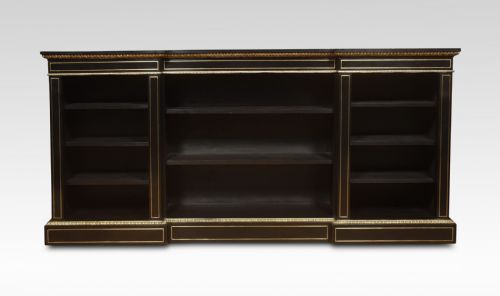
An ebonised breakfront bookcase is a substantial piece of furniture designed to house libraries and display collections, defined by a central section that projects forward from the flanking wings. These cabinets emerge primarily from the Victorian era and the nineteenth century, often appearing alongside related forms such as display cabinets, credenzas and vitrines.
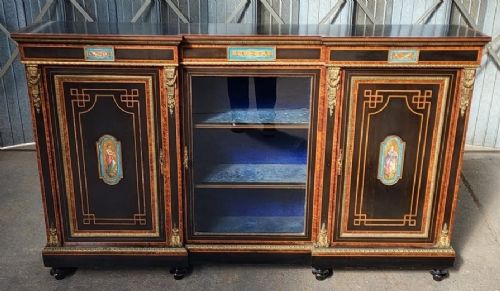
The aesthetic movement and Napoleon III styles heavily influence these pieces, introducing rich contrasts through contrasting inlays and gilt metal mounts. Buyers most frequently meet large Victorian examples finished in darkened woods, combining open shelving with enclosed glazed compartments.
Makers such as Lamb of Manchester occasionally signed these ambitious cabinet forms, marking them out as high-status commissions. The configuration generally balances glazed display doors with open shelving or solid timber lower cupboards.
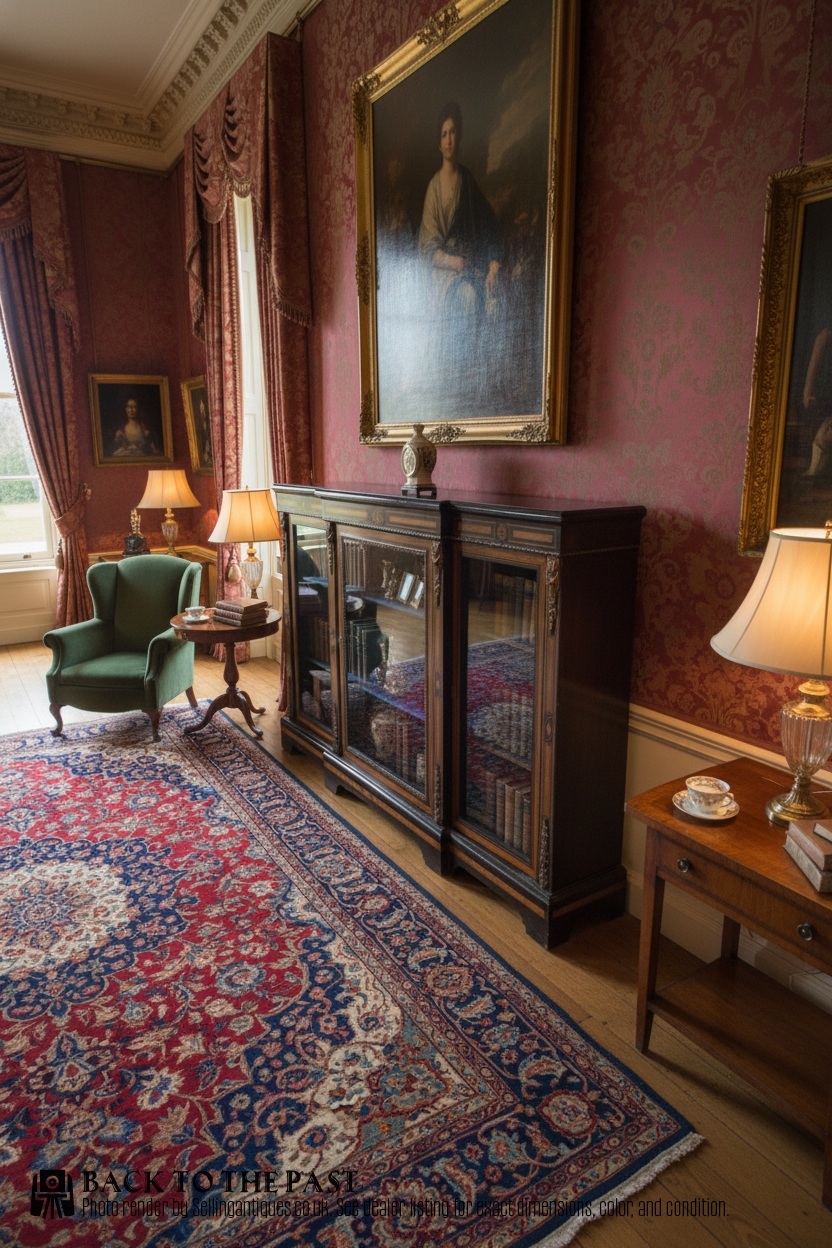
How they were made
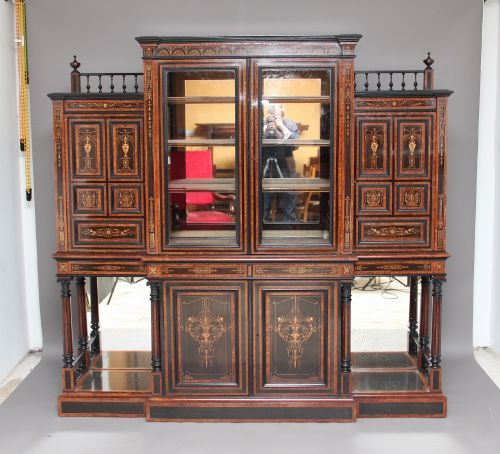
Cabinet makers utilised dense secondary timbers coated in a deep black finish to simulate costly ebony, frequently highlighting the dark surfaces with parcel-gilt and ormolu mounts. Intricate marquetry and stringing in contrasting woods like amboyna, burr walnut and coromandel provide geometric and floral decoration across the doors and friezes.
Glazing bars are painstakingly joined to form complex lattice patterns that frame the contents of the shelves. Cast brass and ormolu hardware secures the doors and corners, adding metallic warmth to the sombre ebonised carcase.
Listings feature Victorian and nineteenth-century pieces employing ebonised wood, glass, brass, ormolu, porcelain, amboyna, burr walnut and walnut.
What varies in quality
The refinement of the cabinet work distinguishes the finest examples, particularly in the precision of the breakfront joints and the crispness of the applied mounts. Superior pieces employ expensive secondary veneers like amboyna and burr walnut beneath the inlay, whereas standard production relies simply on flat ebonised surfaces.
The quality of the cast ormolu and the complexity of the marquetry inlay dictate the hierarchical tier of the piece. Well-balanced proportions across the projecting central section and recessed wings demonstrate superior design intelligence.
Lamb of Manchester
The Ebonised Breakfront Bookcase Glossary
- Ebonised wood
- Timber stained or painted to resemble solid ebony, popular during the Victorian period for its sleek, dark finish. This technique creates a dramatic contrast with gilt mounts and inlaid veneers.
- Breakfront
- A piece of furniture where the central section projects forward from the flanking ends. This architectural layout adds depth and shadow to large library bookcases.
- Ormolu
- Gilded bronze mounts applied to furniture for decorative accent and edge protection. These cast metal details reflect light against the dark ebonised surfaces.
- Vitrine
- A glass-fronted cabinet designed specifically for displaying porcelain and curiosities. Many tall breakfront bookcases incorporate vitrine doors into their upper sections.
- Marquetry
- Decorative patterns formed by fitting together thin veneers of various coloured woods. Craftsmen used this technique to create floral and geometric panels on cabinet doors.
Ebonised Breakfront Bookcase: Frequently Asked Questions
How do I date an ebonised cabinet?
Dating relies on observing stylistic markers such as nineteenth-century Aesthetic Movement motifs, specific timber combinations like burr walnut and amboyna, and construction methods. Victorian pieces often incorporate machine-cut veneers alongside hand-finished brass mounts.
Examining the interior linings and backboards provides further clues regarding the manufacturing decade.
Are these bookcases suitable for modern rooms?
These large cabinets require significant wall space and sturdy flooring due to their substantial timber construction. Their dark ebonised finishes contrast effectively against pale walls in contemporary interiors.
Proper placement avoids direct sunlight to protect vulnerable internal veneers and delicate brass mounts.
What is the difference between a vitrine and a bookcase?
A vitrine is built primarily with glass panels on the front and sides to display decorative objects from multiple angles. Bookcases prioritize shelf space for storing volumes, though many Victorian examples combine both functions.
Hybrid pieces feature glazed upper sections for books and lower solid cupboards for storage.