
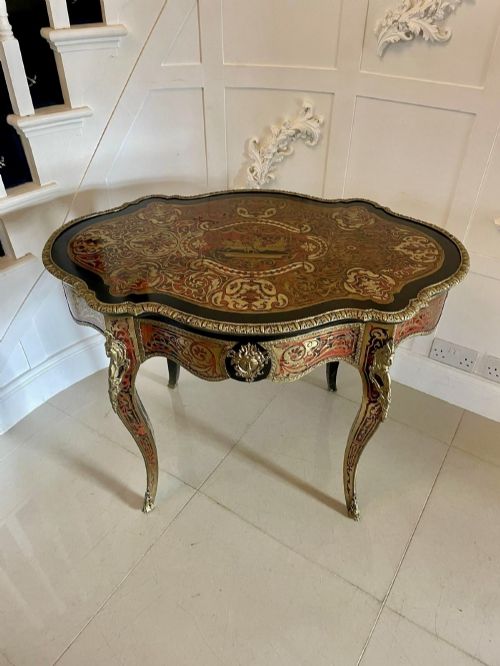
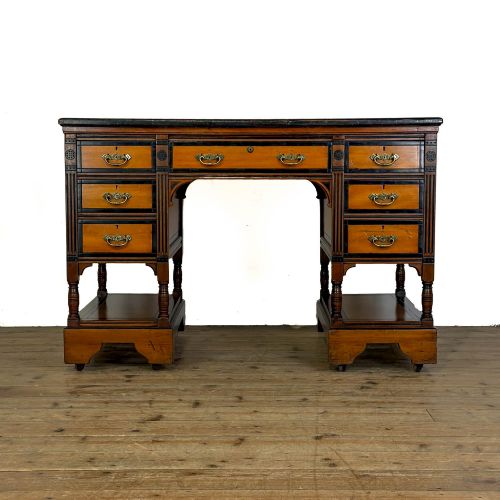
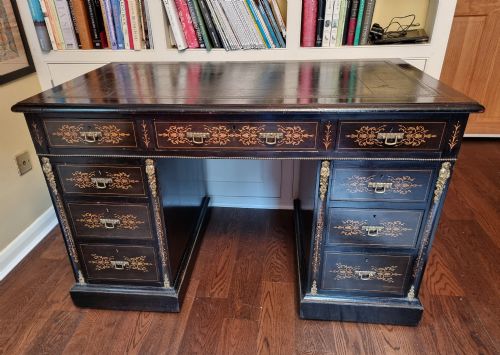
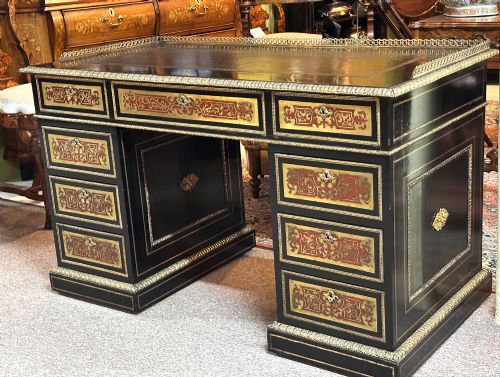


Ebonised Brass Writing Table
An ebonised brass writing table brings dark wood and bright metalwork together for a striking desk.
Ebonised Brass Writing Table
An ebonised brass writing table is a piece of furniture designed for correspondence and paperwork, combining a darkened wooden surface with metallic detailing. The selection ranges from nineteenth-century French bureau-plat designs to Victorian partners desks and compact bonheur-du-jour cabinets.
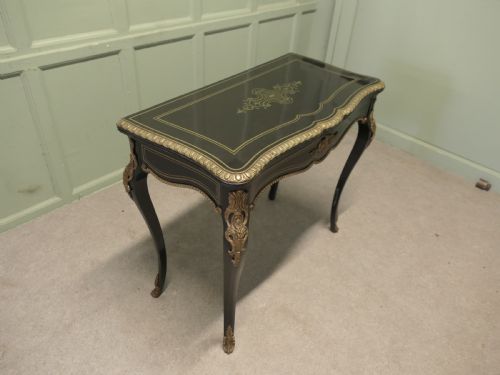
Most examples you encounter stem from the nineteenth century, including specific periods like the 1860s and 1880s, alongside Napoleon III and Victorian styles. These forms encompass centre tables, games tables, and freestanding writing desks intended to sit proudly in the middle of a room.
How they were made
Cabinet makers achieved the dark, polished finish of ebonised wood by staining timber to resemble ebony, often pairing it with brass inlay or ormolu mounts. Marquetry and parquetry techniques also appear, incorporating materials like tortoiseshell, rosewood, and amboyna.
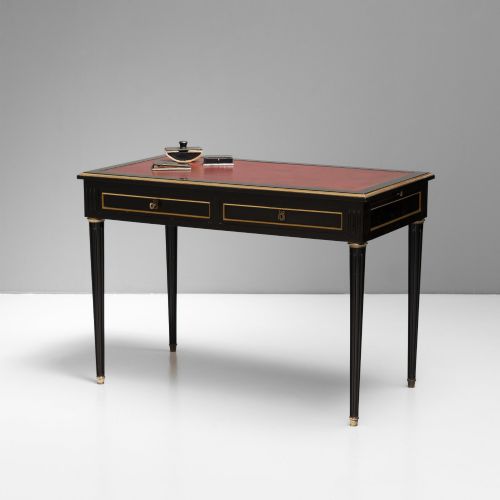
Gilt bronze and ormolu mounts provide structural accenting around drawers and legs, while inset leather surfaces offer a practical writing area. Fine metal engraving and precision brass stringing complete the decorative scheme on these desks.
Listings feature nineteenth century pieces spanning the Victorian, Regency, and Napoleon III periods, constructed from ebonised wood, brass, and ormolu.
What varies in quality
The standard of an ebonised brass writing table depends on the crispness of the brass inlay and the depth of the ebonised finish. Finer pieces demonstrate precise marquetry and substantial gilt bronze mounts rather than surface-level casting.
Mastery of construction shows in the smooth operation of drawers, the integration of double-sided designs, and the preservation of delicate tortoiseshell or boulle work. Maker attribution also elevates certain desks above standard production pieces.
Edwards and Roberts·Maison Millet·Paul Sormani·Diehl Paris
The Ebonised Brass Writing Table Glossary
- Ebonised wood
- Timber treated with a dark stain or finish to imitate expensive ebony. This technique was popular in nineteenth-century cabinet making.
- Bureau-plat
- A flat-topped writing table, usually freestanding with drawers beneath the writing surface. It originated in France.
- Ormolu
- Gilt bronze mounts applied to furniture for decoration. The quality depends on the sharpness of the chasing.
- Boulle work
- Marquetry of tortoiseshell and brass popularized by André-Charles Boulle. It creates a rich, contrasting surface pattern.
- Bonheur-du-jour
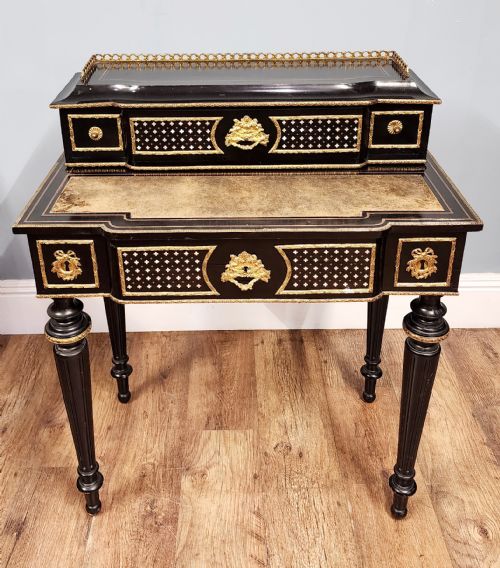
- A light ladies writing desk featuring a small cabinet or set of drawers on top. These often include delicate brass galleries.
Ebonised Brass Writing Table: Frequently Asked Questions
How do I care for an ebonised finish?
Dust regularly with a soft, dry cloth and avoid placing the desk in direct sunlight or near heat sources, which can dry out the wood.
Wax polish applied sparingly helps protect the ebonised surface and maintains the subtle sheen of the timber.
Where should I place a freestanding desk?
These tables are designed to be viewed from all sides, making them ideal for the middle of a study or living room rather than pushed against a wall.
Ensure there is enough clearance around the piece for chairs and movement to appreciate the finished backs and side details.
What is the difference between a bureau-plat and a bonheur-du-jour?
A bureau-plat provides a simple flat writing surface with drawers below, built for general correspondence and paperwork in a central room setting.
A bonheur-du-jour includes a superstructure with small drawers and pigeonholes on top, offering a more compact and decorative workstation.
How do I identify nineteenth century French styles?
Look for characteristic motifs such as gilt bronze mounts, intricate brass inlay, and curving cabriole legs associated with revival periods.
Construction methods, timber choices like amboyna or rosewood, and maker signatures often help pinpoint the exact decade of manufacture.