





Earthy Tone Landscape
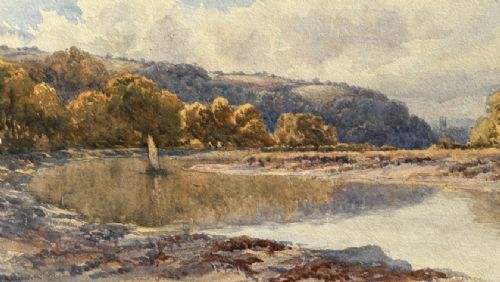
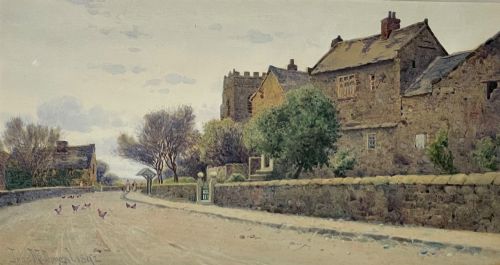
An earthy tone landscape brings muted palettes and natural pigments into a room, offering a quiet record of fields, rivers and rural villages.
Earthy Tone Landscape
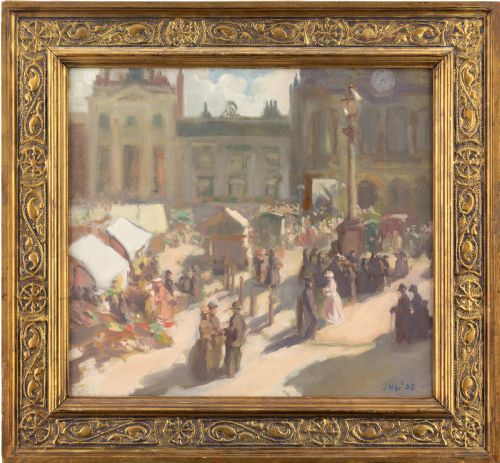
An earthy tone landscape encompasses works created across the nineteenth and twentieth centuries, spanning Victorian, Edwardian, and mid-twentieth-century periods. These pieces record rural scenes, farmyards, rivers, and village views through the lens of British, French, and Italian movements.
The most common examples encountered on this page are oil paintings on canvas, board, or wood panel, alongside watercolours on paper. Artists from regional schools, including the Scottish School and British Impressionism, frequently focused their palettes on natural ochres, browns, and muted greens.
Subjects range from Yorkshire farmyards and moorland streams to French provincial courtyards and Normandy pastures. The focus remains steadfastly on the land, agricultural labour, and pastoral architecture rendered in subdued, grounded colour harmonies.
What varies in quality
Quality rests in the sureness of the handling and the cohesion of the tonal palette. A stronger work demonstrates confident brushwork and a balanced composition that unites foreground detail with atmospheric distance.
The sensitivity with which natural light and earthy pigment are managed separates competent records from more accomplished artistic interpretations. Material integrity, such as stable paint layers on canvas or well-preserved paper without excessive fading, also distinguishes the range.
Listings feature works from the nineteenth century up to 1960, executed in oil paint, watercolour, canvas, board, and wood.
David Law·Tom Campbell·John McDougal·John Hodgson Lobley·Raimond Louis Lecourt·Herbert Royle·William JB Jenkins·Reginald Grange Brundrit·John Atkinson·Majorie Hoare·John Frederick Herring·G Villiers Stuart·Paul Jones·Thomas Creswick·Owen Bowen·Charles H Poingdestre·Ernest Higgins Rigg·Rowland Henry Hill·Kershaw Schofield·George F Wetherbee·William Greaves·Francis William Topham·Maurice Asselin·Fred C Jones·John D Walker
The Earthy Tone Landscape Glossary
- Oil paint
- A slow-drying medium made by mixing pigments with oils such as linseed. This allowed artists to build rich, textured surfaces on canvas or wood panel.
- Watercolour
- A painting method where fine pigment powders are suspended in a water-soluble binder. Applied to paper, it creates translucent washes that depend on the white of the sheet for brightness.
- Wood panel
- A rigid wooden support used by painters before stretched canvas became dominant. It provides a firm, smooth surface that retains crisp brushstrokes over decades.
- Canvas
- A heavy woven fabric stretched tightly across a wooden frame to serve as a painting support. Its textured surface absorbs oil paint and supports varied impasto techniques.
- Barbizon School
- A French mid-nineteenth-century movement focused on realist landscape painting. Artists painted directly from nature, emphasising earthy tones and atmospheric rural scenes.
Earthy Tone Landscape: Frequently Asked Questions
How should I clean an antique oil painting?
Surface dust can be removed gently with a soft, dry artist's brush, taking care not to touch exposed canvas edges or areas of flaking paint.
More thorough cleaning requires professional intervention, as household solvents or moisture can permanently damage historic oil pigments and varnishes.
What periods do these landscapes cover?
The selection spans from the nineteenth century through the Victorian and Edwardian eras into the mid-twentieth century, including works dated from the 1900s to the 1960s.
Different decades brought shifts in regional painting styles, moving from academic realism towards looser impressionistic interpretations of the countryside.
Can I hang watercolours in direct sunlight?
Watercolours on paper are sensitive to ultraviolet light and can fade significantly if exposed to direct, strong sunlight over long periods.
Framing these works with UV-protective glass and placing them away from sunlit walls helps preserve the original pigment tones.
What is the difference between canvas and board supports?
Canvas is a woven textile stretched over a wooden frame, offering slight give and a textured surface that catches the brush. Board is a rigid, flat support that provides a completely stable and unyielding plane for detailed paint application.