
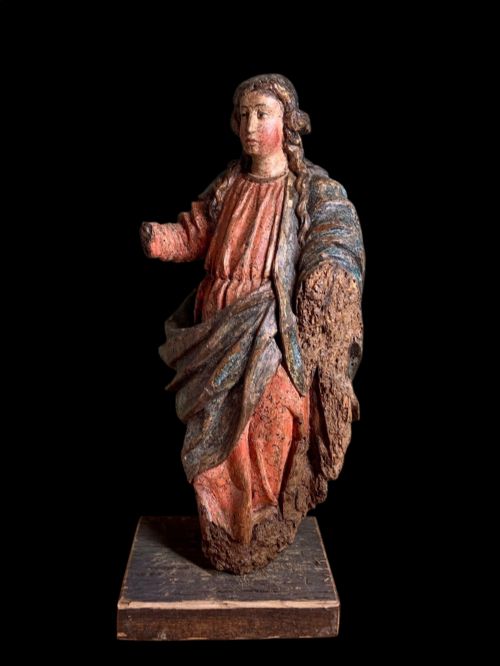


Early Religious Wooden Sculpture
Early religious wooden sculpture brings centuries of devotion into a room, taking the form of saints, angels, and holy figures carved from oak, lime wood, and hardwood.
Early Religious Wooden Sculpture
When you search for early religious wooden sculpture, you encounter devotional carvings spanning several centuries, ranging from medieval figures to later ecclesiastical pieces. The examples you meet most frequently on this page are carved wooden statues and groups depicting saints, angels, and biblical figures.
These works originate from various European traditions, including Flemish and German workshops, alongside distinct regional interpretations like Anglo-Indian carvings and Santos figures. The forms vary from solitary figures of saints with their attributes to pairs of angels and complete Madonna and child groupings.
Makers shaped these devotional objects for altars, churches, and private domestic shrines, utilising timber to create three-dimensional representations of sacred narratives. The surviving pieces carry the marks of their ecclesiastical history, often retaining traces of their original function within religious spaces.
Materials and construction methods
Carvers selected dense timbers such as oak, lime wood, and assorted hardwoods that could withstand intricate detailing without splitting along the grain. Artisans worked these logs with gouges and chisels to establish the primary volumes of drapery and anatomy before refining the facial expressions and hands.
Surfaces were frequently prepared with a layer of gesso, providing a smooth, absorbent ground for subsequent layers of polychrome paint and gilding. Painters applied pigments and gold leaf to bring garments and halos to life, adding realism and devotional splendour to the wooden core.
Listings feature carvings in oak, lime wood, and assorted hardwoods, spanning the sixteenth to the early twentieth century.
Distinctions in execution and survival
The survival of original surface decoration, including polychrome paint and gold leaf, heavily influences the integrity of a piece. Carvings that preserve their early layers without heavy modern repainting offer a more authentic witness to their period of origin.
Franz Keller
The Early Religious Wooden Sculpture Glossary
- Polychrome paint
- Decoration applied in several colours to the surface of wood or gesso. This technique brought statues closer to life by adding realistic skin tones and coloured vestments.
- Gesso
- A mixture of plaster of Paris and glue used to coat wooden sculptures. It created a smooth white foundation that held fine details and secured the gold leaf or paint.
- Gold leaf
- Gold beaten into extremely thin sheets and applied to a prepared surface with an adhesive size. It created radiant halos and gilded borders on ecclesiastical vestments.
- Lime wood
- A pale, fine-grained timber favoured by northern European carvers. Its lack of pronounced grain made it ideal for intricate undercut details and delicate facial expressions.
- Santos figure
- A devotional statue representing a saint or deity, particularly associated with Spanish and Latin American colonial traditions. These figures were often dressed in real textiles for religious processions.
Early Religious Wooden Sculpture: Frequently Asked Questions
What is early religious wooden sculpture?
Early religious wooden sculpture comprises devotional carvings created for churches, chapels, and private prayer spaces across Europe and other regions. These objects include figures of saints, angels, and biblical scenes fashioned from timber by skilled craftsmen.
They reflect the religious practices and artistic styles of periods spanning from the medieval era through the nineteenth century. Each piece serves as a physical link to historical traditions of worship and ecclesiastical art.
How were these wooden sculptures used?
These sculptures functioned primarily as focal points for prayer and contemplation within religious architecture and domestic settings. Many stood upon altars or within architectural niches, while others formed part of larger carved altarpieces.
Some figures were carried in religious processions or placed in private shrines for daily devotion. Their presence helped illiterate congregations visualise sacred narratives and connect with holy figures.
How do I care for wooden religious sculptures?
Preserving these sculptures requires stable environmental conditions away from direct sunlight, heating vents, and dampness. Fluctuating humidity causes wood to expand and contract, which can lead to cracking and the flaking of gesso or paint.
Dust the surface gently with a soft, dry brush rather than using cloths or liquid cleaners that might damage fragile polychrome layers. Professional conservation advice should be sought before attempting any surface cleaning or structural repair.
How can I tell different periods apart?
Differentiating periods relies on observing the stylistic conventions of the carving, such as the treatment of drapery folds, facial types, and overall posture. Gothic pieces often feature linear, cascading drapery and solemn expressions, whereas Renaissance and Baroque examples display greater anatomical realism and dynamic movement.
Material analysis and tool marks also provide clues to the date, as mechanical saws and modern adhesives indicate later production. Comparing the piece with documented examples from specific centuries helps confirm its chronological placement.