


Early 20th Century Charcoal
Early 20th century charcoal works capture transient human moments and places through immediate, dusty marks on paper.
Early 20th Century Charcoal
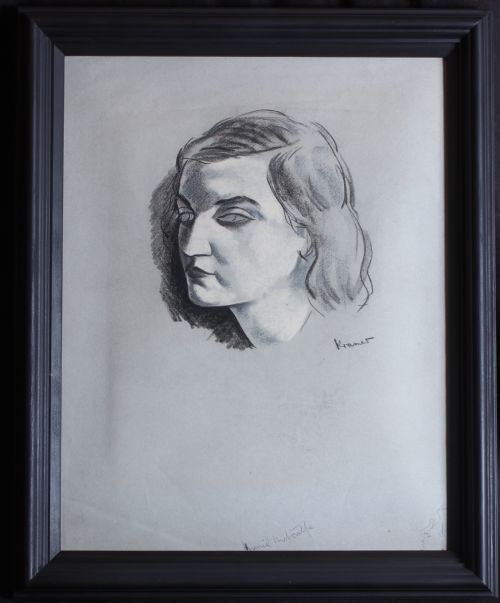
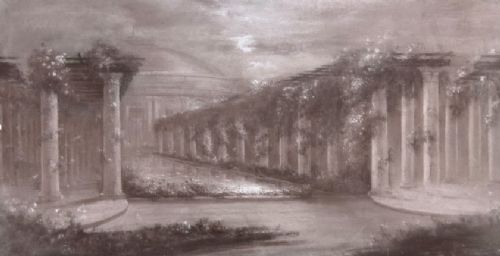
These early 20th century charcoal pieces encompass original portrait drawings, life studies, and tonalist cityscapes produced during the Edwardian and interwar decades. Buyers will encounter both rapid preparatory sketches from art schools and highly finished exhibition pieces signed by known painters.
The most common formats on this page are paper sheets mounted behind glass in wooden frames, capturing figures like portrait sitters, nudes, and street scenes. Subjects range from academic realism and impressionist street views to avant-garde cubist compositions.
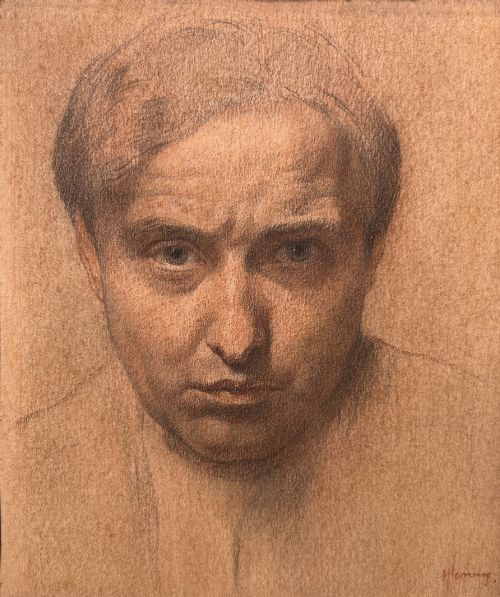
Portraits dominate the selection, recording artists, explorers, and actors drawn by contemporaries using charcoal alongside pastel, chalk, and graphite. Every piece reflects the direct handling characteristic of the period's draughtsmanship.
Materials and technique
Artists drew with compressed charcoal and soft chalks on various grades of paper, sometimes attaching sheets directly to canvas stretchers for larger scales. The friable black carbon lines were occasionally combined with graphite or watercolour washes to build depth.
Framed works rely on traditional wooden mouldings and glass to protect the delicate, unsealed charcoal dust from smudging. Scagliola and plaster objects also appear alongside the works on paper, representing the broader decorative output of the era.
Listed materials include paper, charcoal, glass, wood, plaster, graphite, canvas stretchers, and chalk.
Quality and execution
The distinction between ordinary and exceptional works lies entirely in the confidence of the line and the psychological weight of the subject. A master draughtsman commands volume and shadow with minimal strokes, whereas weaker pieces rely on laboured smudging.
Provenance and attribution elevate certain drawings above anonymous student exercises. Signed sheets by documented Royal Academicians or museum-exhibited artists hold greater documentary interest than uncredited life studies.
Herbert Johnson Harvey·Demetrios Galanis·Winifred Eugene Ballard·Reginald G. Eves·Robin Watt·Ernest Borough Johnson·Francis O. A. Haviland·Francis Dodd·Jacob Kramer
The Early 20th Century Charcoal Glossary
- Tonalism
- An artistic style focusing on atmospheric shadows and muted tones rather than sharp outlines. It dominates many landscape and cityscape drawings from this era.
- Academic Realism
- A rigorous style of drawing taught in official art academies, emphasising strict anatomical accuracy from life models. This training produced the precise nude studies found in the period.
- Deux crayon
- A drawing technique using two distinct coloured chalks or pencils, often black and white or charcoal and red, on tinted paper. It creates immediate contrast and highlights.
- Scagliola
- A composite material made from selenite, glue, and pigments, painted and plastered to imitate marble. It appears in decorative objects associated with the period.
- Canvas stretcher
- A wooden frame used to tauten canvas before paper is attached to it for large-scale drawing. It provides a rigid support for heavy charcoal studies.
Early 20th Century Charcoal: Frequently Asked Questions
How should I frame charcoal drawings?
Charcoal powder remains permanently loose on the paper surface and requires framing behind glass to prevent accidental smudging or loss of pigment.
Ensure the glass does not touch the paper directly by using a mount or spacers inside the frame, as trapped humidity can cause the fragile carbon to adhere to the glazing.
Are these works originals?
Every charcoal piece listed is a unique, hand-drawn original created directly by the artist, rather than a mechanical print or reproduction.
Close inspection under magnification will reveal individual carbon particles, pressure ridges in the paper fibres, and the artist's original corrections.
How do I identify a life study?
Life studies typically depict unclothed human figures posed in studio settings, focusing on musculature, lighting, and proportion without narrative context.
These drawings often bear institutional stamps or artist estate marks, reflecting their origins in formal art school training sessions.
What is the difference between charcoal and pastel?
Charcoal is made from burnt organic material, producing deep matte blacks and grey gradients through smudging and linear hatching.
Pastel incorporates chalk and pigment binders to add colour, though artists frequently combined both mediums on tinted paper for tonal depth.