


Early 19th Century Vases
These early 19th century vases bring neoclassical symmetry and rich material detail into a room, offering a tangible link to period design.
Early 19th Century Vases
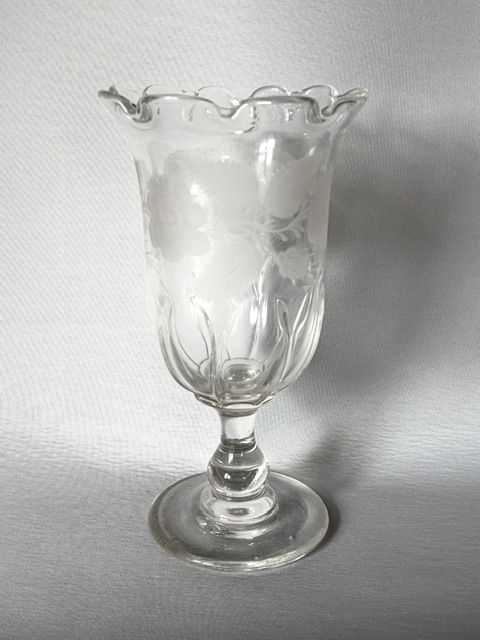
Early 19th century vases encompass a diverse range of decorative vessels produced across Europe and Asia during periods such as the Regency, Georgian, and French Empire. These pieces served as ornamental centrepieces, mantel decorations, or functional vessels like celery holders and spill vases.
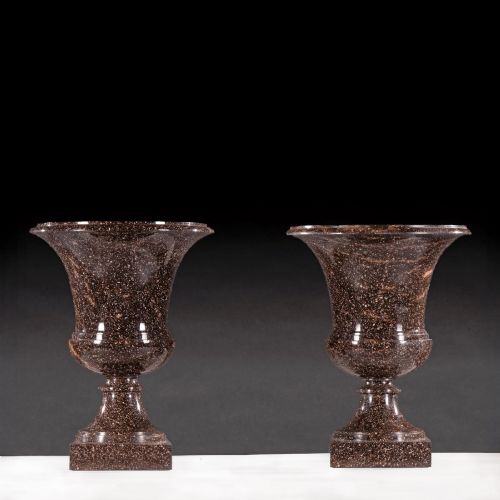
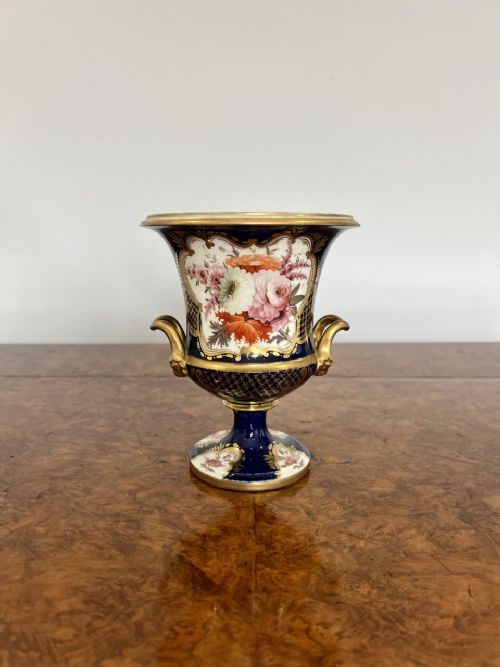
The most common forms encountered in this collection are classical campana-shaped urns and cylindrical beakers, often rendered in porcelain, bronze, or carved stone. Many bear the distinct stylistic hallmarks of Neoclassicism, featuring motifs drawn from Greek and Roman antiquity.
Buyers also encounter examples reflecting international trade and taste, including Chinese porcelain and Japanese bronze work alongside domestic English ceramics and European glass. This variety reflects a period of extensive cross-cultural exchange in decorative arts.
Materials and construction
Ceramic production during this era relied on refined porcelain, ironstone, and earthenware bodies, frequently decorated with hand-painted blue and white designs, gilt accents, or Chinoiserie motifs. Glass vessels were shaped through blowing, then finished with wheel-cut etching and engraved detailing.
Metalwork utilised cast bronze, ormolu, and toleware, often combined with marble plinths or gilded mounts to add weight and visual presence. Stonework such as porphyry and alabaster was hand-carved, reflecting the demand for Grand Tour souvenirs inspired by classical antiquity.
Listings include functional items such as celery vases and taper holders alongside large decorative campana urns.
Assessing quality and execution
Quality in these vases rests on the crispness of the casting in metalwork, the fineness of the hand-painting on porcelain, and the precision of the carving in stone pieces. Superior examples exhibit well-defined details that remain sharp and balanced across the entire form.
The integrity of the materials, such as the depth of colour in blue and white porcelain or the rich patination on bronze and gilt surfaces, distinguishes finer pieces from simpler utilitarian items.
Spode·Miles Mason·Derby·Sevres
The Early 19th Century Vases Glossary
- Campana urn
- A bell-shaped vessel with a flared rim and footed base, heavily favoured in neoclassical design. This form originates from ancient Roman marble garden vases.
- Ormolu
- Finely ground high-carat gold applied to a bronze base using a mercury amalgamation technique. It produces a rich, lasting metallic lustre typical of French Empire mounts.
- Celadon
- A ceramic glaze denoting a pale green jade-like hue, originating in East Asia. It creates a translucent finish over carved or moulded porcelain bodies.
- Toleware
- Lacquered or enamelled sheet metal painted with decorative motifs. It was frequently used in the 19th century to simulate more costly bronze or ceramic vessels.
Early 19th Century Vases: Frequently Asked Questions
How were early 19th century vases used?
These vessels functioned primarily as decorative ornaments on mantelpieces, sideboards, and pedestals within formal rooms. Some specific forms, such as celery vases or posy holders, also served practical dining and floral display purposes.
Larger urns were often displayed in matched pairs to create symmetrical focal points in neoclassical interiors. Smaller spill holders kept taper matches close to fireplaces for lighting household lamps and candles.
What styles define these vases?
Neoclassical design dominates the era, drawing heavily on archaeological discoveries from Pompeii and Herculaneum. This style manifests in classical urn shapes, bronze mounts, and architectural motifs.
Asian export styles, particularly Chinese blue and white porcelain and Japanese bronzes, also heavily influenced contemporary European domestic interiors.
How do I identify a Grand Tour vase?
Grand Tour pieces are typically carved from decorative stones such as alabaster or Italian marble. Wealthy travellers acquired them as souvenirs during educational tours of European cultural centres.
These vases frequently replicate famous classical antiquities seen in Italian museums and archaeological sites.
Can these vases be used for flowers?
Many ceramic and glass variations, including posy vases and bud vases, were designed specifically to hold water and fresh floral arrangements. Porous stone or unglazed metal vessels are generally unsuited for direct liquid use without an internal liner.
Checking the interior glaze and material composition helps determine whether a piece can safely hold water.