






Early 19th Century Tazzas
Early 19th century tazzas are footed display vessels of classical inspiration that bring gravitas and refined presence to any mantelpiece or table.
Early 19th Century Tazzas
Early 19th century tazzas are shallow footed vessels or bowls designed primarily for decorative display rather than utility. When you search for early 19th century tazzas, you encounter pieces rooted in the Neoclassical taste and Grand Tour souvenir tradition.
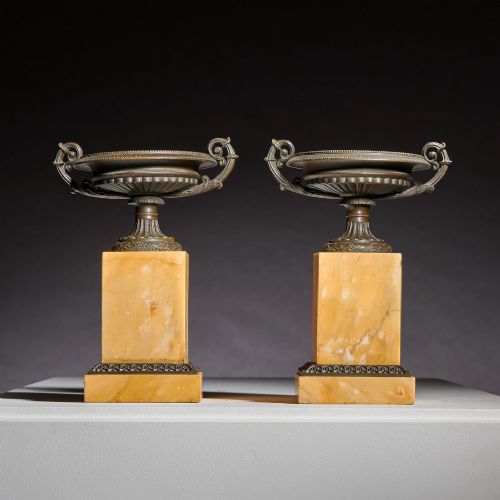
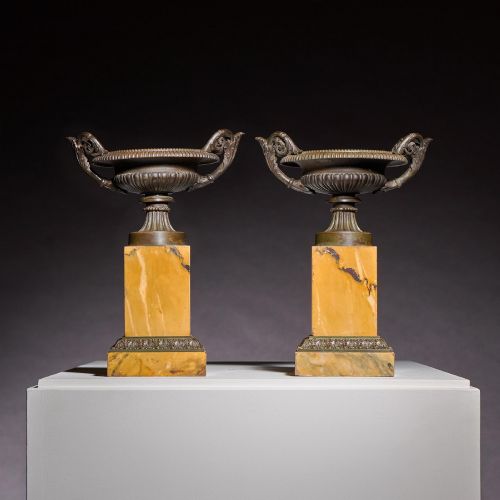
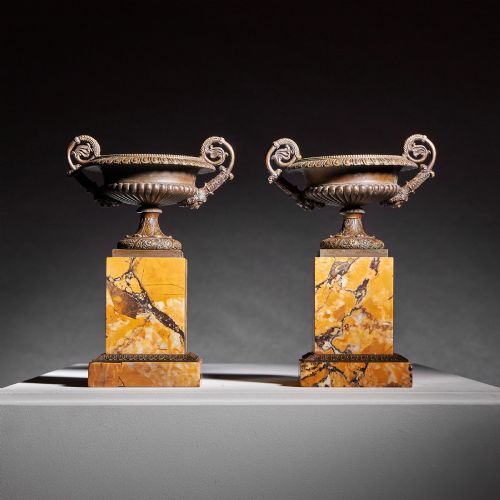
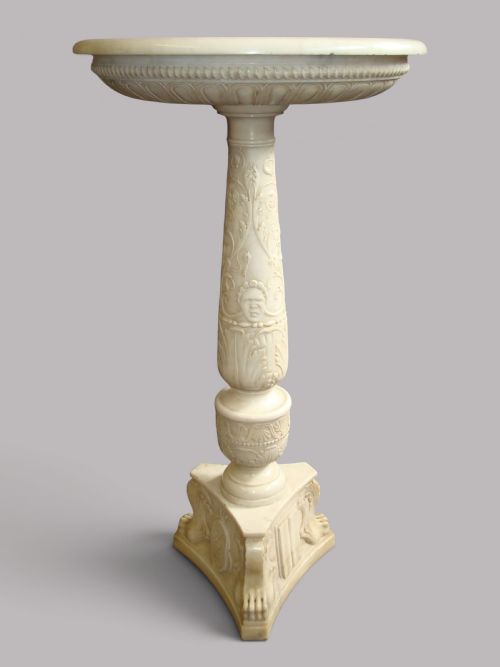
The selections available here span French, Italian, and English sensibilities, frequently taking the form of pairs designed for symmetrical placement. Forms range from classical bronze and Siena marble tazze to cut crystal centrepieces and carved marble pedestals.
Occasional variants include Chinese cloisonné enamel pieces from the Jiaqing period and gilt bronze or ormolu mounted vases. These objects reflect a period obsessed with classical antiquity and archaeological discovery.
Materials and construction
Makers of early 19th century tazzas relied on a combination of patinated or gilt bronze, ormolu, and various marbles such as yellow and Siena. Metal components were cast and chased, then combined with stone turned on a lathe to create striking textural contrast.
Glass and crystal examples demonstrate heavy cutting and moulding techniques suited to footed centrepieces. Cloisonné enamel pieces employ wired metal cells soldered to a base and filled with vitreous paste before firing.
Early 19th Century Tazzas Retail Price Guide 2026
Typical asking prices for early 19th century tazzas among the pieces listed under this phrase on Sellingantiques today, from the lower quarter to the upper quarter. They describe what is for sale here now, not the wider market.
Travellers returning from Italy packed heavy marble pedestals and bronze tazzas into their luggage, risking carriage suspensions for the sake of classical style.
Factors of quality
Quality in these vessels rests upon the crispness of the bronze casting and the precision of the chasing. Sharp detail in classical friezes and acanthus leaves distinguishes superior examples from softer, more generalised commercial castings.
The selection of stone also dictates worth; richly figured Siena marble or flawless yellow marble displays greater mineral depth than uniform grey alternatives. Furthermore, the integration between metal mounts and stone bases must show tight, seamless assembly.
The Early 19th Century Tazzas Glossary
- Tazza
- A shallow bowl on a foot or pedestal, used historically for display or serving. In the nineteenth century, these were predominantly ornamental.
- Ormolu
- Gilded bronze, produced by applying a mercury and gold amalgam to cast bronze and heating it to drive off the mercury. This technique creates a rich, matte gold surface finish.
- Grand Tour
- A traditional trip of Europe undertaken by upper-class young European men of means in the 18th and 19th centuries to flourish their education. Souvenirs included classical bronzes and architectural models.
- Siena marble
- A distinctive yellow Italian marble featuring dark grey or purple fossilised veins. It was prized during the Neoclassical period for its vibrant colour.
- Patinated bronze
- Bronze that has been treated with chemical solutions to produce a controlled surface colour or dark protective coating. This finish highlights the underlying metallic relief.
Early 19th Century Tazzas: Frequently Asked Questions
What were early 19th century tazzas used for?
These pieces served primarily as decorative ornaments rather than practical tableware. They were displayed on sideboards, mantels, and central tables to demonstrate classical taste.
In Grand Tour interiors, they functioned as conversation pieces that signaled the owner's travels and cultural erudition.
How do I style a tazza in my home?
Place a single marble or bronze tazza on a stack of art books or in the centre of a dining table. Pairs look particularly striking when symmetrical placement is used on a mantelpiece or console.
Keep the bowl empty to let the material and form take focus, or occasionally display small decorative stones or dried botanicals within them.
How can I tell Italian Grand Tour pieces apart?
Italian Grand Tour pieces often utilise local materials like Siena marble paired with patinated classical bronze. They frequently reference specific antique excavations or architectural ruins.
French equivalents from the same era tend towards heavier ormolu mounts and a more formal Empire style of decoration.