

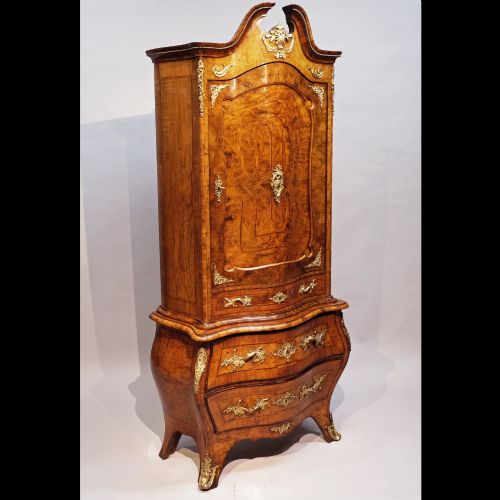


Dutch Press Cupboard
These substantial pieces are a dutch press cupboard, built for serious storage and designed to command attention in a room.
Dutch Press Cupboard
A dutch press cupboard represents a major piece of case furniture designed primarily for storing textiles, linen, and garments. You will most frequently encounter walnut and oak examples dating from the seventeenth and eighteenth centuries, often showing regional cabinet-making traditions.
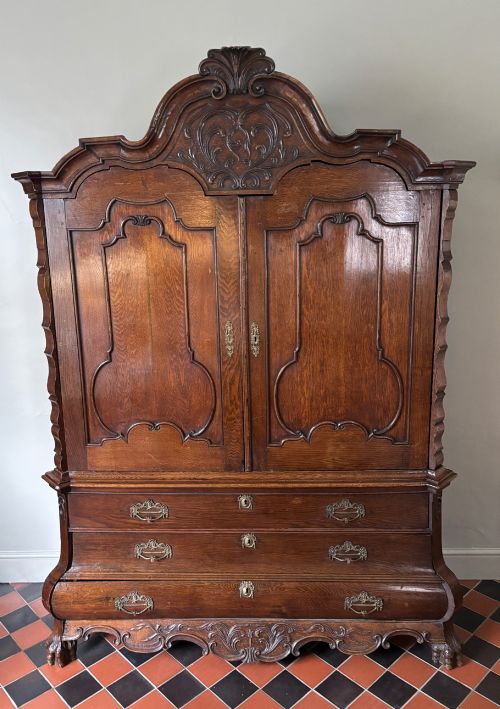
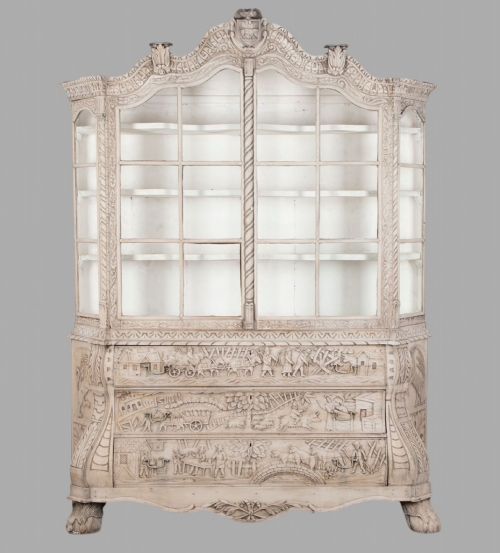
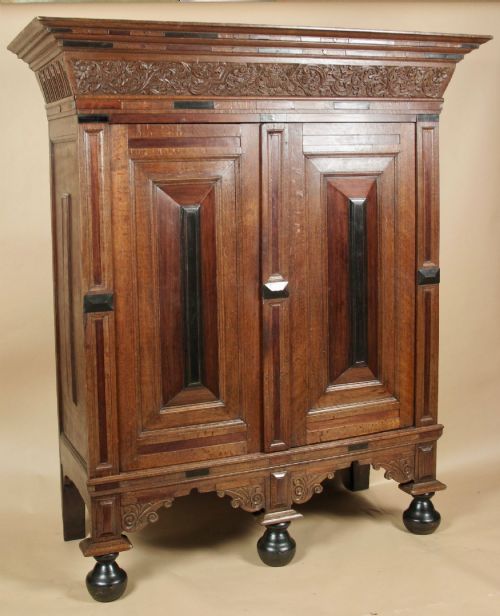
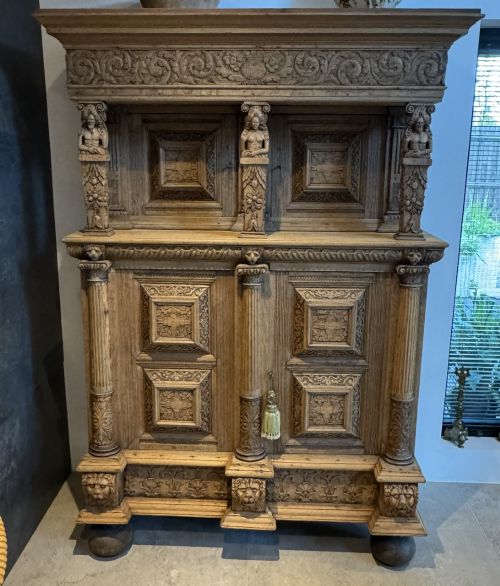
The form ranges from severe architectural seventeenth-century kasten with cushion-moulded doors to flowing eighteenth-century baroque and rococo designs featuring shaped cornices and bombé lower chests. Many incorporate panelled doors, deep drawers in the base, and elaborate architectural cornices.
Origins stretch across the Netherlands and Flanders, encompassing grand urban town house pieces alongside simpler country house variations. Buyers seek these out for their monumental presence and the remarkable depth of internal storage they provide.
How they were made
Cabinet-makers relied on solid oak as the primary structural timber, laying down heavy frames to support the immense weight of large panelled doors and deep cornices. Selected pieces employ fruitwood or pine for secondary timbers and internal shelving.
Decorative surface treatments set these items apart, utilising burr walnut, rosewood, and ebony veneers arranged in geometric or floral marquetry patterns. Brass hardware, including heavy escutcheons and drop handles, secures the doors and drawers while adding a sharp metallic contrast to the dark wood.
Listings feature oak, walnut, burr walnut, and pine across periods spanning the sixteenth century to nineteen hundred.
What varies in quality
The refinement of the timber selection dictates the standing of the piece, moving from straightforward planked oak construction up to intricate burr walnut and multi-wood marquetry panels. Mastery in cutting and laying veneers without lifting or splitting marks the output of superior workshops.
Proportion and carving depth define the upper tier of examples, where mouldings remain crisp and architectural elements maintain strict symmetry. Lesser pieces exhibit simpler panel construction and minimal decorative carving, reflecting regional utility rather than grand urban fashion.
The Dutch Press Cupboard Glossary
- Kast
- A large traditional Dutch wardrobe or press cupboard. These monumental items typically feature two large panelled doors enclosing deep storage space above a base chest of drawers.
- Bombé
- A swelling, outwardly curved profile found on the lower drawer sections of later pieces. This dramatic shaping requires advanced timber-bending and carving skill.
- Marquetry
- The art of applying thin decorative veneer slices to form intricate floral or geometric pictures. Craftsmen used contrasting woods like walnut, rosewood, and ebony to achieve tonal variation.
- Cushion-moulded
- A heavy, raised convex moulding framing door panels on seventeenth-century pieces. This distinctive profile creates a strong three-dimensional effect across the facade.
- Cornice
- The ornamental moulding capping the top of the cabinet. Grand examples feature stepped or architectural crown designs that emphasise the height of the piece.
Dutch Press Cupboard: Frequently Asked Questions
What is a kasten?
A kasten is a traditional Dutch term for a large freestanding wardrobe or press cupboard designed for substantial linen and garment storage.
These pieces form the backbone of seventeenth- and eighteenth-century storage furniture from the Netherlands and Flanders.
How were they used?
Households utilised these large cupboards to store household linen, folded garments, and valuable textiles safely away from dust and pests.
The deep internal shelves and base drawers provided secure storage for a family's most prized fabrics.
How do I date a piece?
Dating relies on identifying structural characteristics, such as heavy cushion-moulding for seventeenth-century items versus flowing rococo marquetry for eighteenth-century examples.
Timber choices and hardware styles further help separate early oak construction from later walnut and pine variations.