
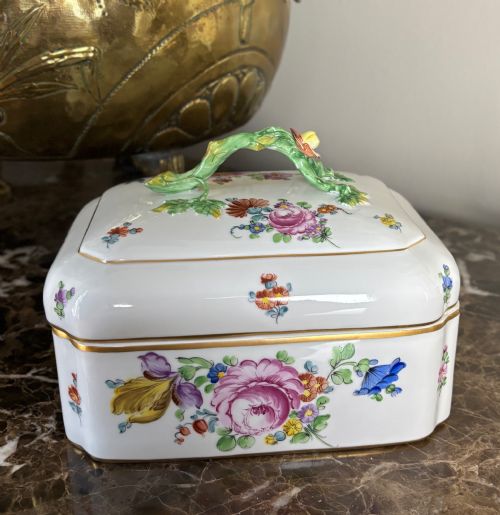
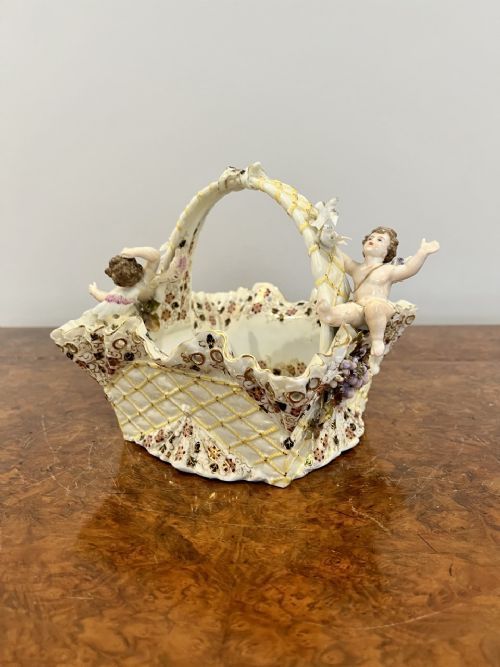
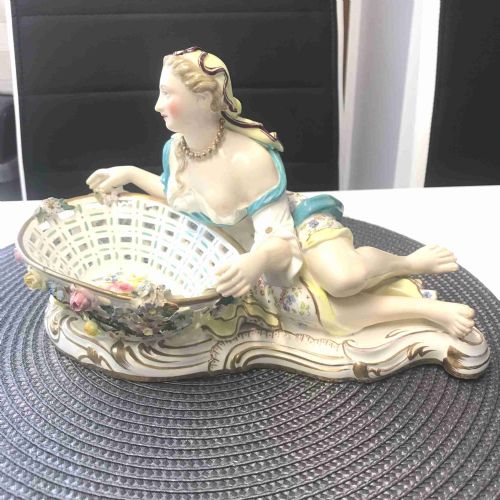


Dresden Porcelain Dish
These dresden porcelain dish examples are decorative hard-paste ceramics shaped for the table and cabinet, offering collectors elaborate rococo revival forms and hand-painted floral bouquets.

Dresden Porcelain Dish
When you search for dresden porcelain dish, you encounter a range of forms including decorative bowls, sweetmeat dishes, centrepieces, and reticulated dishes intended for display.
The selections span from the late eighteenth century through the nineteenth century, Edwardian era, and early twentieth century, showing strong ties to continental and German production.
Makers and workshops such as Helena Wolfsohn, Paul Müller Selb, and Schierholz Plaue dominate the styles, frequently employing rococo revival aesthetics complete with applied roses and putti.
How they were made
These items utilise hard-paste porcelain fired at high temperatures to create durable white ceramic bodies suitable for intricate modelling.
Decoration relies on hand-painting using enamel colours, often enhanced with gold leaf and gilt highlights applied to moulded surfaces.
Complex pieces incorporate applied elements like ceramic flowers and cherubs, joined to baskets, bowls, and dishes prior to firing.
Listings feature hard-paste porcelain, enamel, and gold leaf applied across nineteenth-century and Edwardian decorative forms.
What varies in quality
The refinement of the modelling distinguishes standard production from finer work, particularly in the crispness of applied roses and figural putti.
Hand-painted detail on floral bouquets and enamel surfaces shows varying degrees of brushwork control and artistic skill across different workshops.
Paul Müller Selb·Helena Wolfsohn·Schierholz Plaue
The Dresden Porcelain Dish Glossary
- Hard-paste porcelain
- A durable ceramic composition fired at high temperatures, composed of kaolin and petuntse. It forms the solid body of continental decorative wares.
- Reticulated
- An openwork pattern formed in the ceramic body, often resembling a lattice or basket weave. This technique appears frequently on nineteenth-century dishes.
- Sweetmeat dish
- A small vessel designed for holding confections, nuts, or small delicacies at the table. These often feature elaborate handles or figural supports.
- Putti
- Depictions of plump, winged infant figures, commonly used in rococo revival ornamentation. They frequently support baskets or clamber over the rims of centrepieces.
- Gilt
- A thin layer of gold applied to the porcelain surface for ornamentation. It accentuates moulded edges and rims on cabinet plates and bowls.
Dresden Porcelain Dish: Frequently Asked Questions
Are these dishes meant for food use?
These decorative ceramics serve primarily for display, cabinet exhibition, or holding small trinkets rather than daily dining.
Their historical enamel decoration and applied elements require gentle care and handling to preserve the painted surfaces.
How do I date a Dresden dish?
Dating relies on stylistic markers such as the exuberant curves of the nineteenth-century rococo revival period, alongside hand-painted botanical motifs and specific workshop traditions.
Marks on the base of the hard-paste porcelain provide further indication of the manufacturing era, ranging from the late nineteenth century to the Edwardian period.
What is the difference between a dish and a centrepiece?
Dishes generally function as flat or shallow vessels for cabinet display or serving small items, while centrepieces take larger, multi-tiered forms designed as table focal points.
Centrepieces frequently incorporate figural groups, cherubs, or pierced baskets that elevate their decorative presence.
How should I clean my porcelain dish?
Dusting with a soft, dry brush keeps the delicate applied roses and painted enamel free from grime without risking abrasion.
Harsh cleaning agents and immersion in water should be avoided to protect the gilt highlights and fragile ceramic details.