



Domed Top Tea Caddy
A domed top tea caddy is a refined wooden chest designed to safeguard dried leaves, offering collectors rich cabinet timbers and elegant curved lids.
What a domed top tea caddy is
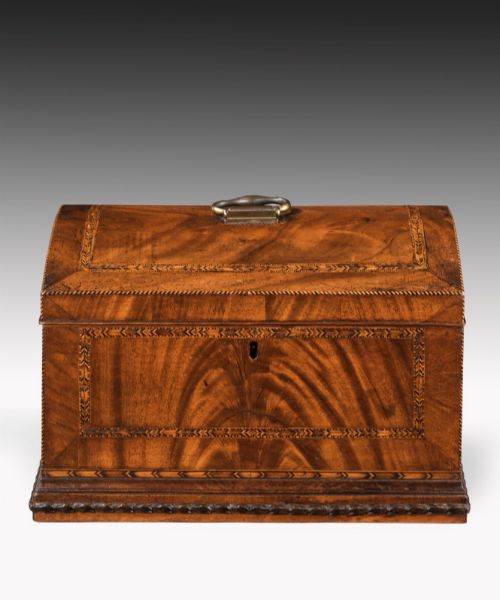
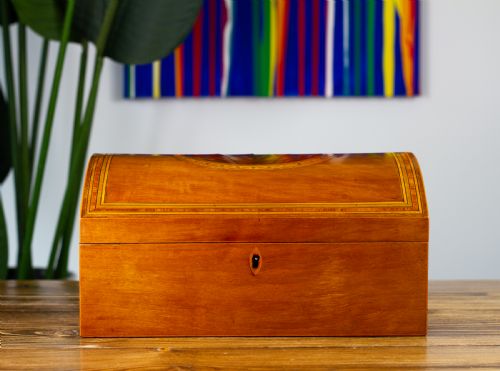
A domed top tea caddy is a specialised storage box for dried tea leaves, featuring a characteristic curved lid that provides extra internal height. When searching for a domed top tea caddy, buyers encounter examples primarily spanning the Georgian and Victorian eras, along with specific dates like seventeen ninety and eighteen hundred. These pieces take the form of tea caddies, tea caddy boxes, and domed boxes.
The versions most frequently met on this page are constructed from mahogany and coromandel wood, often ornamented with brass mounts. Surviving pieces demonstrate the enduring appeal of these curved receptacles, which bridge the gap between utilitarian kitchenware and sophisticated desk accessories. The selection encompasses Georgian mahogany pieces alongside Victorian burr walnut and coromandel variations.
How they were made
Makers constructed these caddies using dense cabinet timbers such as mahogany, coromandel wood, burr walnut, boxwood, and yew wood. The curved lids required precise carpentry to shape the timber smoothly over internal framing without splitting the grain.
Metal components played a structural and decorative role, with brass fixtures applied to reinforce corners, secure hinges, and house working locks provided with a key. Some surfaces incorporated parquetry patterns, demonstrating advanced veneering techniques across the wooden shells.
Retail Price Guide 2026
Typical UK retail prices for domed top tea caddy, calculated from the Sellingantiques database of over a million retail prices indexed since 2003. This retail price guide relies exclusively on Sellingantiques data; no external sources or auction records are used, so the figures do not describe the wider market.
This site's listings show cabinet timbers including mahogany, coromandel wood, burr walnut, boxwood, and yew wood across Georgian and Victorian periods.
What varies in quality
The distinction between standard examples and superior specimens rests on the choice of cabinet timber and the complexity of its grain. Highly figured burr walnut and richly patterned coromandel wood elevate a piece significantly above plain mahogany alternatives.
Quality also manifests in the integration of metalwork, where substantial brass mounts and intact keys demonstrate superior original craftsmanship. The precision of the joinery on the curved lid further separates ordinary boxes from exceptional works.
The Domed Top Tea Caddy Glossary
- Coromandel wood
- A dense, heavy timber prized for its dark brown colour and striking contrasting streaks. This material was frequently utilised by Victorian makers for high-status boxes.
- Burr walnut
- A decorative wood grain derived from walnut tree growths, producing swirling patterns that catch the light. It appears on mid-nineteenth-century examples.
- Parquetry
- A geometric mosaic of wood pieces used for surface decoration on boxes. This technique creates patterned panels across the lid and sides.
- Boxwood
- A pale, hard wood employed for fine stringing and contrasting inlay details. It offers a bright visual accent against darker cabinet timbers.
Frequently Asked Questions
What is a domed top tea caddy?
A domed top tea caddy is a small wooden chest built to store and preserve expensive tea leaves during the Georgian and Victorian periods. The curved lid distinguishes it from flat-topped boxes by offering a more monumental profile.
These boxes typically sat on sideboards or parlor tables where guests could observe the rich grain of mahogany, walnut, or coromandel wood.
How were tea caddies used originally?
Households used these caddies to lock away precious tea leaves when tea was a costly commodity imported from abroad. The owner retained the key to prevent domestic staff from accessing the contents.
Inside, the space was often divided to separate different varieties of tea leaves before brewing.
How do I date a tea caddy?
Dating relies on identifying the primary timber, hardware style, and construction methods associated with specific decades. Georgian examples frequently utilise plain or figured mahogany, whereas Victorian pieces often showcase exotic woods like coromandel and burr walnut.
Matching the overall proportions and the design of any brass mounts provides further clues to the period of manufacture.
Are keys usually included?
Some surviving examples retain their original working keys, while others do not possess them. Finding a caddy with a matching key adds to its completeness.
The presence of a brass escutcheon around the keyhole highlights the decorative attention given to these locking mechanisms.