


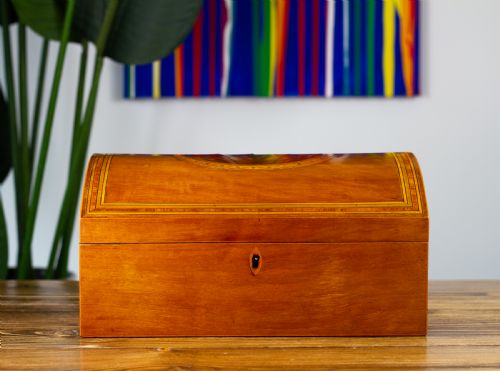


Domed Top Desk Box
These domed top desk box examples are practical desk furniture from the Georgian and Victorian eras, designed to organise correspondence and papers with architectural elegance.
Domed Top Desk Box
A domed top desk box is primarily represented here by Victorian stationery boxes and caskets designed for desktop use. These pieces often take the form of stationery boxes or letter boxes created to hold writing materials securely.
The dominant forms span the nineteenth century, including pieces from around 1860 alongside Georgian and 19th-century examples. Buyers frequently encounter variations featuring distinctive curved lids that distinguish them from flat-topped caskets.
Materials and construction
Constructed from substantial timbers such as burr walnut, coromandel wood, pollard oak, amboyna wood, and satinwood, these boxes showcase rich natural grain patterns. Cabinetmakers utilised exotic veneers over solid wood carcases to create decorative surfaces.
Metalwork is integral to the construction, with brass mounts and brass bound edges providing structural reinforcement and visual contrast. Gothic Revival influences occasionally shape the architectural detailing of the woodwork and hardware.
Domed Top Desk Box Retail Price Guide 2026
Typical asking prices for domed top desk box among the pieces listed under this phrase on Sellingantiques today, from the lower quarter to the upper quarter. They describe what is for sale here now, not the wider market.
Some Victorian stationers added a curve just to make sure your letters lived under a proper architectural roof.
Assessing quality
Quality rests upon the selection of timber figures, where richly patterned burr walnut, coromandel, and amboyna elevate a piece above plain varieties. The skill of the veneer matching across the curved dome lid demonstrates the maker's proficiency.
The integration of brass mounts and corner bindings defines the finish at the upper end of the scale. Heavier gauge metalwork and precise fitting separate superior examples from standard production boxes.
The Domed Top Desk Box Glossary
- Dome top
- A curved lid profile that adds height and architectural presence to a desk box. This shape is characteristic of nineteenth-century stationery caskets.
- Stationery box
- A fitted desk accessory designed to hold writing paper, envelopes, and correspondence upright. These pieces often feature tiered interiors.
- Coromandel wood
- A dense, heavily figured exotic timber from Asia featuring dark brown stripes. It was favoured by Victorian cabinetmakers for luxury boxes.
- Burr walnut
- Wood taken from a walnut tree growth that produces intricate, swirling grain patterns. It creates a highly decorative surface on Victorian desk furniture.
- Gothic Revival
- A nineteenth-century architectural and decorative style influencing box design. It introduces pointed arches, medieval motifs, and robust brass mounts.
Domed Top Desk Box: Frequently Asked Questions
How do I identify a Victorian domed top box?
Victorian examples frequently utilise exotic timbers like coromandel and burr walnut, often accented with heavy brass banding and mounts. The architectural domed lid is a defining feature of these mid-nineteenth-century pieces.
Construction details, such as the use of brass strapwork and Gothic Revival design elements, further point to the Victorian period.
Are these boxes made from solid exotic wood?
Most pieces are constructed using fine veneers of timbers like amboyna, burr walnut, or coromandel applied over a stable secondary wood carcase. This technique allowed makers to display dramatic natural grain patterns across the curved lids.
Solid timber was typically reserved for moulding, framing, and interior partitions rather than the primary exterior surfaces.
How should I care for a wood stationery box?
Keep the box away from direct sunlight and sudden temperature changes to protect the delicate veneers and prevent timber splitting. Regular dusting with a soft, dry cloth maintains the polished finish of the wood and brass.
Avoid using modern liquid polishes or silicone sprays, which can build up and damage antique polished surfaces over time.