

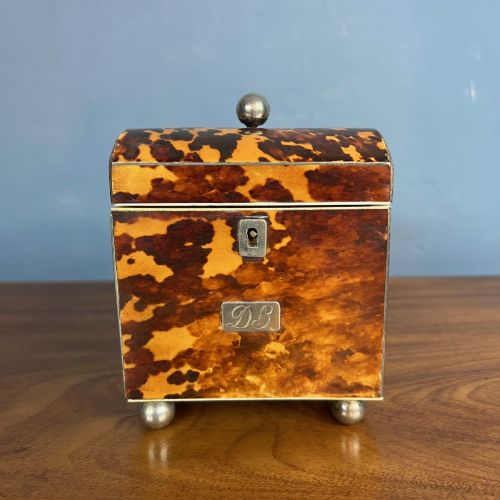


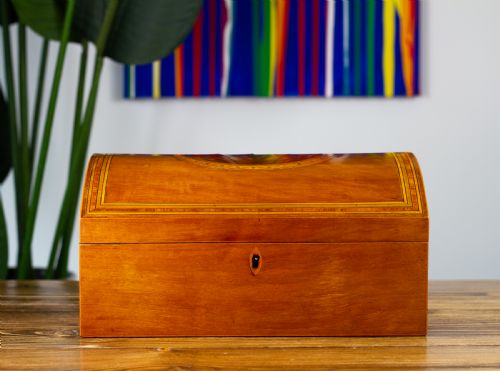
Domed Tea Caddy
A domed tea caddy is a compact wooden container shaped to hold dried leaves safely, offering tactile warmth and period character to any surface.
Domed Tea Caddy
A domed tea caddy is a small storage box designed during the Georgian and Victorian eras to protect dry tea leaves from moisture and air. The curved lid marks out these pieces from flat-topped boxes, giving them a distinct profile that sits well on a sideboard or table.
Most examples seen here date from the Georgian and Victorian periods, with Regency pieces also appearing regularly. Mahogany and burr walnut dominate the selection, often finished with decorative inlays or brass mounts.
Makers shaped these containers into various forms including single domes and double compartments, whilst some incorporate detailed motifs like compass stars, flower baskets, and insects. These variations reflect the changing tastes of households across the eighteenth and nineteenth centuries.
How they were made
Cabinet makers built these boxes using solid timbers and decorative veneers such as mahogany, burr walnut, coromandel, and satinwood over a secondary wood base. The curved lids required careful steam bending or shaped core construction to achieve the smooth domed profile.
Surface decoration relied on traditional techniques including boxwood stringing, parquetry, and marquetry inlay to create contrasting geometric patterns or pictorial motifs. Metal elements like brass escutcheons, hinges, and carrying handles provided both structural reinforcement and visual contrast.
Domed Tea Caddy Retail Price Guide 2026
Typical asking prices for domed tea caddy among the pieces listed under this phrase on Sellingantiques today, from the lower quarter to the upper quarter. They describe what is for sale here now, not the wider market.
Listings feature woods including mahogany, burr walnut, coromandel, satinwood, yew, and boxwood across Georgian and Victorian periods.
What varies in quality
The choice of timber sets the baseline for quality, with richly figured burr walnut and exotic coromandel sitting above standard mahogany. Superior execution shows in the crispness of the parquetry, the precision of the boxwood stringing, and the integration of detailed marquetry panels depicting subjects like clipper ships or flower baskets.
Construction details distinguish finer workshops from standard production. Well-made pieces retain their original working locks and keys, tight mitre joints on the curved dome, and matching grain patterns across the visible surfaces of the box.
The Domed Tea Caddy Glossary
- Domed tea caddy
- A small lidded container with a rounded top, built originally to store and preserve loose tea leaves. The curved lid distinguishes it from standard rectangular storage boxes.
- Burr walnut
- A highly prized timber cut from the abnormal growth of a walnut tree, yielding swirling grain patterns. It provides a rich, decorative surface texture on Victorian and Georgian boxes.
- Parquetry
- A geometric mosaic of wood pieces laid down in a pattern similar to parquet flooring. It frequently decorates the surfaces of Victorian walnut tea caddies.
- Marquetry
- The art of applying pieces of veneer to a structure to form decorative patterns and pictorial designs. Examples often feature floral or nautical motifs.
- Coromandel wood
- A dense, heavy tropical timber with dark stripes, used for high-end nineteenth-century boxes. Its striking grain makes it easily identifiable.
- Boxwood stringing
- Thin inlay lines of pale boxwood set flush into darker wood to outline panels and edges. This technique defines the borders on Georgian mahogany pieces.
Domed Tea Caddy: Frequently Asked Questions
What is a domed tea caddy?
A domed tea caddy is a lidded wooden box created in the Georgian and Victorian periods to store precious tea leaves. The curved top distinguishes it from flat-topped storage containers.
These pieces combined practical storage with decorative cabinet-making, often featuring fitted internal compartments and fine wood veneers.
How were tea caddies used?
Tea was an expensive commodity in the eighteenth and nineteenth centuries, so households kept leaves locked away in these dedicated caddies. The master of the house or the housekeeper held the key to control access.
Inside, the boxes often featured interior lids or foil-lined compartments to preserve the aroma and keep moisture away from the dry leaves.
How do I date a tea caddy?
Dating relies on timber choices, construction methods, and decorative styles. Georgian pieces often use plain or inlaid mahogany and satinwood, whilst Victorian examples frequently showcase burr walnut, coromandel, and parquetry.
Hardware such as brass hinges and escutcheons also offers clues, alongside the presence of hand-cut dovetails inside the box compartments.
How do I care for wooden caddies?
Keep wooden tea caddies away from direct sunlight and dramatic changes in temperature to prevent the timber and veneer from splitting. Dust them gently with a dry, soft cloth.
A light application of appropriate wax polish helps maintain the finish of the wood without building up heavy residue over time.