

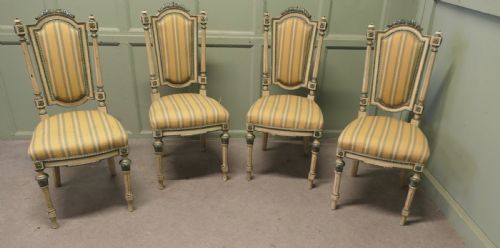
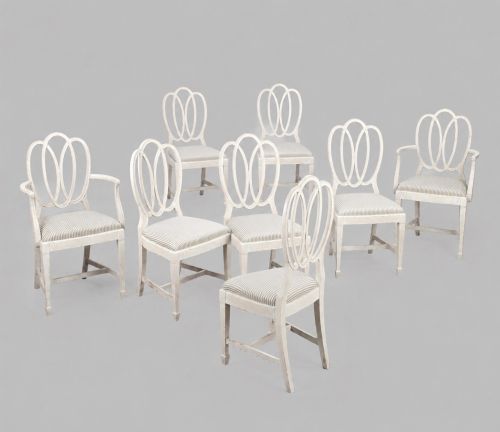


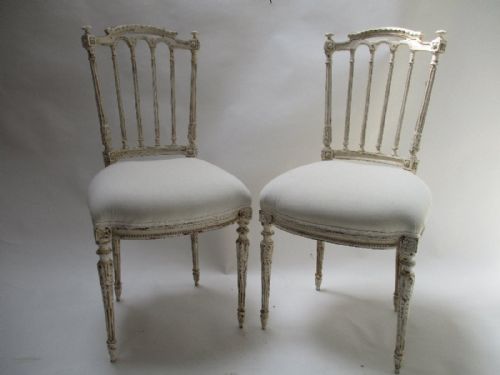
Distressed White Dining Chairs
Distressed white dining chairs bring painted timber character to the table, spanning nineteenth-century forms and twentieth-century revivals.
Distressed White Dining Chairs
Distressed white dining chairs encompass seating finished in pale paint across various periods, including Victorian examples and items from the year 1920. Buyers searching this phrase encounter forms ranging from salon chairs and side chairs to garden dining sets.
The selection includes specific design traditions such as Louis XVI style, Hepplewhite, Gustavian, Queen Anne style, and French chateau influences. Makers and workshops utilise painted wood, carved wood, beech, and wrought iron alongside fabric and textile upholstery.
Pieces span single pairs, sets of four, six, eight, and larger groupings up to fourteen chairs. These items bridge rustic country aesthetics and formal French neoclassical or decorative carved styles.
How they were made
Construction relies on timber frames, specifically beech and general carved wood, shaped into distinct period silhouettes. Joinery and carving support the structural integrity of both dining chairs and garden sets.
Surfaces receive paint or lacquer finishes, contributing the characteristic white and distressed appearance seen across the inventory. Upholstered variants incorporate textiles and fabric elements fixed to the seat bases or backs.
Distressed White Dining Chairs Retail Price Guide 2026
Typical asking prices for distressed white dining chairs among the pieces listed under this phrase on Sellingantiques today, from the lower quarter to the upper quarter. They describe what is for sale here now, not the wider market.
Even fourteen hungry guests can sit in matching lacquered Queen Anne style.
What varies in quality
Quality rests in the precision of the timber carving and the fidelity of historical styles such as Gustavian or Queen Anne influences. The execution of painted finishes and the integrity of underlying beech or carved wood distinguish finer examples.
Larger matched sets demonstrate greater consistency in design execution across multiple chairs compared to assembled pairs. The integration of textile upholstery and structural joinery further separates standard items from decorative statement pieces.
The Distressed White Dining Chairs Glossary
- Gustavian style
- Swedish neoclassical design originating in the late eighteenth century, known for restrained ornamentation and pale painted finishes. This style appears frequently in twentieth-century revivals.
- Beech
- A hard, fine-grained timber commonly utilised for chair frames due to its strength and suitability for shaping and carving. It frequently accepts paint finishes.
- Queen Anne style
- Characterised by rounded forms, cabriole legs, and simplified lines emerging from the early eighteenth century. Influences persist in later revival seating.
- Wrought iron
- Tough, malleable iron worked by hand into durable frames, seen here in garden dining sets. It provides robust outdoor structural support.
- Louis XVI style
- French neoclassical design featuring straight tapering fluted legs and classical geometric motifs. It informs several salon and dining chair iterations.
Distressed White Dining Chairs: Frequently Asked Questions
What periods do these chairs date from?
The inventory spans the nineteenth century, including Victorian productions and specific dates such as 1860, 1880, and 1920.
Revival movements account for many pieces, reflecting earlier aesthetics like Queen Anne and Louis XVI styles.
Are these chairs sold in sets?
Listings include individual pairs as well as larger groupings ranging from four to fourteen chairs.
Some entries also combine chairs with matching tables to form complete garden dining sets.
What materials are used in these chairs?
Construction primarily involves wood, specifically beech and carved timber, finished with paint or lacquer. Wrought iron appears in outdoor garden sets.
Upholstered versions incorporate various textiles and fabrics for seat pads and backs.
How do I identify different styles?
Design vocabulary guides identification, from Gustavian restraint to French chateau ornamentation. Hepplewhite and Queen Anne influences dictate specific leg shapes and backrest contours.
Painted surfaces tie these diverse regional and chronological styles together under the distressed white aesthetic.