
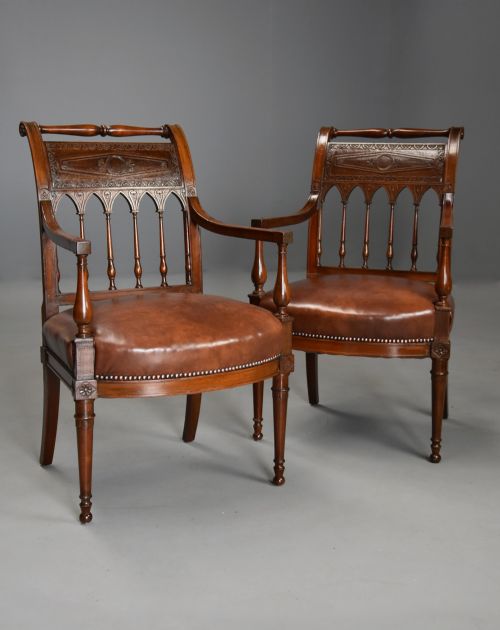

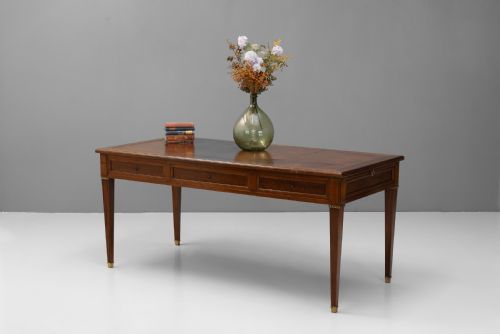


Directoire Style Desk
A directoire style desk brings understated neoclassical lines and refined mahogany or walnut timber into a room.

Directoire Style Desk
When you search for a directoire style desk, you are looking at writing furniture shaped by the transition between Louis XVI and Empire aesthetics. These pieces often feature clean rectangular forms, slender tapered legs, and restrained classical mounts that set them apart from heavier baroque designs.
On this page, you are most likely to meet mahogany or walnut bureau plat and cylinder desk variants spanning the eighteenth to the early twentieth century. These tables and desks balance functional writing surfaces with disciplined proportions derived from French neoclassical design.
How they were made
Cabinetmakers built these desks using solid and veneered timbers like mahogany and walnut, often mounting the primary wood with cast brass details along the drawers and framing. Writing surfaces were routinely inset with panels of supple leather to provide a smooth, durable plane for daily correspondence.
The construction relies on disciplined joinery suited to rectilinear forms, avoiding excessive carving in favour of clean architectural lines. Gilt metal and brass hardware accent the structural corners and key escutcheons without overwhelming the timber grain.
A carriage clock sometimes keeps quiet watch over a pile of unfinished correspondence.
What varies in quality
The quality of a directoire style desk rests upon the selection of the timber and the crispness of the brass mounts. Finer examples display carefully matched veneer grains across the top and drawer fronts, while simpler versions rely on plainer secondary woods.
Execution of the hardware also separates workshop tiers, as finely chased brass mounts fit flush to the wood with precise alignment. The tactile weight of the drawers and the condition of the integrated leather writing surface further distinguish superior pieces from standard workshop output.
The Directoire Style Desk Glossary
- Bureau plat
- A freestanding writing table fitted with one or more rows of drawers beneath the top. This form emerged in France and typically stands away from the wall.
- Cylinder desk
- A writing desk featuring a quarter-cylinder rolling shutter that encloses the inner compartments and writing slide. It offers privacy and conceals correspondence when closed.
- Tapered leg
- A support column that narrows progressively toward the foot, characteristic of neoclassical furniture. These legs frequently end in brass sabots.
- Directoire style
- A transitional French design movement bridging Louis XVI and Empire periods. It is defined by republican restraint, classical motifs, and geometric austerity.
- Ormolu
- Cast bronze mounted with a fine layer of gold amalgam, used for decorative mounts on fine cabinetry. It provides a warm metallic contrast against dark mahogany.
Directoire Style Desk: Frequently Asked Questions
How do I identify directoire style?
Directoire style is recognised by its stripped-down neoclassical geometry, straight tapered legs, and minimal reliance on heavy carving. It rejects the excessive curves of earlier rococo forms in favour of architectural restraint.
Look for symmetrical arrangements, urn or star motifs, and subtle brass mounts that accentuate the clean lines of the mahogany or walnut frame.
Where should I place a cylinder desk?
A cylinder desk works well against a wall or floating in a well-lit study where its rolling shutter can be easily operated. The enclosed writing slide provides a contained space for modern notebooks or stationery.
Ensure the room has sufficient clearance for the chair when the writing slide is pulled forward into use.
What woods were commonly used?
Mahogany and walnut predominate among the timber choices recorded for these desks. Cabinetmakers valued them for their rich grain patterns and structural stability.
Secondary woods like oak or pine often appear within drawer linings and internal framing compartments.