



Fluted Leg Bureau Plat
These pieces known as a fluted leg bureau plat offer a practical writing surface supported by classical design, combining fine timber with metal mounts.
Fluted Leg Bureau Plat
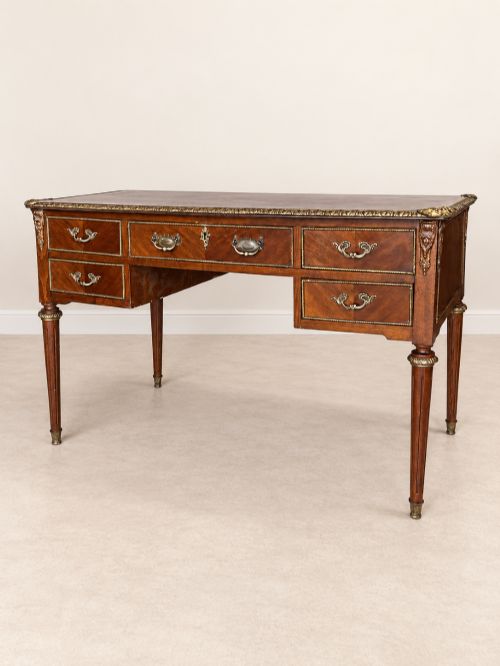
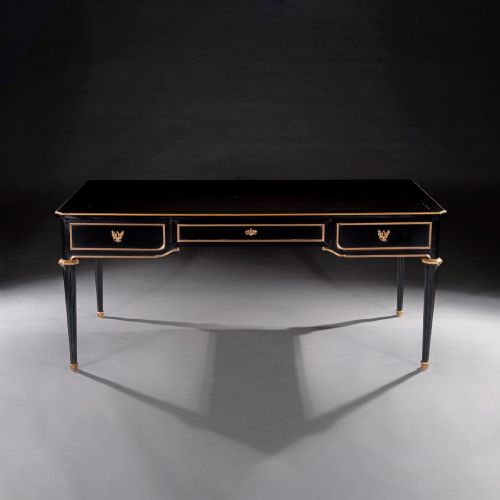
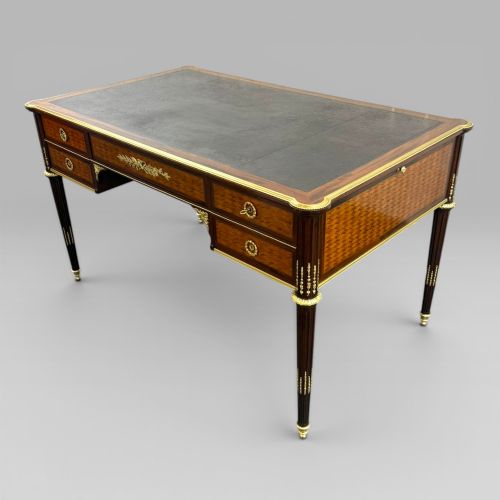
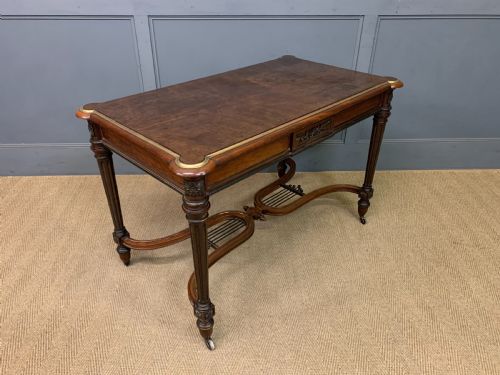
A fluted leg bureau plat is a writing table shaped by French Louis XVI style and its later revivals, appearing from the eighteenth century through to the mid twentieth century. These desks provide a dedicated writing surface combined with classical architectural lines.
The pieces on this page span the nineteenth and twentieth centuries, alongside earlier forms, taking the shape of desks and writing tables. Mahogany and ebonised wood dominate the forms, frequently accompanied by contrasting timbers such as satine and kingwood.
Makers and workshops across these periods adopted French Directoire and Louis XVI idioms, integrating inlaid parquetry and leather writing surfaces. Buyers encounter both French workshop production and English interpretations of the form.
How They Were Made
Cabinetmakers constructed these desks from solid timbers and veneers, utilising mahogany, kingwood, and ebonised wood over structural carcasses. Parquetry patterns formed geometric designs across the writing surfaces and drawers.
Ornaments of brass, ormolu, and gilt bronze were cast and chased before being mounted to the legs, corners, and apron rails. Leather inserts provided a durable writing plane, bordered by subtle gilt tooling.
Listings feature mahogany, kingwood, satine, and ebonised wood, alongside leather writing surfaces and gilt bronze mounts.
What Varies in Quality
The refinement of the cast metal mounts separates standard production from exceptional pieces, as seen in the work of François Linke and Henry Dasson. Crisp chiselling on ormolu and gilt bronze demonstrates superior workshop output.
Timber selection and the precision of parquetry define the visual hierarchy of these desks. Finely figured mahogany and intricate wood combinations indicate greater workshop ambition and time spent at the bench.
François Linke·Henry Dasson
The Fluted Leg Bureau Plat Glossary
- Bureau plat
- A flat-topped writing table, typically freestanding with drawers in the frieze. These tables originated in France and gained popularity during the eighteenth century.
- Ormolu
- Gilt bronze ornament applied to furniture mounts. The technique involves coating bronze with a mercury and gold amalgam before heating.
- Parquetry
- Geometric wood inlay forming patterns across furniture surfaces. Craftsmen arrange contrasting veneers such as satine and kingwood.
- Directoire
- A transitional style bridging Louis XVI and Empire periods. The aesthetic favours restrained classical lines and architectural simplicity.
- Ebonised
- Wood treated to imitate ebony. This dark finish appears frequently on nineteenth-century library and writing tables.
Fluted Leg Bureau Plat: Frequently Asked Questions
What is a fluted leg bureau plat?
A fluted leg bureau plat is a traditional writing table featuring characteristic vertical grooves carved into the legs. These desks originated in France and follow classical design principles.
They serve as freestanding writing desks with flat tops and frieze drawers. The form draws heavily on Louis XVI aesthetics.
How do you use a bureau plat today?
These tables function well as writing desks or console tables in studies and living spaces. Their finished backs allow them to sit away from walls.
The leather top provides a practical writing surface, while the drawers accommodate stationery and modern desk accessories.
How do I identify Louis XVI style?
Louis XVI style is distinguished by straight tapered legs, often fluted, and a return to classical symmetry. Ornaments reference Greek and Roman architecture.
In these desks, look for rectangular proportions, gilt bronze mounts, and restrained floral or geometric inlay rather than curved rococo lines.
Are these desks French or English?
The form is fundamentally French, associated with Paris workshops and cabinetmakers such as François Linke and Henry Dasson. Many pieces on this page reflect this origin.
English makers also adopted the style during the nineteenth century, producing their own interpretations of the French bureau plat.