
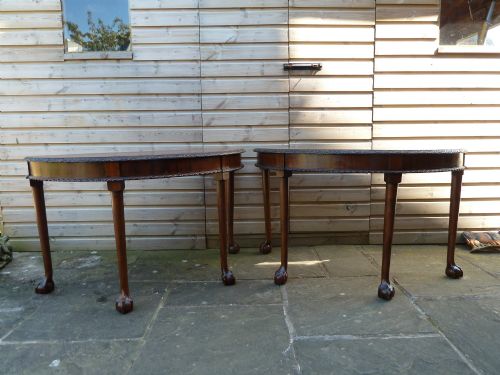


Demilune Entryway Table
A demilune entryway table brings elegant semicircular form and compact utility to a narrow hall, combining rich historical timber with classic architectural presence.
Demilune Entryway Table
A demilune entryway table provides a flat back to sit flush against a wall while projecting a graceful half-moon profile into the hallway. The selection spans the eighteenth century through to the twentieth century, embracing periods like the Georgian, Regency, and Victorian eras.
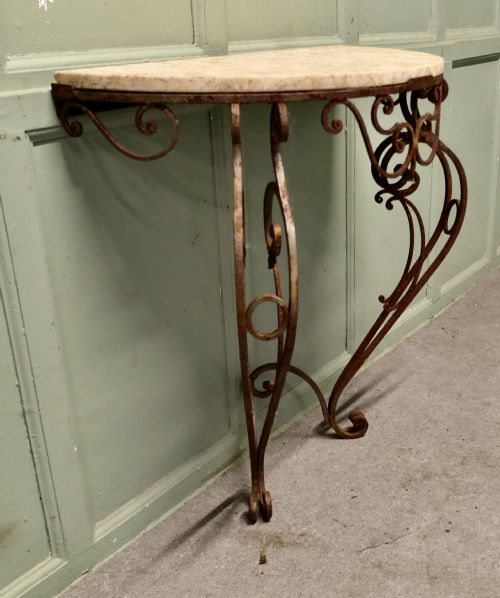
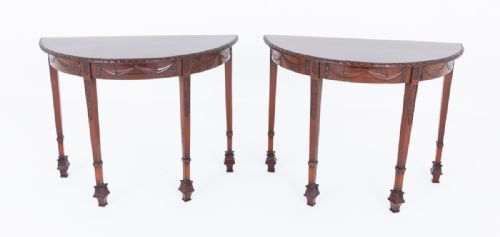
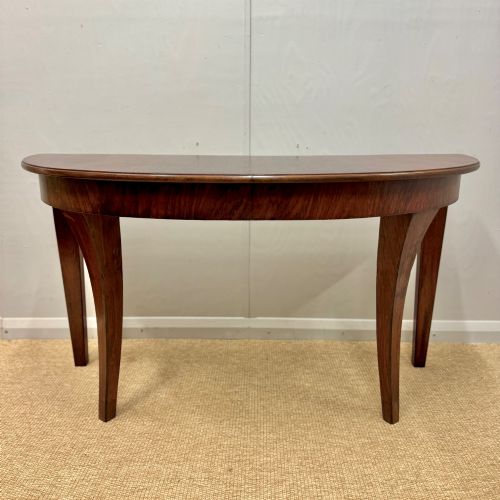
Makers shaped these items primarily as console or tea tables, designed to stand neatly in entrance spaces without blocking movement. You will encounter pieces finished in polished mahogany, painted wood, satinwood, and walnut, frequently topped with marble.
Regional variations include English mahogany designs, French painted finishes, and Italian neoclassical forms. These half-moon shapes successfully solve the problem of surface space in confined areas while maintaining a formal aesthetic.
Judging the standard of manufacture
Quality rests in the precision of the curved joinery and the selection of figured timber veneers on the top. Superior examples display seamless grain matching along the sweeping edge and finely carved legs.
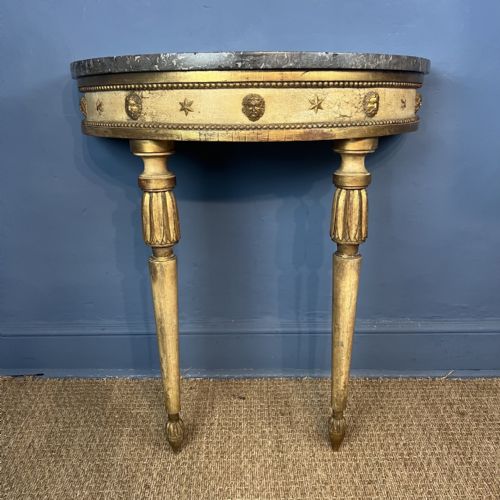
The integration of heavy materials like fitted marble tops demonstrates a higher tier of workshop production. Detail work such as crossbanding, delicate inlay, and parcel gilding elevates the visual weight of the piece.
Early cabinetmakers curved solid timber by hand, ensuring your post lands safely on a genuinely historic half-moon surface.
The Demilune Entryway Table Glossary
- Demilune
- A half-moon shape used to describe furniture with a semicircular top and a flat back edge. This format allows the table to sit tightly against an entryway wall.
- Console table
- A side table designed to stand against a wall, frequently supported by wall brackets or decorative legs. In narrow spaces, it serves as a surface for lamps and decorative objects.
- Crossbanding
- A strip of veneer running perpendicular to the grain of the main surface, creating a decorative border. It frames the curved edge of mahogany and satinwood tabletops.
- Parcel gilt
- The practice of applying thin layers of gold leaf to specific carved details on a painted or wooden surface. This technique highlights neoclassical motifs.
- Gesso
- A plaster mixture applied to wood surfaces as a base for paint or gilding. It allows artisans to carve sharp ornamental details before finishing.
Demilune Entryway Table: Frequently Asked Questions
Where should I place a demilune table?
These pieces suit narrow hallways, landings, and entrance foyers where floor space is limited. The flat rear edge allows the furniture to rest securely against the wall.
Positioning the table near the front door creates a convenient drop point for keys and post while establishing a formal focal point.
How do I care for a marble top?
Marble surfaces require regular dusting with a soft, dry cloth to prevent grit accumulation. Avoid placing acidic liquids directly onto the stone.
Promptly wiping spills protects the polished finish from etching and staining over years of daily domestic use.
Can I use a tea table as a console?
Many historical tea tables share the semicircular footprint and dimensions of dedicated hall furniture. Their folding leaves and compact proportions adapt well to hallway placement.
Using a tea table in this manner repurposes a traditional dining room item for modern entryway display.
How do I identify a Georgian style piece?
Georgian style items often feature rich mahogany timbers, understated classical proportions, and careful crossbanded borders. Cabinetmakers emphasised balanced lines and restrained decorative carving.
Examining the construction of the frame and the treatment of the woodwork helps distinguish these formal eighteenth-century designs.