
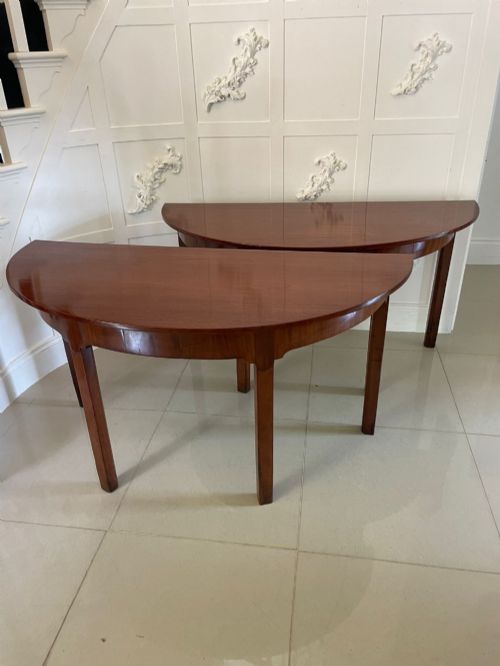
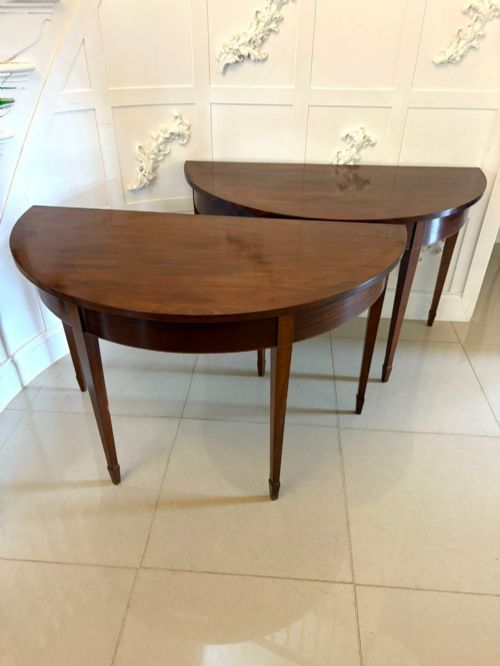
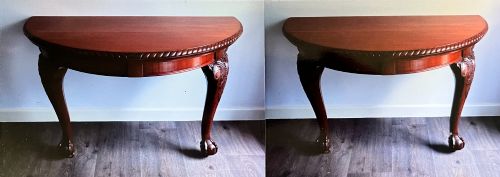
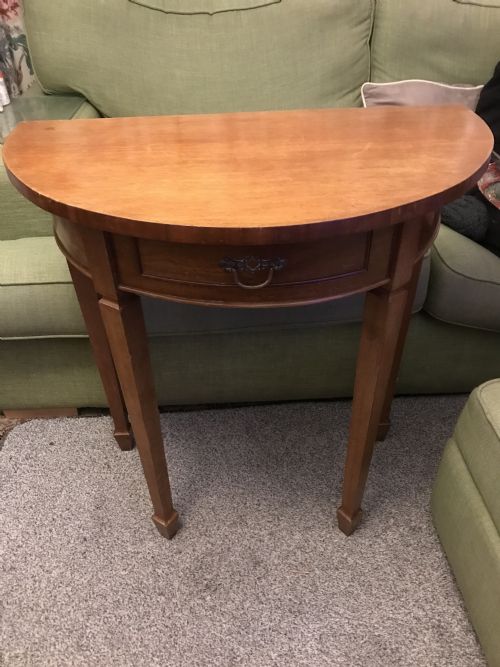
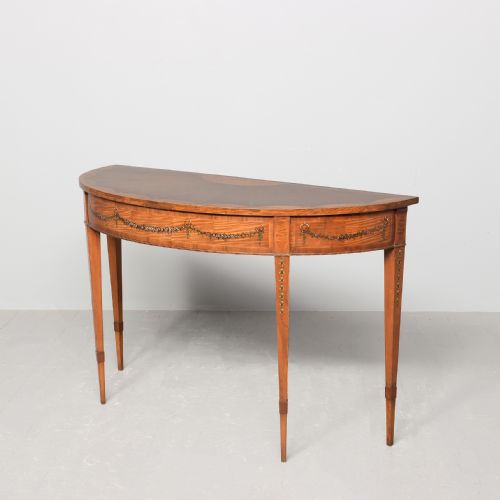


Semi Circular Hall Table
These semi circular hall table pieces are clever space-savers designed to sit flat against a wall, offering a neat surface without blocking a busy corridor.
Semi Circular Hall Table
A semi circular hall table typically presents as a demi-lune, half round, or D-end console form designed specifically for narrow spaces like hallways and landings. You will find these pieces spanning periods from the eighteenth century through to the Edwardian era, rendered as dedicated console tables or convertible tea and card tables.
The selection ranges from George III mahogany examples with boxwood inlay to painted Edwardian satinwood pieces and Victorian maple wood versions. Many appear in pairs, offering a balanced arrangement for flanking a doorway or filling a larger wall space.
How they were made
Cabinet makers utilised dense timbers such as mahogany, walnut, and satinwood, often applying crossbanding and boxwood inlay to define the curved edges of the top. Frames relied on sturdy pine for internal structure while exterior surfaces received fine veneers and polished finishes.
Structural support came from tapered spade feet or turned legs positioned carefully to bear the weight of the semi-circular top without tipping when laden with lamps or decorative items.
Listings feature mahogany, satinwood, walnut, and maple wood across Georgian, Victorian, and Edwardian styles.
What varies in quality
The distinction between standard items and superior pieces rests on the choice of figured timber, the crispness of the marquetry inlay, and the finesse of the curved edge construction. Grain matching across the semi-circular top demands exceptional joinery skill.
Proportion and foot design also dictate worth, where delicate spade feet and balanced proportions elevate a piece far above a plain utility table from the later periods.
The Semi Circular Hall Table Glossary
- Demi-lune
- Half-moon shape. This term describes tables built with a flat back to stand flush against a wall.
- Crossbanding
- A strip of veneer applied to the border of a table top. The grain runs perpendicular to the main panel for contrast.
- Marquetry
- Decorative patterns formed by inserting pieces of coloured wood into a veneer. It appears frequently on Edwardian pieces.
- D-end
- A table end shaped like the letter D. Pairs of these join together to form larger freestanding circles or stand individually against walls.
- Card table
- A folding table with a hinged top. Many semi-circular hall tables covert into gaming surfaces.
Semi Circular Hall Table: Frequently Asked Questions
Where should I put a semi circular hall table?
These tables suit narrow corridors, landings, and entranceways because their flat backs allow them to sit flush against the wall without jutting into walking space.
They also function effectively in living rooms as lamp tables or beneath mirrors where depth is restricted.
How do I identify a George III table?
George III pieces often feature figured mahogany, subtle boxwood stringing, and tapered legs that show eighteenth-century proportions.
Look for hand-cut dovetails in the drawer construction and traditional timber shrinkage patterns underneath.
Can these tables be used for dining?
Some pieces in this category are D-end or tea tables designed to fold out or join together into larger surfaces.
Standard console versions remain purely decorative and support lighter items like lamps rather than heavy dining loads.
What is the difference between a console and a pier table?
Console tables rely on wall brackets or legs for support, while pier tables traditionally sat specifically against the wall between two windows.
In modern usage, the terms often overlap for semi-circular furniture designed for wall placement.