
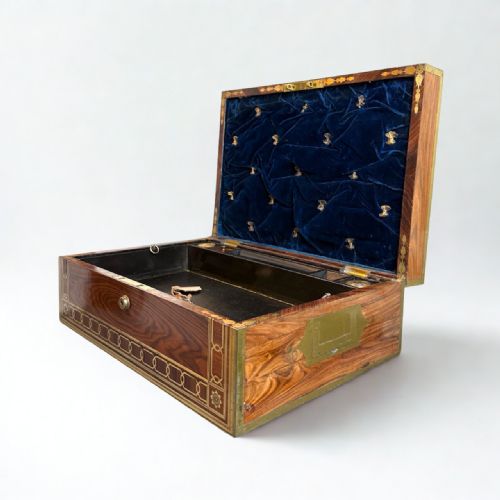


Decorative Wood Desk Box
A decorative wood desk box brings warmth and order to a workspace, offering a solid home for letters, trinkets and daily writing tools.
Decorative Wood Desk Box
A decorative wood desk box encompasses everything from Georgian stationery cases to Victorian letter caskets and tabletop writing slopes. Buyers seeking a decorative wood desk box will find pieces designed for writing desks, tables and bureaus, serving practical and ornamental roles alike.
The selection ranges across the eighteenth, nineteenth and early twentieth centuries, drawing on styles such as Regency, Victorian Gothic Revival and Anglo-Indian. Formats vary from tea caddies and keepsake chests to specialised stationery boxes with fitted compartments.
How they were made
Cabinetmakers constructed these pieces from dense timbers including coromandel, walnut, rosewood, amboyna, burr yew and satinwood. Many examples utilise contrasting veneers and solid cuts to display natural grain patterns across the lid and sides.
Metalwork played a structural and decorative role, featuring brass banding, inlaid mother of pearl and bone details. Specialised techniques such as Tunbridge ware and pietra dura panels appear on select nineteenth-century pieces.
Periods represented on the site range from the eighteenth century through the Regency, Victorian and Edwardian eras up to the nineteen-thirties.
What varies in quality
Quality rests on the choice of timber and the precision of the joinery, with figured woods like burr walnut or coromandel commanding attention for their rich grain. The integration of decorative elements such as flush brass mounts, detailed inlay and pietra dura plaques distinguishes finer examples from simpler containers.
Interior fittings reveal the standard of construction, particularly where dividers, letter slots and velvet or silk linings remain intact. The harmony between the exterior timber selection and the interior arrangement marks the difference between standard utility boxes and pieces intended for prominent display.
C.G. Hope Hastings
The Decorative Wood Desk Box Glossary
- Coromandel
- A dense, heavily figured exotic timber with dark brown and black striping, prized by nineteenth-century cabinetmakers for luxury boxes. It provides a striking surface for brass inlay and mounts.
- Tunbridge ware
- A form of mosaic woodwork produced in Kent using thousands of tiny coloured wood blocks to create pictorial or geometric designs. This technique decorates the surface of specific nineteenth-century boxes.
- Pietra dura
- An Italian technique involving the inlay of cut and fitted polished coloured stones to form decorative images, often incorporated into Victorian box lids. It creates a smooth, permanent mosaic surface.
- Writing slope
- A desk accessory featuring a hinged, angled lid that opens to reveal a flat or sloping surface for writing. These boxes typically house compartments for inkwells, pens and stationery.
- Stationery box
- An upright desk container designed to hold envelopes, writing paper and correspondence upright in tiered slots. These pieces often feature glass panels or hinged folding doors.
Decorative Wood Desk Box: Frequently Asked Questions
What is a decorative wood desk box used for?
These boxes served to hold correspondence, writing implements, postage stamps and personal valuables on a desk or table. In daily use, they kept loose papers organised while adding a refined element to study and drawing room interiors.
Today, they function well for storing modern stationery, photographs, jewellery or desk accessories. Their partitioned interiors remain practical for sorting small items.
How do I identify the wood used?
Examining the grain, colour and weight helps determine the timber species used in each box. Dense, dark woods with contrasting stripes typically indicate coromandel or rosewood, while swirling patterns point towards burr woods like amboyna or yew.
Patina also plays a role in identification, as older French polish and wax finishes darken and warm over decades of handling. Comparing the grain on the lid to the internal carcase reveals whether solid timber or fine veneer was applied.
Are these boxes suitable for daily desk use?
Most antique boxes remain robust enough for regular use when handled with care. Their sturdy timber construction and original hinges continue to function well after generations of service.
Placing them on a stable surface away from direct heat sources protects the polished finish and delicate veneers. Ensuring that internal velvet or leather linings are kept clean preserves the condition of the box.
How do I tell nineteenth-century boxes apart?
Distinguishing between Regency, Victorian and Edwardian examples involves looking at the prevailing design motifs and construction methods. Regency pieces often favour clean neoclassical lines, while high Victorian boxes frequently display heavy brass banding, coromandel veneers and Gothic or exotic influences.
Materials and decorative techniques also shift across decades, with Tunbridge ware and pietra dura appearing more frequently on mid-to-late nineteenth-century surfaces. Examining internal paper labels, locks and hinges provides further clues to the manufacturing era.