
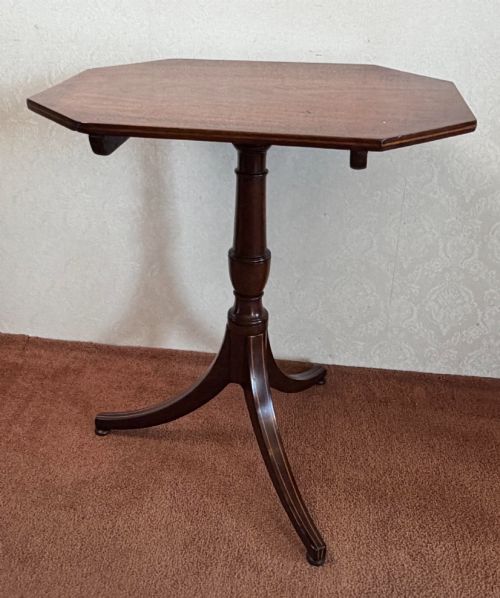


Small Inlaid Wood Box
A small inlaid wood box holds small treasures while showing off the quiet skill of a joiner working in satinwood, mahogany, or rosewood.
Small Inlaid Wood Box
A small inlaid wood box is primarily represented here by trinket boxes, keepsake containers, and snuff boxes spanning the Georgian, Victorian, and Edwardian eras. Buyers searching for a small inlaid wood box will frequently encounter compact nineteenth-century pieces alongside table-form examples and miniature chests.
The assortment includes domestic pieces from British workshops alongside items reflecting Chinese Export, Middle Eastern, and French Second Empire styles. Formats range from simple circular receptacles to serpentine sewing tables and kidney-shaped bijouterie cases.
Many of these items served specific personal functions, such as holding sewing needles, tobacco, or paper memorabilia. Their enduring appeal lies in combining practical storage with decorative marquetry and banded borders.
Materials and construction
Cabinetmakers constructed these pieces using dense hardwoods including mahogany, rosewood, satinwood, and cedarwood as a foundation. Finer examples incorporated contrasting boxwood and brass stringing or Tunbridge Ware mosaic detailing.
Inlay work relied on precise hand-cutting of contrasting timber veneers, which were then fitted into recessed channels carved into the primary carcass. Interior compartments often featured lined fabric to protect delicate personal items.
Evaluating craftsmanship
Quality in these pieces rests on the precision of the veneer work and the tightness of the mitred corners. Finer examples maintain crisp alignment where contrasting timbers meet, without noticeable gaps or thick adhesive lines.
The choice of primary wood and secondary detailing dictates the grade of the piece, with figured satinwood and intricate Tunbridge Ware commanding greater attention than plain hardwood carcasses. Original hinges, escutcheons, and internal fittings also elevate the standard of a box.
The Small Inlaid Wood Box Glossary
- Inlay
- A decorative technique where pieces of contrasting wood or other materials are inserted into a recessed surface to form a flat design. This method defines the primary ornamentation on these boxes.
- Satinwood
- A durable, yellowish timber prized for its lustrous sheen and smooth grain. It frequently serves as the main veneer on nineteenth-century pieces.
- Tunbridge Ware
- A type of woodworking consisting of tightly fitted mosaic tiles made from natural coloured woods to form geometric or pictorial scenes. It appears on miniature boxes from the period.
- Serpentine
- A curved shape featuring a convex centre flanked by concave ends, often seen on the front profile of tables and larger boxes. This contour requires advanced woodworking skill.
- Snuff box
- A small lidded container designed to hold powdered tobacco. Examples are fashioned from specimen woods or shaped like miniature books.
Small Inlaid Wood Box: Frequently Asked Questions
What were small inlaid wood boxes used for?
These boxes served as personal receptacles for valuable keepsakes, letters, sewing implements, and tobacco. Owners kept them on dressing tables, writing desks, and in antechambers.
Their compact size allowed personal items to remain secure and private while adding a decorative element to domestic interiors.
How can I tell a Victorian box from a Georgian one?
Georgian pieces often display restrained lines with simple boxwood stringing and classical proportions. Victorian boxes frequently employ bolder contrasts in rosewood and satinwood, alongside more elaborate internal trays.
Examining the construction of the interior compartments and the style of the hinges provides further clues to the period of manufacture.
What is Tunbridge Ware?
Tunbridge Ware is a specialised form of woodwork originating from Kent, featuring mosaic decoration built from thousands of tiny tinted wood blocks. These blocks combine to create detailed geometric patterns or architectural views.
Boxes bearing this work require careful handling to preserve the microscopic tesserae making up the surface pattern.
How do I care for an antique wood box?
Keep these boxes away from direct sunlight and sudden humidity shifts to prevent the wood veneers from warping or cracking. Maintaining a stable indoor environment protects both the outer polish and any internal fabric lining.
An occasional application of appropriate paste wax helps preserve the sheen of the timber without building up heavy residue.