
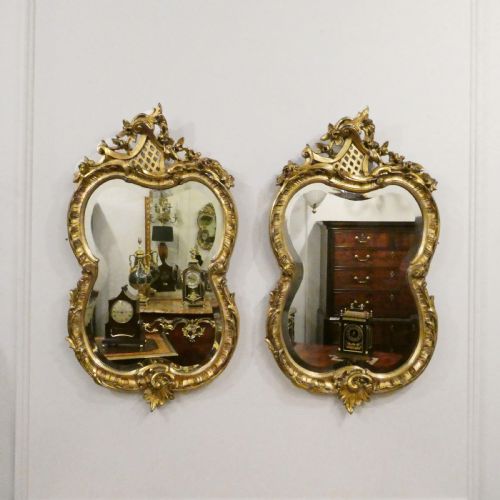
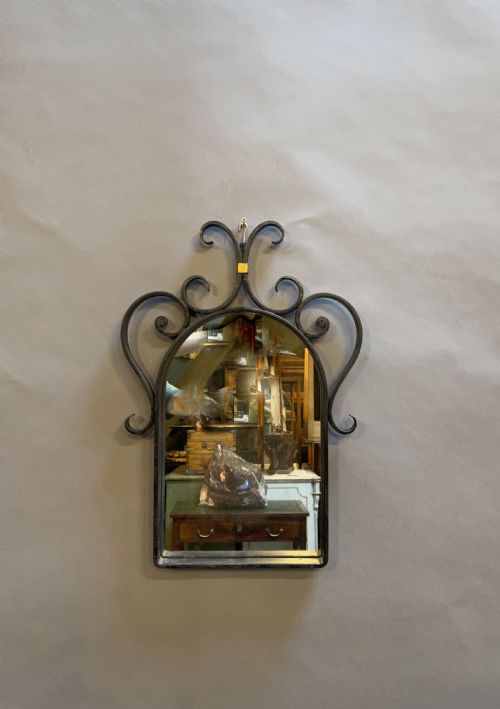


Decorative Scrollwork Wall Mirror
These decorative scrollwork wall mirrors bring warmth and character to a room, offering intricate frames crafted across the nineteenth and twentieth centuries.
Decorative Scrollwork Wall Mirror
A decorative scrollwork wall mirror serves as both a functional looking glass and a striking focal point in an interior. The selection here spans multiple periods, including Victorian, Edwardian, and the early twentieth century, showing a strong presence of French and Italian influences.
You will encounter various forms ranging from grand overmantle mirrors to smaller hall and shield-shaped pieces. Styles lean heavily towards Rococo Revival, Baroque, and Florentine designs, featuring elaborate carved work and ornate crests.
How they were made
The frames rely on traditional craftsmanship, combining carved wood, gesso, and giltwood to achieve deep, textured relief. Gilding methods give these surfaces their characteristic metallic sheen, whether bright or mellowed with age.
Alternative materials include cast and framed brass, wrought iron, and inlaid mahogany, particularly in Edwardian and Scottish pieces. Fretwork techniques allow for intricate openwork patterns in wood, while gesso provides a smooth base for moulded ornamentation.
What varies in quality
Quality rests primarily in the depth and crispness of the carving or moulding. Superior examples show confident handling in the scrollwork and foliage, where every curl and acanthus leaf retains sharp definition.
The choice of base material and the application of the finish dictate the longevity and visual weight of the piece. Hand-carved giltwood and deep gesso mouldings command greater presence than simpler assembled frames.
The Decorative Scrollwork Wall Mirror Glossary
- Giltwood
- Wood that has been coated with gold leaf or a metallic substitute. This finish provides the bright, reflective surface seen on many period frames.
- Gesso
- A plaster-like material applied to wood frames and carved or moulded into relief designs before gilding. It allows for intricate ornamentation that wood carving alone cannot achieve easily.
- Fretwork
- Ornamental perforated or cutout woodwork created by piercing a board with a saw. It is commonly found on Georgian style and Edwardian mirrors.
- Overmantle
- A large mirror designed to hang specifically above a fireplace mantelpiece. These pieces often feature extended proportions to suit the wall space.
- Rococo Revival
- A nineteenth-century style drawing on eighteenth-century French motifs, characterised by asymmetry, C-scrolls, and naturalistic shell work.
Decorative Scrollwork Wall Mirror: Frequently Asked Questions
How do I hang a heavy antique mirror?
Heavy mirrors require secure fixings into solid masonry or direct attachment to wall studs using appropriate brackets.
Professional installation is often recommended to support the substantial weight of carved wood and gesso frames safely.
How do I clean an antique gilt frame?
Dust the surface gently with a soft, dry brush to remove surface particles without disturbing the delicate finish.
Avoid using water, chemical sprays, or abrasive cloths, as these can strip the historical gilding away.
Are these mirrors original to their stated periods?
The listings include pieces dating from the nineteenth and early twentieth centuries, retaining their original construction and materials.
Wear and patina on the glass and frames typically align with the age indicated in each description.
What is the difference between Rococo and Baroque styles?
Baroque design focuses on symmetry, heavy grandeur, and dramatic theatrical presence.
Rococo introduces lighter, asymmetrical scrollwork, C-curves, and playful organic motifs inspired by nature.