
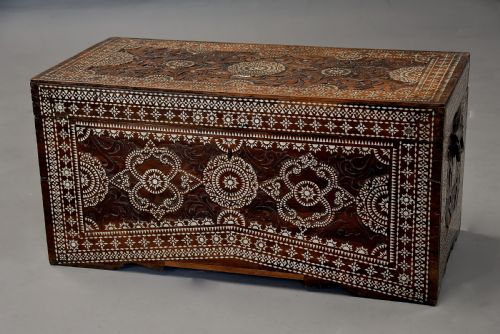
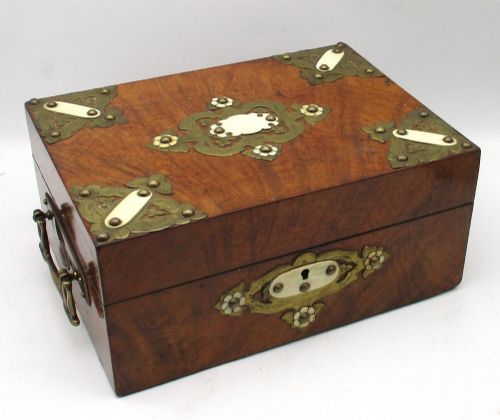


Decorative Inlaid Storage Box
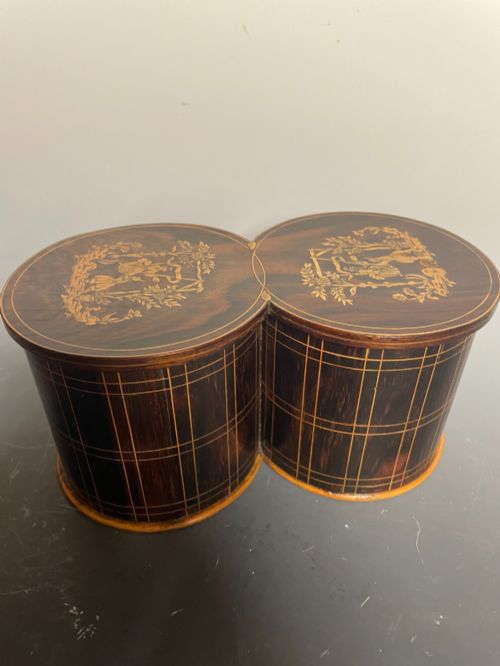
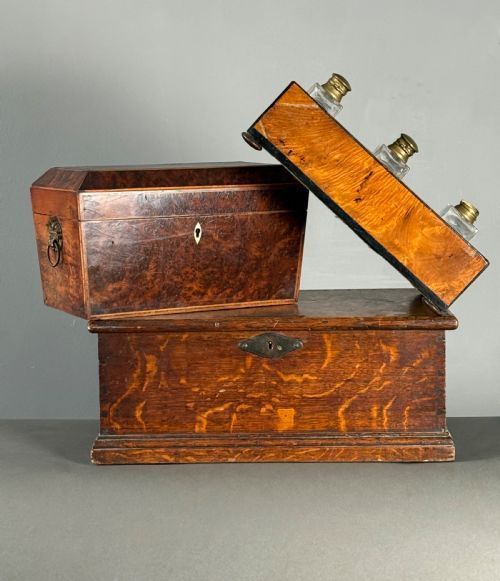
These decorative inlaid storage boxes span the Georgian, Regency, and Victorian periods, offering refined timber construction and intricate craftsmanship.
Decorative Inlaid Storage Box
A decorative inlaid storage box serves as a receptacle for tea, stationery, trinkets, or sewing accessories, combining practical utility with ornamental display. These pieces frequently take the form of tea caddies, work boxes, or small caskets designed for the desk or parlour.
The versions most commonly met on this page date from the Georgian, Regency, and Victorian eras, alongside later nineteenth and early twentieth-century examples. They appear in rich hardwoods such as rosewood, mahogany, and walnut, frequently enhanced by parquetry, marquetry, and shell or metal details.
How they were made
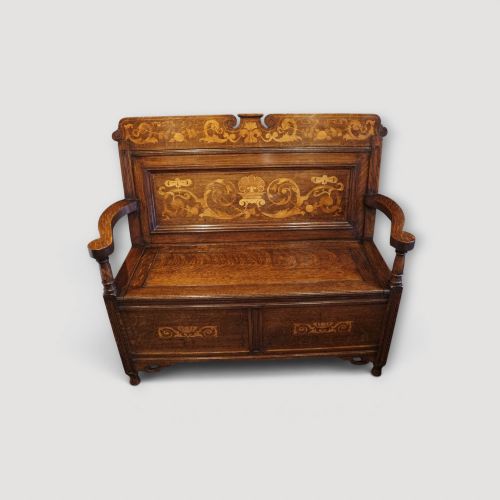
Cabinet makers utilised dense hardwoods like mahogany, rosewood, walnut, and satinwood as foundations, often applying fine veneers over a secondary timber core. These surfaces received meticulous parquetry and marquetry arrangements to form geometric patterns or pictorial scenes.
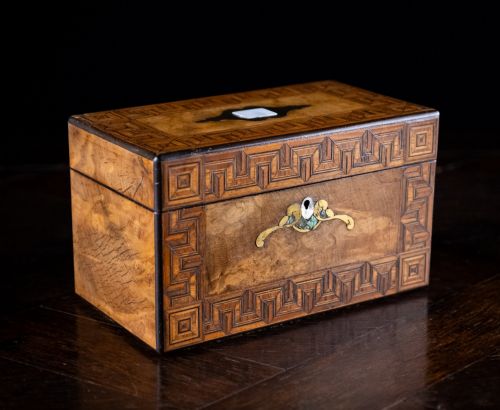
Inlay work incorporated contrasting materials including boxwood, bone, mother of pearl, brass, and tortoiseshell, secured into precision-cut recesses. Specialised regional techniques such as Tunbridge ware produced intricate mosaic designs from small blocks of naturally coloured woods.
Book-shaped olive boxes from the nineteenth century offer secret storage that mimics a modest library shelf.
What varies in quality
The refinement of the surface decoration largely distinguishes the standard of a piece, from simple stringing lines to complex pictorial marquetry and multi-material parquetry. Precision in the fitting of contrasting veneers and the harmonious selection of timber grain dictate the visual impact.
Structural integrity and the retention of original interior fittings, such as internal canisters, mixing bowls, or velvet linings, elevate the standing of a box. The crispness of carved mouldings and the quality of brass escutcheons and handles further mark out superior workshops.
The Decorative Inlaid Storage Box Glossary
- Marquetry
- The art of forming decorative patterns by fitting together thin veneers of wood, shell, or bone into a glued backing. This technique allows for elaborate pictorial and floral designs across box lids.
- Parquetry
- Geometric mosaic woodwork formed by arranging small veneer blocks into repeating patterns like cubes or chequers. It creates a striking, structured surface on table boxes and tea caddies.
- Tunbridge Ware
- A distinct form of British woodworking originating from Kent, featuring mosaic scenes assembled from thousands of tiny wood blocks. It commonly decorates small trinket and ladies boxes.
- Caddy
- A small container historically used for storing loose tea leaves securely, often fitted with internal compartments or canisters. Many examples feature lockable lids and fine wood veneers.
- Sarcophagus
- A box shape characterised by a steep, sloping lid and a rectangular or octagonal body, often raised on bracket feet. This classical form frequently appears in Regency rosewood and mahogany.
Decorative Inlaid Storage Box: Frequently Asked Questions
What were decorative inlaid storage boxes used for?
These vessels served primarily to store valuable household commodities such as tea leaves, which required protection from moisture and light in secure containers. They also functioned as elegant desktop receptacles for letters, stationery, jewellery, and sewing implements in the principal rooms of the house.
Over time, their roles evolved alongside changing domestic habits, shifting from utilitarian containers to purely decorative objects displayed on tables and cabinets. Their compartmented interiors accommodated specialised items like coin collections, stamps, and trinkets.
How do I date a Georgian or Victorian box?
Dating relies heavily on the prevailing furniture styles, timber choices, and decorative techniques characteristic of specific reigns and decades. Georgian and Regency pieces often showcase mahogany and rosewood with restrained brass stringing, while Victorian examples frequently employ bolder mother of pearl inlay and elaborate marquetry.
Construction methods inside the box, such as the cut of the wood and the type of hinges or locks used, offer further clues to the period of manufacture. Secondary woods visible on interior dividers or bases can also confirm the era of origin.
How do I care for antique wood and inlay?
Maintaining these pieces requires keeping them away from direct sunlight and extreme fluctuations in temperature or humidity, which can cause timber to warp and veneers to lift. Gentle dusting with a dry, soft cloth is sufficient for daily maintenance.
Occasional application of microcrystalline wax helps protect polished surfaces without sealing moisture into the wood or damaging delicate shell and bone inlays. Avoid using liquid cleaners or standard furniture polishes that might seep beneath loose veneer edges.
What is Tunbridge ware?
Tunbridge ware is a specialised form of nineteenth-century woodwork defined by mosaic decoration created from thousands of precisely cut, naturally coloured wood strips. These tiny segments form detailed images of flora, butterflies, or geometric borders on the lids of small boxes.
Produced predominantly in Kent, these items represented a high degree of Victorian craftsmanship and remain distinct collectible objects due to their miniature scale and intricate assembly.