




Decorative Bronze Candelabra Pair
These decorative bronze candelabra pair selections bring striking nineteenth-century illumination and classical presence to any mantelpiece or dining table.
Decorative Bronze Candelabra Pair
A decorative bronze candelabra pair comprises matched multi-armed candleholders originating primarily from the nineteenth century, including French Empire, Regency, and Art Nouveau styles. These lighting pieces combine functional branches with sculptural forms, often pairing cast bronze and ormolu.
Buyers frequently encounter French production from periods such as the Charles X and Restauration eras, alongside specific variations incorporating marble, porcelain, or cloisonné enamel. Beyond standard table candelabra, related items on this page include wall sconces and converted lamps.
Materials and construction methods
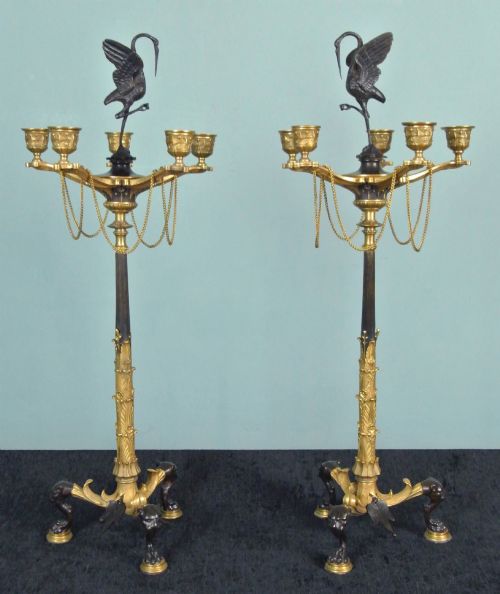
Items in this category rely heavily on cast bronze and ormolu, utilising mercury gilding or modern electroplating to achieve a contrasting gold-toned finish against patinated dark surfaces. Founders frequently incorporated marble bases and porcelain elements into the primary bronze framework.
Detailed chasing and finishing define these objects, with workshops employing patinated metal and cloisonné enamel to add texture and colour. Multi-arm structures are bolted securely to heavy cast bases to support the weight of multiple candles.
Decorative Bronze Candelabra Pair Retail Price Guide 2026
Typical asking prices for decorative bronze candelabra pair among the pieces listed under this phrase on Sellingantiques today, from the lower quarter to the upper quarter. They describe what is for sale here now, not the wider market.
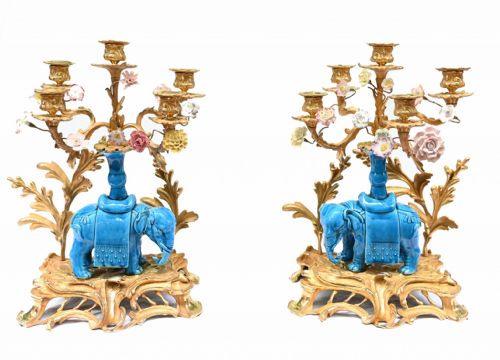
Elephants occasionally support nineteenth-century candle branches.
Distinctions in craftsmanship and design
Material integration also dictates standard versus superior execution, such as the use of solid statuary marble versus lesser stone, or the precision of applied cloisonné enamel work. Complete sets retaining their original matching patination and gilding show superior preservation.
Barbedienne·Pierre Philippe Thomire·Liberty
The Decorative Bronze Candelabra Pair Glossary
- Ormolu
- Gilded bronze, typically achieved through an amalgam of mercury and gold applied to a bronze base. This technique produces a warm, durable metallic lustre characteristic of nineteenth-century decorative arts.
- Patinated metal
- Metal treated with chemicals or heat to create a darkened, aged surface finish. It provides contrast against bright gilt ormolu mounts in classical designs.
- Cloisonne enamel
- Decorative work where glass paste is fired inside wire compartments soldered to a metal ground. This technique introduces vibrant colour to candelabra stems and bases.
- Restauration
- A French design period spanning the early nineteenth century between the fall of the Empire and the July Monarchy. Pieces from this era often feature restrained classical lines combined with rich bronze patination.
- Wall sconce
- A lighting fixture secured directly to a wall rather than standing on a horizontal surface. These fixtures carry candle nozzles on projecting arms.
Decorative Bronze Candelabra Pair: Frequently Asked Questions
What periods do these candelabra cover?
The selection spans the nineteenth century, capturing distinct historical design movements from the Regency and French Empire through to late nineteenth-century Art Nouveau.
Specific dates mentioned in descriptions point toward the 1880s and 1890s, alongside earlier decades of the eighteen-hundreds.
Are these items strictly for candles?
While originally designed to hold candles across multiple arms, several examples feature alterations or adaptations into table lamps.
Buyers should examine specific listings to determine if the wiring is modern or if the piece retains its original candle-holding configuration.
How do I identify French Empire style?
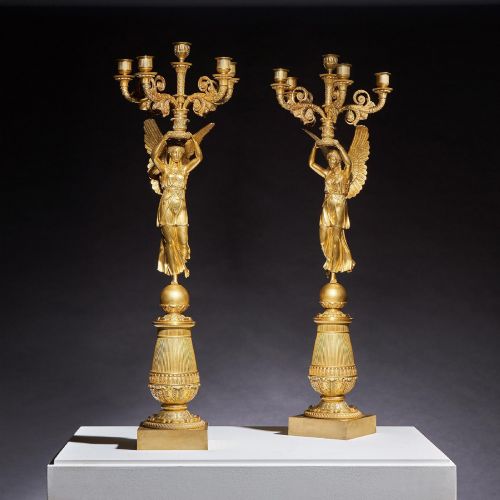
French Empire pieces rely heavily on classical antiquity, drawing inspiration from ancient Roman and Greek motifs. You will notice symmetrical designs incorporating martial emblems, classical figures, and crisp ormolu mounts.
This aesthetic dominated the early nineteenth century and emphasises formal grandeur.
What materials are used alongside bronze?
Makers frequently combined bronze with contrasting elements such as white marble bases, porcelain bodies, and cloisonné enamel sections.
Parcel gilt and patinated metal surfaces also appear frequently, creating dual-tone finishes on the structural stems and arms.