



Dark Wood Correspondence Box
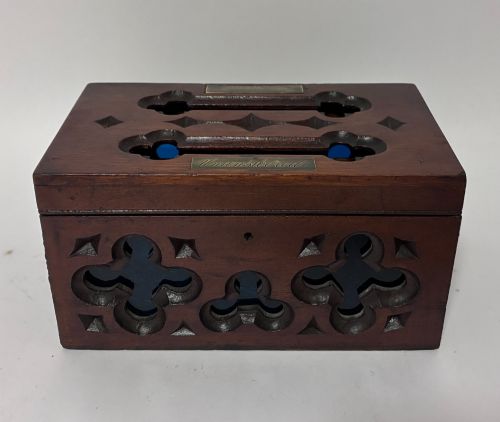
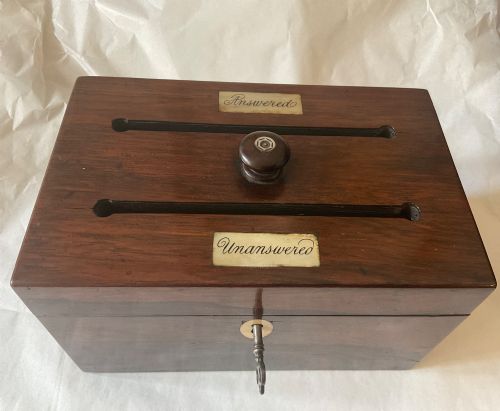
A dark wood correspondence box organises incoming and outgoing post with panelled partitions, offering a handsome addition to a desk from the Georgian era to the Edwardian period.
Dark Wood Correspondence Box
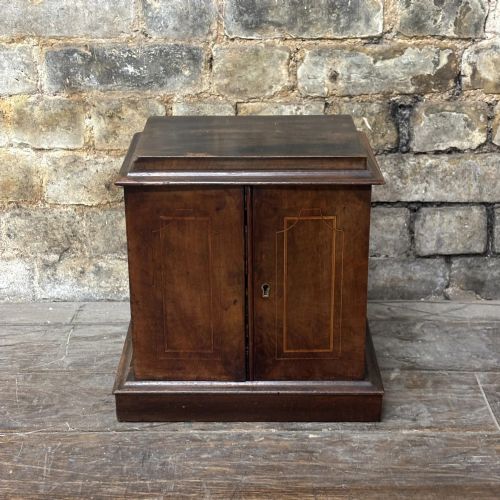
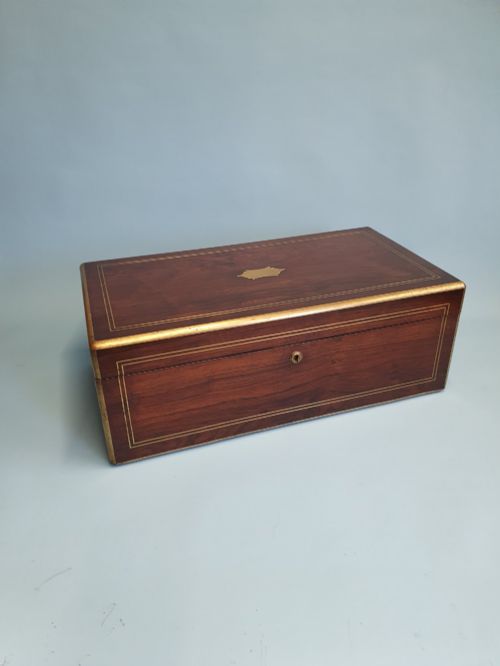
A dark wood correspondence box groups together stationery cabinets, letter boxes and writing slopes designed to hold paper and envelopes. These desk accessories appear in forms spanning the Georgian, Victorian and Edwardian periods.
The version most commonly met on this page is the Victorian specimen in dense timbers like mahogany, rosewood or coromandel, often fitted with sloping lids or upright cabinet doors.
Origins stretch from English country houses to Anglo Indian workshops, demonstrating the global reach of nineteenth-century cabinet making.
Materials and construction
Cabinet makers utilised heavy tropical hardwoods, particularly mahogany, rosewood, coromandel and ebony, valued for their deep natural colour and fine grain. These timbers provided the rigid structure necessary for daily desk use.
Internal layouts relied on thin wood dividers and fabric-lined compartments to separate writing paper, cards and incoming letters within the main box or cabinet.
Dark Wood Correspondence Box Retail Price Guide 2026
Typical asking prices for dark wood correspondence box among the pieces listed under this phrase on Sellingantiques today, from the lower quarter to the upper quarter. They describe what is for sale here now, not the wider market.
The listings here span the Georgian, Victorian and Edwardian periods, showcasing timber choices from standard mahogany to exotic coromandel and ebony.
Assessing quality and execution
The standard of a correspondence box rests on the selection of the timber grain and the precision of the joinery at the mitred corners. Finer examples display symmetrical veneers and carefully matched wood patterns across the lid and front.
Hardware integration marks the distinction between standard utilitarian items and superior pieces, seen in flush-fitting brasses and working locks with intact keys. The treatment of internal stationery partitions reveals the original maker's attention to daily utility.
The Dark Wood Correspondence Box Glossary
- Correspondence box
- A desk accessory designed to hold writing paper, envelopes and incoming letters. These containers range from sloping boxes to upright cabinets with multiple interior divisions.
- Stationery cabinet
- An upright desk box featuring doors that open to reveal pigeon holes and letter slots. This form became particularly popular during the later Victorian and Edwardian periods.
- Writing slope
- A hinged desk box that opens to reveal a slanted writing surface and interior storage for pens and paper. Georgian and Victorian examples frequently incorporate secret compartments beneath the stationery wells.
- Coromandel
- A dense, heavy southeast Asian hardwood with dark brown and black figuring, prized for luxury nineteenth-century boxes. It provides a striking contrast when mounted with brass hardware.
- Campaign box
- Portable desk furniture fitted with recessed brass handles and reinforced corners for travel. These pieces were constructed for use during military or colonial service.
Dark Wood Correspondence Box: Frequently Asked Questions
What is a dark wood correspondence box?
A dark wood correspondence box is a desk accessory built to store stationery, envelopes and letters. These pieces utilise dense timbers like mahogany, rosewood and coromandel.
They date primarily from the Georgian, Victorian and Edwardian eras, reflecting the heavy paper correspondence of those periods.
How do I date my box?
Dating relies on the timber species, construction methods and prevailing decorative styles visible in the piece. Victorian examples often display Gothic Revival details or heavy brass campaign mounts.
Edwardian and later nineteenth-century pieces tend towards upright stationery cabinets with simpler internal partitions than earlier writing slopes.
Where were these boxes used?
These boxes were kept on library tables, bureau desks and writing desks in country houses and town homes. Some travelled with owners as part of campaign equipment.
Their primary function was keeping private letters and writing paper neat and secure between uses.
How should I care for the wood?
Maintain the timber by keeping the box away from direct heat sources and sudden changes in humidity. Regular dusting with a dry cloth preserves the polished surface.
Avoid excessive liquid polishes, applying natural wax sparingly only when the wood appears dry.