

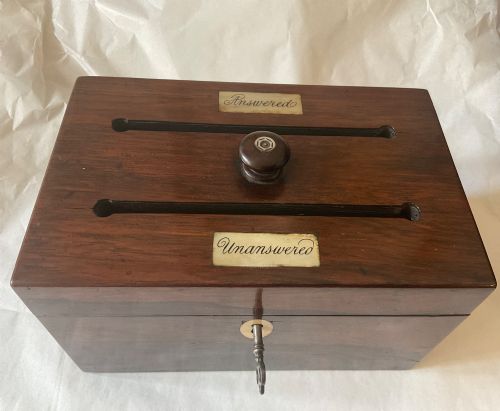


Answered Unanswered Letter Box
These answered unanswered letter box pieces organise domestic correspondence efficiently, offering dual compartments that collectors value for their period utility and desk appeal.
Answered Unanswered Letter Box
An answered unanswered letter box organises daily correspondence into two distinct compartments marked for incoming and processed mail. These desk accessories appear in Victorian forms designed for country house studies and writing desks.
The objects take the form of correspondence boxes, post boxes and stationery boxes constructed during the nineteenth century. Most examples date from the mid-nineteenth century, specifically around eighteen fifty to eighteen sixty, reflecting the expansion of personal and business correspondence during that era.
How They Were Made
Cabinet makers utilised dense hardwoods including mahogany, rosewood, walnut and oak to form the main bodies of these boxes. Artisans applied brass mounts for structural reinforcement and visual contrast against the timber grain.
Interiors and exterior markers frequently incorporate bone and mother-of-pearl for labelling the dual letter slots or compartments. Certain examples feature gold embossed leather work applied to the writing or sorting surfaces within the desk accessory format.
What Varies in Quality
The distinction between standard examples and finer pieces rests upon the choice of timber and the precision of decorative inlays. Rosewood and walnut bodies with mother-of-pearl detailing represent a higher grade of craftsmanship compared to plain utilitarian timber boxes.
Surface embellishments such as brass mountings and embossed leather distinguish superior desk accessories from simpler variants. The clarity of the answered and unanswered lettering, whether carved, inlaid or embossed, dictates the visual refinement of the piece.
The Answered Unanswered Letter Box Glossary
- Correspondence box
- A desk accessory specifically built to hold letters, envelopes and writing paper. These containers often feature internal dividers to keep unanswered post separate from completed items.
- Mother-of-pearl
- An iridescent inner layer of certain shells used by Victorian artisans for inlay work and decorative labels. This material provides a bright contrast against dark woods like rosewood.
- Brass mounted
- Fitted with brass brackets, hinges or escutcheons for durability and decoration. This metalwork strengthens the corners and edges of the wooden box.
- Stationery box
- A desk container designed to store paper, cards and envelopes upright. They share similar forms with letter boxes of the period.
Answered Unanswered Letter Box: Frequently Asked Questions
What is an answered unanswered letter box?
An answered unanswered letter box is a Victorian desk accessory designed to sort incoming mail into two categories. The dual compartments helped households manage their daily correspondence efficiently before the era of modern filing systems.
These pieces typically sit on a desk or table in a study or library. Their wooden construction matches other nineteenth century desk furniture.
How were these boxes used?
Households used these boxes to track the status of written communications. One compartment held incoming post awaiting a reply, while the other stored letters that had already been answered.
This system prevented correspondence from being overlooked in busy Victorian country houses. The labelled slots guided users instantly to the correct section.
What materials are common?
Victorian cabinet makers utilised hardwoods such as walnut, mahogany, rosewood and oak for the primary structure. These timbers provided the durability required for daily desktop use.
Decorative elements often include brass mounts, bone details and mother-of-pearl inlays. Some examples incorporate gold embossed leather on interior surfaces.
How do I date these pieces?
Dating relies on the prevailing styles and materials recorded in nineteenth century examples, primarily spanning the Victorian period from eighteen fifty to eighteen eighty. The combination of dense hardwoods and specific labelling styles points directly to this era.
Construction techniques, such as dovetailing and brass hardware styling, further assist in placing the object within the mid-nineteenth century. Examining the interior fittings and hinges provides additional chronological clues.