

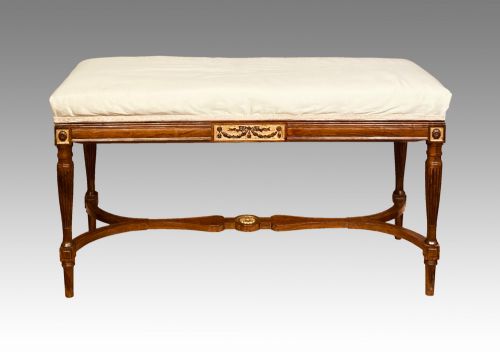


Dark Rosewood Piano Stool
A dark rosewood piano stool brings rich grain and practical height adjustment to a music room or sitting area.

Dark Rosewood Piano Stool
A dark rosewood piano stool is a sturdy seat designed for keyboard players, engineered to adjust for height so the musician sits comfortably at the instrument. The pieces gathered here span the Georgian, Regency, William IV, and Victorian eras, demonstrating how makers adapted seating for the parlour over several decades.
You are most likely to encounter Victorian examples on this page, often featuring revolving tops, rise-and-fall mechanisms, or lift-out upholstered seats. These range from simple cabriole leg designs to ornate Victorian Arts & Crafts and Rococo Revival forms.
The selection also includes earlier Regency and William IV music chairs and benches, alongside oblong stools and dressing table variants. Each piece relies on the deep reddish-brown tones of rosewood to anchor a room's interior scheme.
How they were made
The framework of a dark rosewood piano stool relies on dense tropical hardwood, often embellished with boxwood inlay, giltwood, or brass fittings. Timber selection prioritised stability, allowing makers to turn slender legs or carve robust cabriole supports without compromising strength.
Upholstered seats use period textiles, including contemporary fabrics and later tapestries, secured over lift-out frames or revolving platforms. Mechanical ingenuity defined the era, with threaded wooden screws and metal gear assemblies enabling smooth height adjustments for the player.
Listings feature rosewood furniture spanning the Georgian, Regency, William IV, and Victorian periods, incorporating brass and boxwood.
What varies in quality
Quality in a dark rosewood piano stool reveals itself through the precision of the mechanical adjustment and the crispness of the timber carving. Superior examples operate smoothly without wobble in the screw mechanism, maintaining structural integrity across decades of rotation or height alteration.
The refinement of the secondary details, such as precise boxwood stringing or finely cast brass mounts, separates standard production from exceptional workshop output. Timber choice and grain matching across the apron and legs further distinguish the finer pieces from simpler utilitarian seating.
Charles Nosotti
The Dark Rosewood Piano Stool Glossary
- Rise and fall
- A mechanism utilising a threaded screw column that raises or lowers the seat when turned. This allows the player to customize their seating height relative to the keyboard.
- Revolving piano stool
- A seat featuring a central pivot that allows the top to spin freely. This design enabled musicians to turn toward sheet music cabinets or converse in the room.
- Cabriole leg
- A furniture leg that curves outward and then tapers inward, inspired by the shape of an animal's curving leg. It appears frequently on Victorian interpretations of earlier styles.
- Boxwood inlay
- Contrasting pale wood inserted into shallow channels carved into the dark rosewood surface. This technique creates delicate geometric or floral patterns across the woodwork.
- Lift-out upholstered seat
- A drop-in wooden frame padded and covered in fabric that rests inside the seat rail without permanent fixings. This design facilitated easy reupholstery over time.
Dark Rosewood Piano Stool: Frequently Asked Questions
How do I adjust the height on these stools?
Many examples use a central screw mechanism hidden beneath the upholstery, which raises or lowers the seat when you rotate the top.
Other variants employ a rise-and-fall ratchet system or a hand-turned side handle to alter the vertical position.
Can I use a piano stool for daily seating?
These stools were built for heavy domestic use in nineteenth-century drawing rooms and music parlours, making them robust enough for modern sitting.
Their compact footprints and adjustable heights also make them useful as vanity seats or small occasional chairs.
How do I identify a Victorian piece from a Regency one?
Regency music chairs often lean toward Neoclassical restraint with clean lines and classical proportions, reflecting early nineteenth-century tastes.
Victorian pieces tend to display heavier ornamentation, including elaborate carving, Rococo Revival curves, or Arts & Crafts details.
What is the purpose of the brass fittings?
Brass components usually serve a mechanical function, reinforcing swivel joints, housing screw threads, or tipping the feet.
They also provide a bright metallic contrast against the dark, heavy grain of the polished rosewood timber.