
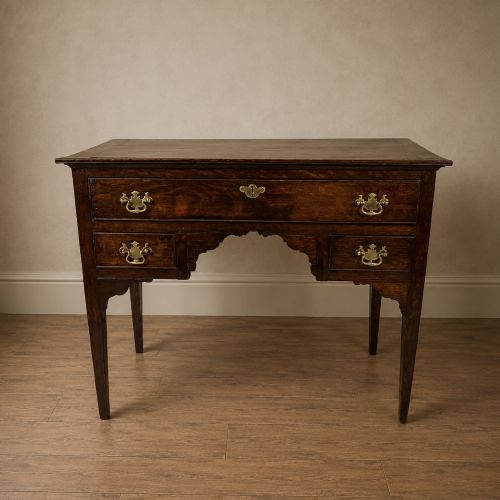
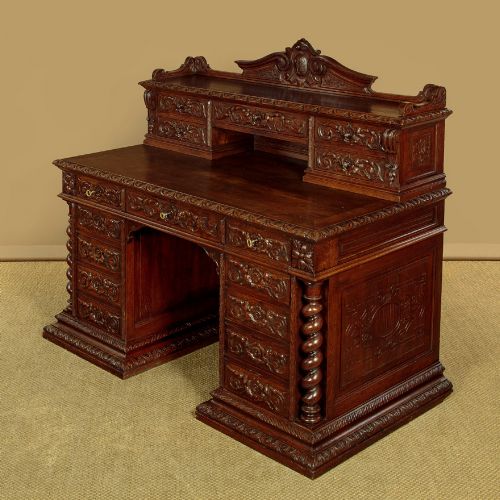


Dark Oak Kneehole Desk
A dark oak kneehole desk is a sturdy piece of functional furniture built with a central recess, offering a dependable workspace defined by rich timber grain.
Dark Oak Kneehole Desk
A dark oak kneehole desk is a practical workspace constructed primarily from oak, featuring a recessed central cupboard or opening flanked by banks of drawers. When searching for a dark oak kneehole desk, buyers encounter forms spanning the eighteenth century, the Victorian era, and early twentieth-century revivals.
The selections on this page incorporate various related forms and timber combinations, including pieces identified in styles such as Carolean Revival, Victorian Gothic, and Georgian. These items range from large writing desks and partners desks to miniature versions and lowboys adapted for writing use.
How they were made
Construction relies heavily on solid oak timbers, frequently complemented by secondary woods like mahogany or walnut, and occasionally utilising exotic materials such as padauk. Metal elements like brass provide handles, escutcheons, and structural support, while inset writing surfaces often feature leather.
Joinery and surface ornamentation define the manufacturing techniques seen across these items, ranging from plain country house construction to elaborate carving. Carved details, such as lions heads or Carolean revival motifs, demonstrate the manual skill applied by makers during the eighteenth, nineteenth, and early twentieth centuries.
What varies in quality
The standard of a piece depends largely on the depth of the timber selection and the precision of the joinery. Tables and desks featuring finely figured oak and well-integrated secondary woods sit above simpler utilitarian examples.
Execution of carved ornamentation and the originality of hardware, such as brass pulls and leather inserts, dictate the standing of an individual desk. Cohesiveness of style, whether an authentic Georgian period piece or a faithful later revival, marks the distinction between ordinary and superior examples.
The Dark Oak Kneehole Desk Glossary
- Kneehole desk
- A writing table with a central recess for the legs, typically flanked by pedestals containing multiple drawers. This layout became popular in the eighteenth century and persisted through various revival periods.
- Lowboy
- A small table with one or more rows of drawers, frequently utilised as a dressing table or side table. Many early examples share proportions and forms with smaller kneehole desks.
- Partners desk
- A large double-sided desk designed for two people to work opposite one another, featuring drawers and cupboards accessible from both sides. These heavy pieces often date from the Victorian period.
- Padauk
- A dense tropical timber exhibiting a deep reddish-brown coloration, occasionally utilised in nineteenth-century cabinet making. It offers a contrasting material choice compared to standard native British oaks.
- Carolean Revival
- A nineteenth or early twentieth-century design movement emulating the ornate carved styles of the seventeenth-century reign of Charles II. Furniture from this movement typically displays rich foliate carving and barley-twist supports.
Dark Oak Kneehole Desk: Frequently Asked Questions
What is a kneehole desk?
A kneehole desk is a freestanding item of furniture featuring a central recessed space beneath the desktop, allowing a person to sit comfortably. The user's legs fit into the kneehole while working at the surface.
Flanking banks of drawers provide storage for writing materials and papers. This configuration emerged in the seventeenth and eighteenth centuries to offer personal workspace in domestic settings.
How do I date an oak desk?
Dating an oak desk involves examining the construction methods, timber selection, and hardware used in the piece. Hand-cut dovetails and pegged joints generally indicate eighteenth-century or earlier craftsmanship.
Later Victorian and twentieth-century revivals often incorporate machine-cut elements or distinct stylistic revival motifs. Comparing the brass handles and secondary woods provides further clues to the period of manufacture.
Where were these desks placed?
These desks were traditionally placed in studies, libraries, or private parlours of large country houses and town residences. They served as private writing spaces for correspondence and estate management.
Smaller versions and lowboys were often positioned in bedrooms or smaller sitting rooms. Today, they function effectively as home office desks or statement furniture in living spaces.
What distinguishes a partners desk?
A partners desk is built on a larger scale to accommodate two individuals working face-to-face. Both sides feature identical drawer and cupboard arrangements.
Standard kneehole desks are finished against a wall with one active working side. Partners desks stand freely in the centre of a room due to their finished all-round construction.