





Dark Navy Rug
A dark navy rug brings deep indigo tones and historical tribal character into a room.
Dark Navy Rug
When you search for a dark navy rug, you encounter hand-knotted tribal and village floor coverings originating from Persia, the Caucasus, and Anatolia. These pieces range from nineteenth-century nomadic weavings to early twentieth-century village runners and prayer rugs.
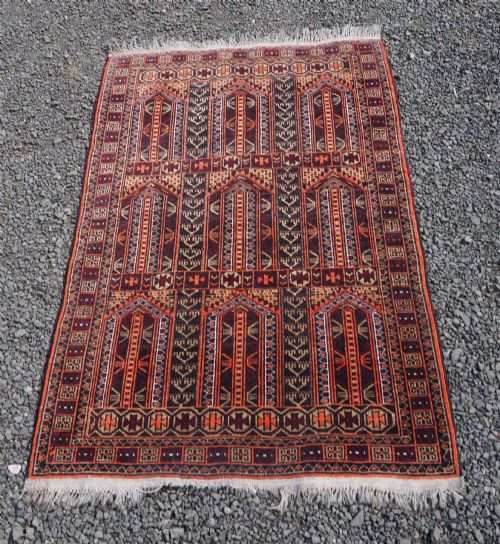
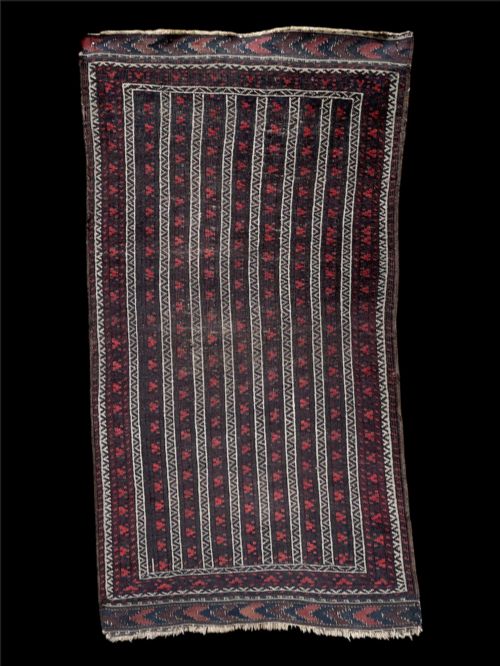
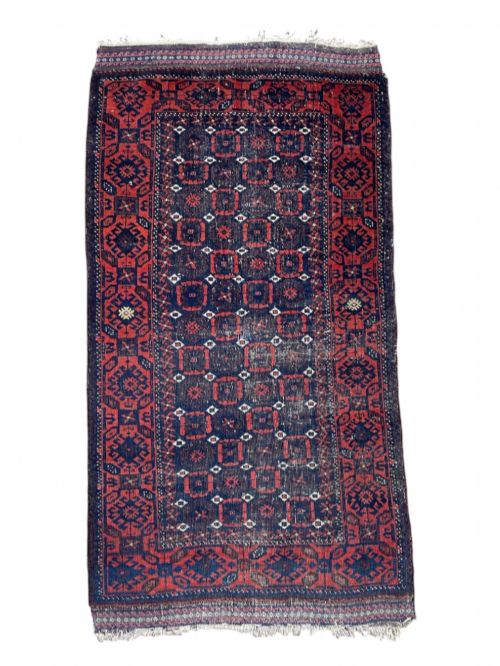
The version you are most likely to meet on this page is a Baluch tribal rug or a related regional variant featuring geometric motifs and mihrab designs. Formats vary from small mats and prayer rugs to narrow hallway runners and area carpets.
How they were made
These textiles rely on a foundation of spun cotton or wool, which carries dense wool pile knotted by hand. Natural dyeing methods yielded deep indigo and navy grounds that anchor the contrasting secondary colours.
Weaving techniques include symmetrical and asymmetrical knotting styles executed on traditional upright looms by nomadic and village weavers.
Listings feature nineteenth and early twentieth-century dates, utilising wool and cotton materials across Persian Tribal and Caucasian styles.
What varies in quality
Knot density and structural tightness dictate the fineness of the weave, separating robust utilitarian floor coverings from delicately detailed prayer rugs. Better examples maintain precise symmetry in their geometric layouts and retain substantial pile across the field.
The clarity and saturation of the dye work also define the grade, with evenly absorbed dark navy tones indicating superior wool preparation and dye practice.
The Dark Navy Rug Glossary
- Mihrab
- A niche design found in prayer rugs that mimics the direction of Mecca. It often appears in single, double, or triple formats on tribal pieces.
- Pile
- The vertical or slanted soft surface of a rug formed by the cut ends of knots. This layer provides the tactile depth and colour of the textile.
- Runner
- A long and narrow format designed for hallways or corridors. These pieces typically feature repeated central medallions or continuous geometric patterns.
- Herati
- A popular repeating pattern composed of a floral rosette enclosed within a rhombus and framed by four acanthus leaves. It frequently covers the field of Persian and Caucasian rugs.
- Knot
- The individual loop of yarn tied around the warp threads to form the pile. The count and tightness influence the durability and detail of the design.
Dark Navy Rug: Frequently Asked Questions
Where were these rugs made?
The listings span regions across Persia, the Caucasus, and Anatolia, reflecting traditional weaving centres and nomadic tribal territories.
Specific origins include Khorassan, Baluchistan, and various village communities across the Middle East.
How do I care for an old rug?
Protect the wool pile by vacuuming gently without a rotating brush bar and keep the piece out of direct sunlight.
Professional cleaning tailored to antique textiles helps preserve the natural dyes and structural integrity over time.
What is a prayer rug?
Prayer rugs feature a distinct arch or niche known as a mihrab, which historically directed the placement of the rug during daily devotions.
These pieces are generally smaller in scale and display symbolic motifs unique to the weaver's tribe or region.
How can I tell the age of a rug?
Dating relies on stylistic markers, structural materials, and the character of the natural dyes used in the wool pile.
Nineteenth-century examples often exhibit more organic dye variations and finer hand-spun wool compared to later twentieth-century productions.