

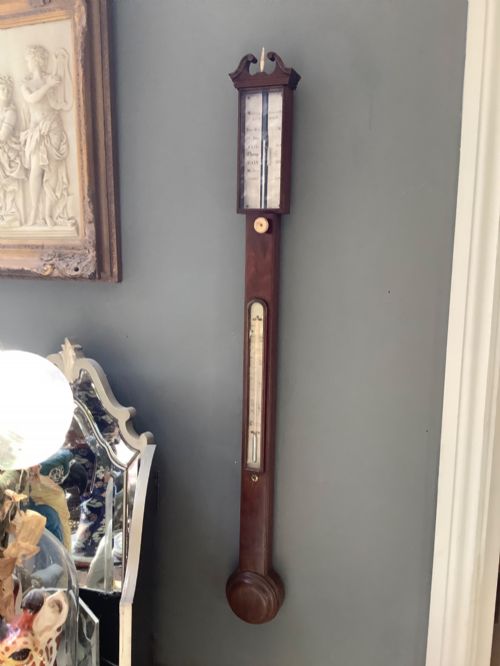


Dark Mahogany Weather Glass
These dark mahogany weather glass instruments measure atmospheric pressure, combining scientific utility with polished timber cabinetry for home interiors.
Dark Mahogany Weather Glass
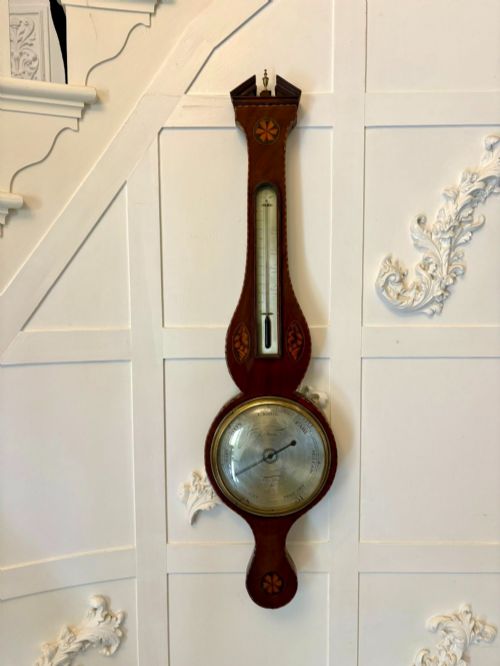
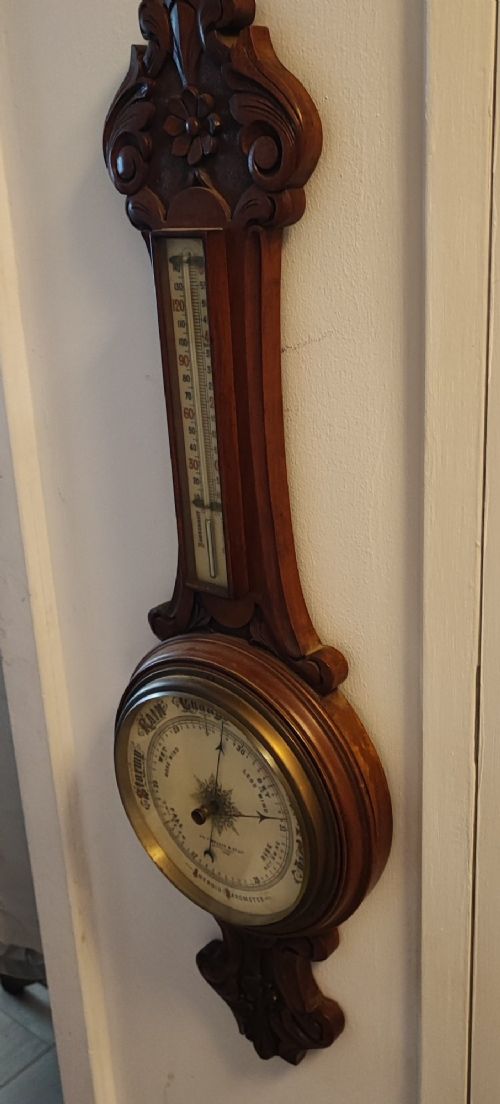
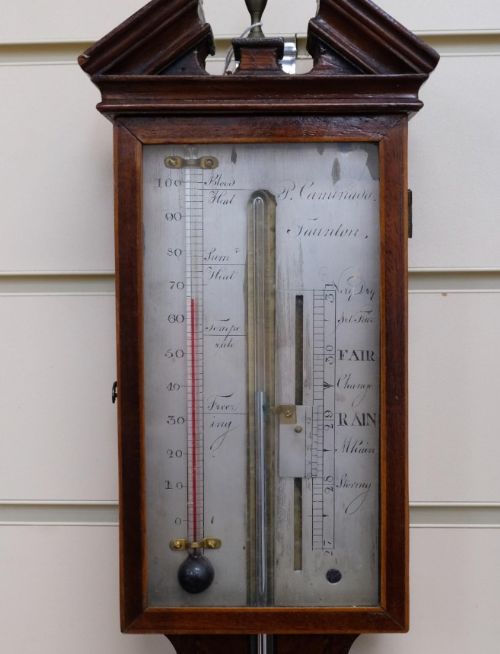
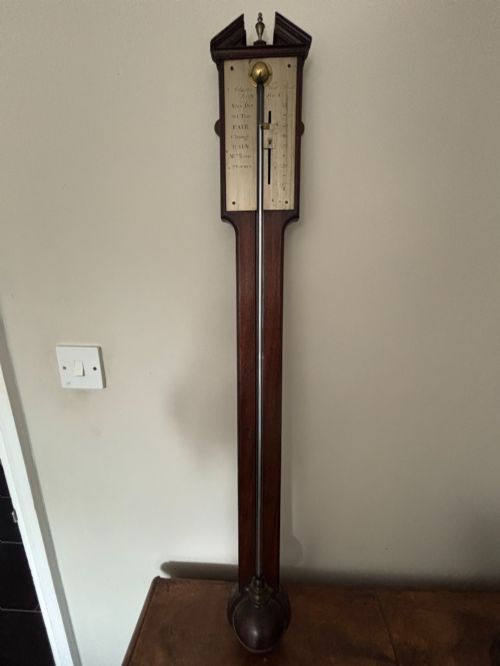
When you search for a dark mahogany weather glass, you encounter functional meteorological instruments housed in rich tropical timber cases. The selection spans stick barometers, wheel barometers, and banjo barometers originating from the Georgian, Regency, and Victorian eras.
Most examples you meet on this page take the form of either upright stick barometers or broad banjo barometers. Makers constructed these pieces in provincial towns and major cities like London, Glasgow, and Newcastle.
The styles range from plain linear stick designs to ornate banjo shapes featuring shell inlays and satinwood borders. These items served as both scientific tools and decorative furnishings in period homes.
How they were made
Craftsmen built the structural housings using solid mahogany timber, sometimes applying boxwood, ebony, and marquetry inlay for decorative contrast. The wood was selected for deep grain patterns and polished to a dark sheen.
Gauges and dials incorporate silvered brass, silvered metal, bone, and plain glass components to display atmospheric readings. Makers mounted these delicate scales securely into the timber fascias alongside mercury or aneroid mechanisms.
Listings feature mahogany, glass, brass, bone, silvered brass, satinwood, and marquetry inlay across Georgian, Regency, Victorian, and Edwardian periods.
What varies in quality
Quality separates instruments by the precision of the maker's engraving on the silvered brass dial and the crispness of the cabinet woodwork. Finer pieces display detailed marquetry inlay, satinwood stringing, and balanced proportions.
Signed instruments by established makers command attention through superior mechanical execution and refined case geometry. Lesser pieces offer simpler construction with plain timber surfaces and basic utility dials.
P. Caminada·George Adams·JB Bergna·Sandrino of Liverpool·Negretti & Zambra·Gilbert London·Bate·Luisetti of London·Charles Aiano·S. P. Cohen·A Pozzoby·J C Moretti
The Dark Mahogany Weather Glass Glossary
- Stick barometer
- A vertical instrument containing a mercury column that measures atmospheric pressure directly against a graduated scale. This form represents the earliest and most scientifically direct weather glass design.
- Banjo barometer
- A widened, symmetrical wall instrument shaped broadly like a stringed instrument, housing a circular dial alongside ancillary indicators. These pieces emerged strongly during the Georgian and Victorian periods.
- Aneroid barometer
- A sealed metal box mechanism that expands and contracts with pressure changes, moving a needle without liquid mercury. This later technology allowed for more robust and varied case designs.
- Silvered brass
- A metallic alloy surface treated with a silver compound to create a matte, reflective background for engraved measurement scales. Makers utilised this material for legibility and durability on the face.
- Marquetry inlay
- Small fitted pieces of contrasting wood or shell embedded into the primary mahogany surface to form decorative patterns. This technique elevates the visual richness of the instrument case.
Dark Mahogany Weather Glass: Frequently Asked Questions
How do stick and wheel barometers differ?
Stick barometers display the direct height of a mercury column within a tall, narrow vertical wooden trunk. Wheel barometers translate that column movement via a pulley and weight system to point a needle on a circular dial.
Vertical stick models generally offer a purer scientific aesthetic, whereas circular wheel versions provide a broader canvas for inlay and decorative woodwork.
Where should I hang a weather glass?
These instruments require stable interior wall locations away from direct sunlight, central heating radiators, and damp exterior stone surfaces. Sudden temperature swings can affect both the timber case and the internal mechanical components.
Positioning the piece at eye level ensures you can easily read the engraved silvered brass scales and track daily atmospheric changes.
How can I tell the period of a barometer?
Georgian examples often favour simple, elegant stick configurations or early wheel formats with understated mahogany cases. Victorian and Edwardian pieces frequently introduce aneroid movements, richer marquetry, and broader banjo silhouettes.
Examining the engraving style on the dial and the specific choice of secondary timbers like satinwood or boxwood helps narrow the date of manufacture.
What is an aneroid movement?
An aneroid mechanism relies on a corrugated elastic metal capsule that expands or contracts as air pressure fluctuates. This clever engineering removes the need for a hazardous liquid mercury column inside the home.
Such movements became common in later Victorian pieces, allowing makers to craft more compact or differently proportioned wall instruments.