
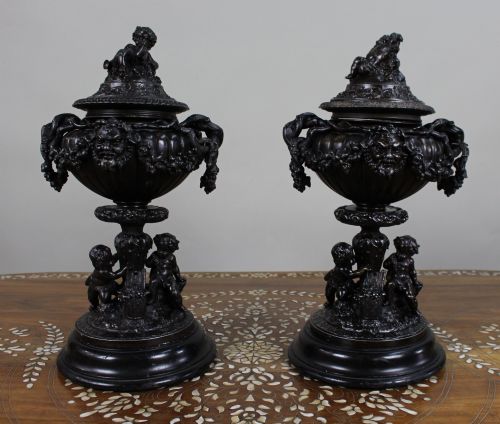


Dark Bronze Cassolettes
Dark bronze cassolettes are reversible decorative vessels that double as urns or candleholders, prized for their sculptural neoclassical presence.
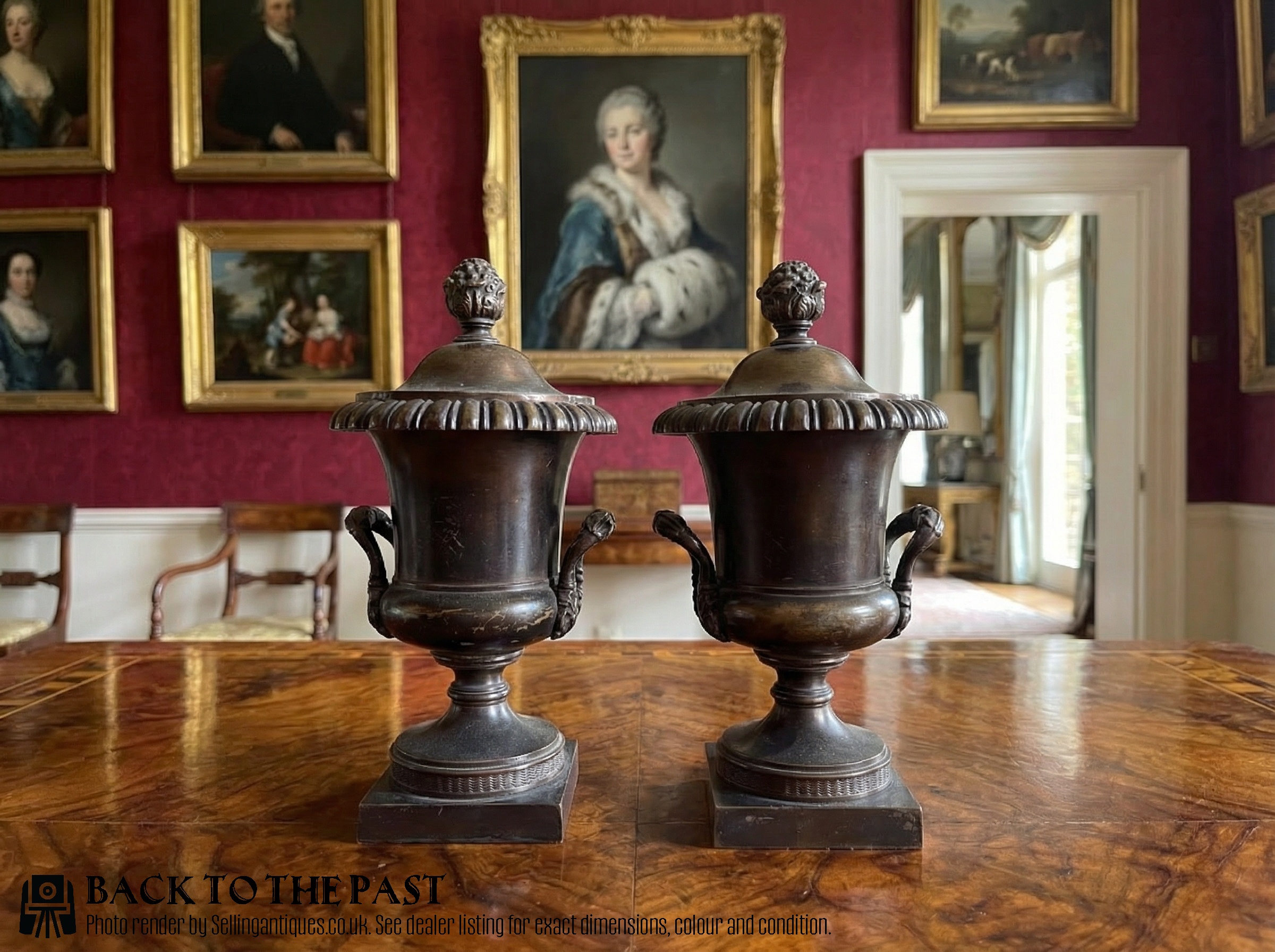
Dark Bronze Cassolettes
Dark bronze cassolettes are classical vessels designed with reversible tops, allowing them to function as lidded urns or invert to hold tapers. When you search for dark bronze cassolettes, you encounter pieces primarily originating from the nineteenth century, including Regency and Louis XVI revival periods.
The inventory on this page showcases forms shaped by French and Italian neoclassical aesthetics, frequently executed in pairs. These decorative vessels appear alongside related campana shapes and classical urns mounted on heavy plinths.
Examples span from Grand Tour souvenirs to substantial French and English decorative works. They draw heavily on ancient Greek and Roman motifs, integrating handles, masks, and architectural bases into domestic ornamentation.
How they were made
Maker's workshops utilised traditional metal casting methods to shape dark patinated bronze, bronzed spelter, and contrasting ormolu or gilt bronze mounts. These metallic elements were often combined with solid marble, slate, and green marble plinths.
Casting techniques allowed for intricate relief work, such as Bacchic masks and putti figures, which were chased and finished by hand. Marble components were turned on lathes and polished to provide stable architectural foundations for the metal bodies.
Some nineteenth-century makers hid candle sockets beneath the lids so an innocent urn could transform into a candelabra by tea time.
What varies in quality
The selection of materials also dictates the grade of the piece, particularly the density and grain of the underlying marble plinths and the quality of the gilt or ormolu mounts. Heavier, more substantial castings command greater visual weight and structural integrity.
Auguste Cain
The Dark Bronze Cassolettes Glossary
- Cassolette
- A decorative vessel with a reversible lid that functions as a vase or a candleholder. The term derives from the French for pan or perfume burner.
- Ormolu
- Finely ground high-carat gold applied to a bronze base using a mercury amalgamation technique. It provides a bright, durable golden contrast against dark patinated bronze.
- Patinated bronze
- Bronze treated with chemicals or heat to produce a dark, protective surface layer. This finish accentuates sculptural details by creating subtle tonal variations.
- Campana-shaped
- Formed in the profile of an inverted bell, typical of classical Roman and Greek mixing vessels. This silhouette is frequently observed in nineteenth-century decorative urns.
- Grand Tour
- A cultural journey undertaken by wealthy young Europeans to study classical antiquities. Souvenirs brought back often included bronze and marble architectural models and urns.
Dark Bronze Cassolettes: Frequently Asked Questions
What is a cassolette?
A cassolette is a dual-purpose decorative vessel featuring a lid that can be reversed to hold a candle or inverted to display a solid top.
These pieces were popular in neoclassical interiors for adding classical proportion and adaptable utility to mantelpieces and side tables.
How do I date a bronze cassolette?
Dating relies on examining the casting technique, the style of the mounts, and the material of the plinth. Nineteenth-century examples often combine patinated bronze with green marble and incorporate revival motifs.
Earlier Regency period pieces tend to show restrained classical lines, whereas late nineteenth-century iterations frequently draw on elaborate French Louis XVI revival styles.
What is bronzed spelter?
Spelter is an alloy of zinc and lead that was used as a less expensive alternative to bronze. It was frequently given a dark bronze finish to mimic heavier metal sculptures.
Pieces made from spelter are lighter than solid bronze castings and require careful handling to preserve the surface finish.