
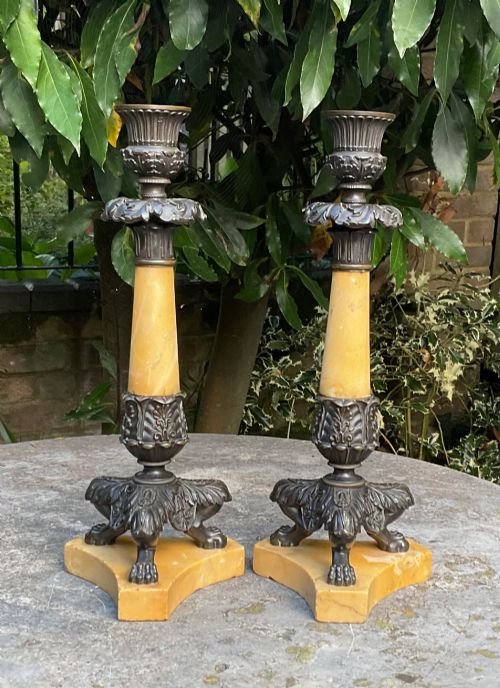


Dark Bronze Candleholders
Dark bronze candleholders combine cast metal and stone in nineteenth-century forms that illuminate period interiors with classical weight.
Dark Bronze Candleholders
When buyers search for dark bronze candleholders, they find nineteenth-century lighting items cast in patinated bronze, often paired with marble plinths or gilt metal mounts. The examples seen here span the Regency period through to the late nineteenth century, taking the form of both single candlesticks and multi-branched candelabra.
French Empire and Régence styles dominate the selection, alongside Renaissance Revival, Venetian, and Chinoiserie designs. Buyers most frequently meet matched pairs configured as classical columns, figural sculptures, or architectural supports holding a single candle socket or branching arms.
How they were made
Maker-craftsmen utilised lost-wax or sand-casting techniques to shape the metal components, producing crisp details on figures, foliage, and architectural bases. They then applied chemical patination to achieve the characteristic dark surface tones on the bronze.
Many pieces incorporate contrasting materials such as ormolu, gilt bronze, and polished sienna marble plinths. The components were mechanically joined with threaded screws and pins, allowing mixed media assemblies to maintain structural stability.
Listings show dark bronze candleholders paired with sienna marble, white marble, ormolu, and gilt metal across the nineteenth century.
What varies in quality
The choice and preparation of associated materials separates standard production from superior examples. High-grade items feature finely turned marble bases, well-gilded ormolu accents, and substantial metal weight rather than hollow or thin castings.
The Dark Bronze Candleholders Glossary
- Patinated bronze
- Bronze treated with chemical solutions to produce a dark, uniform surface finish rather than a bright metallic shine. This dark coating protects the underlying alloy and defines the classic appearance of nineteenth-century metalwork.
- Ormolu
- Finely ground gold amalgam applied to a bronze base metal through fire-gilding. The technique creates a rich, durable golden surface that contrasts sharply against dark patinated bronze.
- Sienna marble
- A yellow-brown Italian marble featuring dark grey or purple veining, frequently utilised for the plinths and bases of Regency and Empire lighting.
- Pricket candlestick
- A candlestick featuring an upward-pointing metal spike designed to impale the base of a wax candle, rather than sitting inside a socket. This form appears often in ecclesiastical and revival metalwork.
- Candelabra
- A branched lighting fixture designed to hold multiple candles simultaneously. These pieces often feature removable upper branches to convert the object into a standard single candlestick.
Dark Bronze Candleholders: Frequently Asked Questions
How do I clean dark bronze candleholders?
Dust the surfaces gently with a soft, dry brush to remove particulate matter without disturbing the dark patination. Avoid commercial metal polishes or water, which can strip the chemical patination and damage adjacent marble components.
For stubborn grime, apply a minimal amount of microcrystalline wax with a soft cloth and buff lightly. This protects the bronze finish from atmospheric moisture while preserving the historical surface.
Were these used on dining tables?
Nineteenth-century households placed pairs of bronze candlesticks and candelabra on mantelpieces, sideboards, and pier tables rather than dining surfaces. Their substantial metal and marble weight made them stable ornamental fixtures for rooms lit by multiple light sources.
Multi-branched candelabra provided functional illumination for evening entertaining when positioned around principal reception rooms. Their sculptural forms ensured they remained decorative objects during daylight hours.
How do I date a bronze candlestick?
Examine the casting quality, assembly methods, and stylistic motifs to determine the period of manufacture. Regency and Empire pieces from the early nineteenth century favour strict classical proportions, whereas later Victorian examples often incorporate revivalist or figural elements.
Tool marks on the underside of the base and the composition of the internal fixing screws provide further clues. Hand-finished chasing on the bronze surface generally points to earlier nineteenth-century production.