
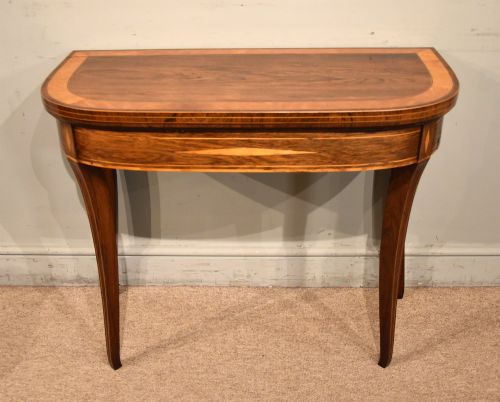

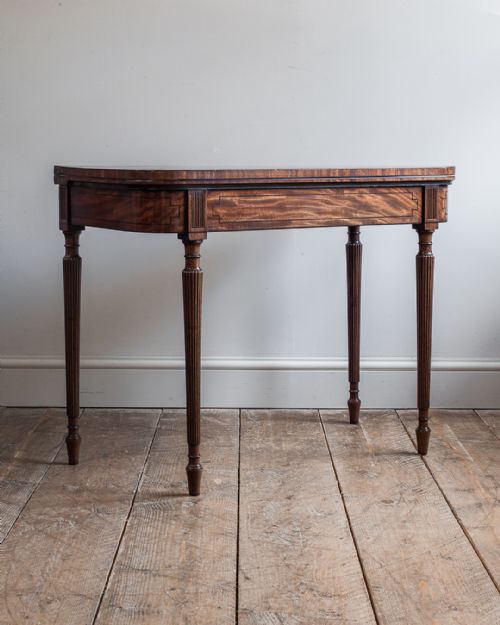


D Shaped Card Table
A d shaped card table provides a folding top for parlour games and evening entertainment, taking a neat flat form against the wall when closed.
D Shaped Card Table
When you examine a d shaped card table, you look at a versatile piece of furniture designed to sit flat against a wall with a straight back and a curved, semi-circular front. When the hinged top opens, it reveals a baize-lined playing surface supported by swing legs or a pivoting rear leg.
The versions you meet most frequently on this page date from the Georgian, Regency, and Victorian periods, constructed mainly in mahogany, rosewood, and burr walnut. These tables served for cards, chess, and general social assembly in drawing rooms across Britain.
Alongside traditional card tables, the selection includes related forms such as tea tables, side tables, and games tables that share the characteristic semi-circular or serpentine footprint. Makers ranged from provincial cabinet makers to renowned workshops like William Trotter of Edinburgh.
How they were made
Cabinet makers utilised solid timber frameworks veneered with figured hardwoods such as mahogany, burr walnut, and rosewood to achieve rich grain patterns on the folding tops. Contrast timbers like satinwood and boxwood formed delicate stringing and geometric inlay around the borders.
Techniques relied on precise joinery for the pivoting hinges and folding leaves, ensuring the top sat perfectly level when open. Carved details appeared on pedestal columns and cabriole legs during the Victorian era, while Georgian examples favoured straight tapered legs or turned supports.
D Shaped Card Table Retail Price Guide 2026
Typical asking prices for d shaped card table among the pieces listed under this phrase on Sellingantiques today, from the lower quarter to the upper quarter. They describe what is for sale here now, not the wider market.
Some tables hide compartments beneath the folding top once designed exclusively for heavy eighteenth-century playing cards and ivory counters.
What varies in quality
The distinction between standard examples and the finest pieces lies in the choice of timber veneer and the crispness of the inlay work. Highly figured burr walnut or meticulously matched satinwood banding indicate a higher grade of manufacture from the workshop.
Structural stability in the pivot mechanism and the precise alignment of the fold-over top separate superior pieces from simpler utilitarian tables. Original polished surfaces and subtle brass fittings retain the integrity valued by collectors.
William Trotter of Edinburgh·Sampson Mordan
The D Shaped Card Table Glossary
- D-shaped
- Descriptive of a table with a straight back edge designed to stand against a wall and a curved front resembling the letter D.
- Demi-lune
- A half-moon shape used to describe the curved top and frame of console and card tables.
- Fold-over top
- A hinged wooden leaf that doubles the surface area of the table when opened for games or dining.
- Serpentine
- A curved line with a convex centre flanked by concave curves, frequently seen on Victorian and Georgian table fronts.
- Marquetry
- Decorative patterns formed by inserting pieces of contrasting veneer into a wood foundation.
D Shaped Card Table: Frequently Asked Questions
What was a d shaped card table used for?
These tables served primarily for evening parlour games such as whist, quadrille, and hazard. The folding top provided a baize-covered playing surface protected from dust and wear when closed.
Between gaming sessions, the furniture doubled as a side table or console against the drawing room wall, often holding lamps or decorative ornaments.
How do I tell a Georgian table from a Victorian one?
Georgian tables tend to feature cleaner architectural lines, straight tapered legs, and subtle mahogany or satinwood veneer work. They reflect the classical proportions popular during the eighteenth century.
Victorian versions frequently employ burr walnut, heavier pedestal bases, serpentine curves, and more elaborate marquetry or carving. The wood selection often displays bolder, highly figured grain patterns.
Why does the top fold over?
The folding leaf allowed the furniture to occupy minimal space against a wall when not in use. Opening the top revealed the hidden playing well and doubled the surface area for guests.
A hinged flap or rotating pivot mechanism supported the second leaf securely once unfolded for play.
Where should I place it in a modern room?
The flat back makes a d shaped card table ideal for hallways, narrow living room spaces, or against feature walls where deep furniture would obstruct movement. Placing it closed beneath a mirror or painting highlights the curved front.
Opening the top occasionally creates a functional console or impromptu desk space without dominating the room.