




Curved Marquetry Commode
A curved marquetry commode brings sweeping lines and intricate wood patterns into a room, offering both sculptural presence and deep drawer storage.
Curved Marquetry Commode
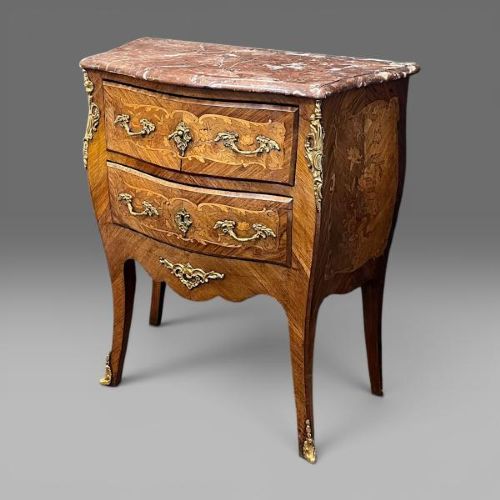
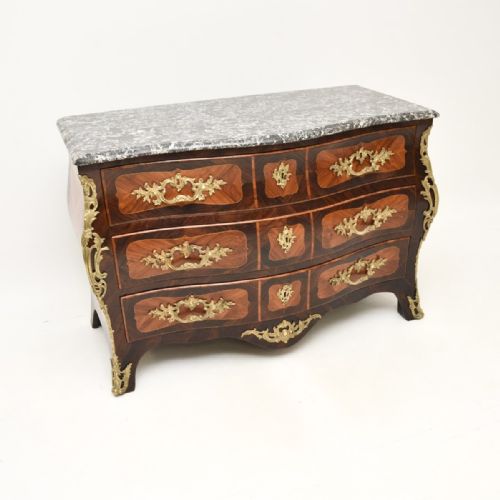
When you search for a curved marquetry commode, you encounter sophisticated case furniture defined by swelling serpentine or bombé contours and patterned wood veneers. These pieces function primarily as statement storage units in reception rooms or bedrooms, often finished with decorative stone tops.
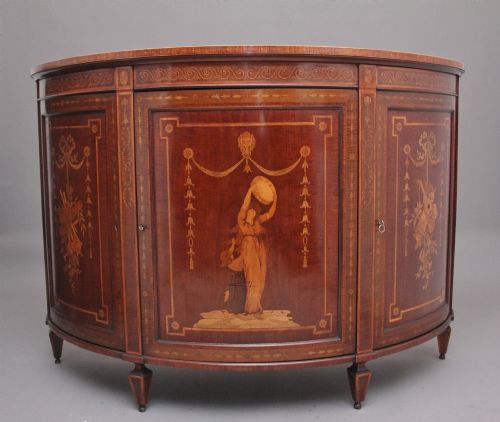
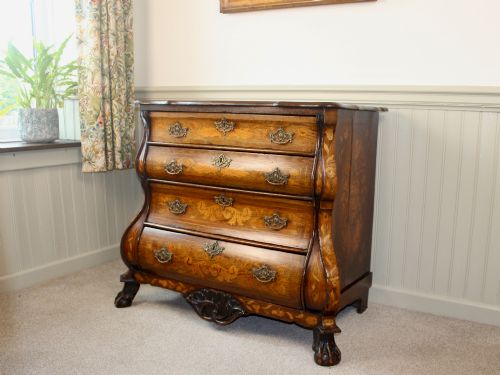
The selections span from eighteenth-century origins through nineteenth-century revivals up to twentieth-century interpretations, showing strong French and Dutch influences. Forms range from deep three-drawer chests to side cabinets and demi-lune shapes featuring elaborate floral or geometric inlays.
Materials and Construction
Cabinet makers utilised dense structural timbers such as oak, mahogany, and walnut to form the curved carcase and supporting framework. Over these resilient foundations, they laid decorative veneers of kingwood, satinwood, rosewood, and tulipwood to build the surface patterns.
Craftsmen applied contrasting wood veneers in intricate floral and geometric marquetry designs across the curved drawer fronts and side panels. Metal mounts in ormolu and brass frequently accent the corners, handles, and feet, whilst shaped slabs of marble complete the tops of many examples.
Curved Marquetry Commode Retail Price Guide 2026
Typical asking prices for curved marquetry commode among the pieces listed under this phrase on Sellingantiques today, from the lower quarter to the upper quarter. They describe what is for sale here now, not the wider market.
The listings span from the early eighteenth century through to the mid-twentieth century, featuring materials such as walnut, satinwood, kingwood, and marble.
Markers of Quality
The standard of a curved marquetry commode rests heavily on the precision of the veneer work and how smoothly it follows the complex contours of the frame. Superior examples display seamless integration of floral patterns across opening drawers without disruption to the visual flow.
Subtlety in the cast ormolu mounts and the weight of the marble top also separate standard items from finer works. The structural integrity of the curved carcase and the snug fit of the drawers indicate the level of care taken by the original maker.
Jacques Bircklé·James Hicks·Mercier Frères
The Curved Marquetry Commode Glossary
- Marquetry
- The art of applying decorative pieces of veneer to a structure to form intricate pictures or patterns. It differs from parquetry through its use of pictorial floral or scroll designs rather than geometric grids.
- Bombe
- A swelling, outward-curving contour found on the sides and fronts of eighteenth-century case furniture. This bulging shape requires advanced woodworking skills to ensure the drawers still operate smoothly.
- Ormolu
- Gilt bronze mounts used extensively on decorative furniture to highlight corners, feet, and key escutcheons. The metal is cast and then gilded to provide a bright metallic contrast against dark wood veneers.
- Demi-Lune
- A half-moon shape used for the ground plan of console tables and side cabinets. This curved outline allows the furniture to sit flat against a wall whilst projecting gracefully into the room.
Curved Marquetry Commode: Frequently Asked Questions
Where should I place a curved marquetry commode?
These decorative chests suit hallways, drawing rooms, or master bedrooms where their curved profiles can be viewed from multiple angles. They serve as focal points against plain walls rather than being crowded among other heavy furniture.
Because many examples feature polished stone tops or delicate wood inlays, keep them away from direct sunlight and damp environments to protect the fragile veneers and polished surfaces.
How do I care for the wood and marble surfaces?
Dust the marquetry regularly with a soft, dry cloth and apply occasional specialised wax to maintain the moisture in the antique wood. Avoid silicone sprays and excessive moisture which can lift the delicate veneer layers.
Marble tops require simple cleaning with a damp cloth and mild soap. Prevent acidic liquids like wine or citrus juice from resting on the stone to avoid permanent etching.
How can I tell an eighteenth-century piece from a later revival?
Eighteenth-century examples typically show hand-cut dovetails, older timber shrinkage, and subtle signs of hand-tooling on the secondary interior woods. The specific species of carcase wood often matches the regional origin of that period.
Revival pieces from the nineteenth and twentieth centuries often employ more uniform machine-sawn elements and standardised fixings while faithfully copying the earlier Louis styles and floral marquetry.
What is the difference between marquetry and parquetry?
Marquetry involves cutting and fitting various coloured wood veneers to create pictorial scenes, foliage, or organic scrolls across the curved surfaces. It creates flowing, painterly designs across the front of the cabinet.
Parquetry uses geometric pieces of wood to form repeating patterns like cubes, chevrons, or squares. Both techniques decorate high-status furniture but achieve entirely different visual textures.