

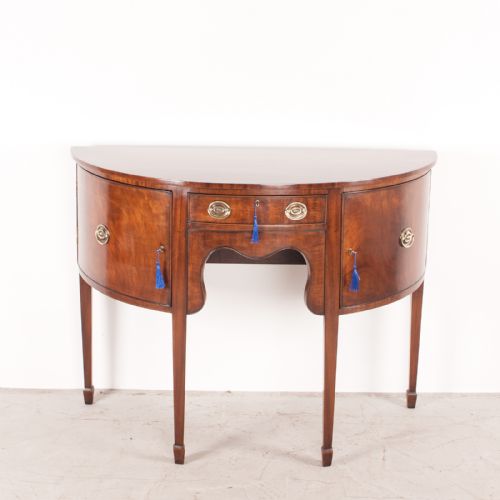


Curved Mahogany Console Table
These curved mahogany console table pieces offer rich grain and fluid lines, designed to anchor a hallway or reception room with elegance.
Curved Mahogany Console Table
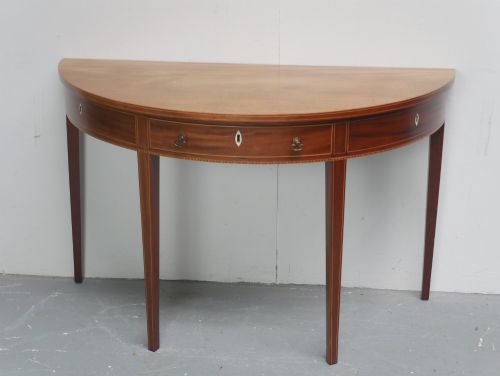
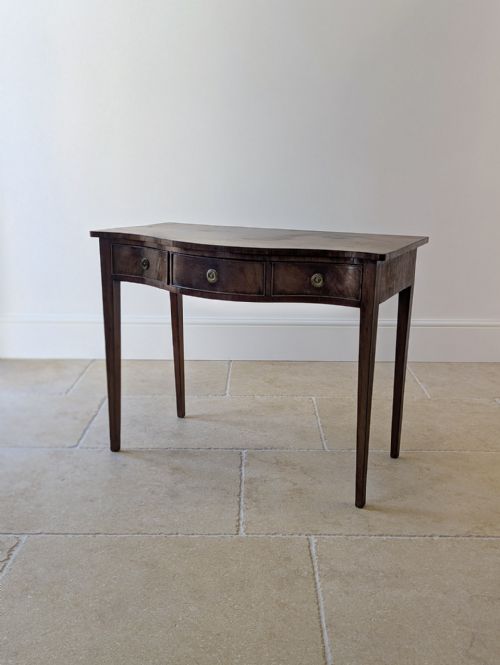
A curved mahogany console table brings formal architectural presence to an interior, shaped in semi-lune, serpentine, or bow front profiles. These forms sit flat against a wall, making them practical for narrow spaces like hallways or drawing rooms.
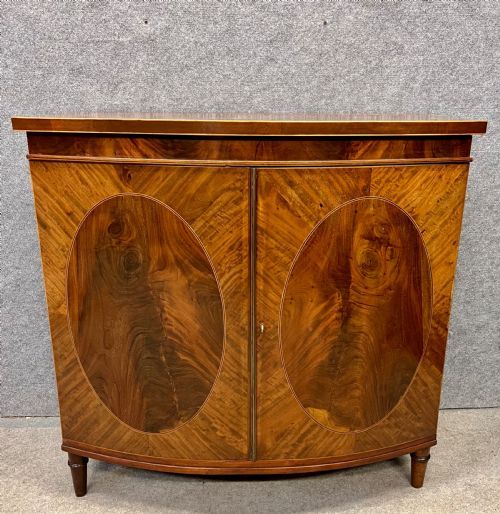
The selection ranges from 18th century Georgian examples to later revivals from the Edwardian and Regency periods. Alongside standard console tables, the related forms appearing here include side tables, sideboards, and demi-lune cabinets sharing the characteristic curve and timber.
How they were made
Makers utilised solid and figured mahogany, often enhanced with satinwood inlay, boxwood stringing, or brass mounts. These dense timbers were shaped into sweeping curves for tops and friezes, demanding precise woodworking skill.
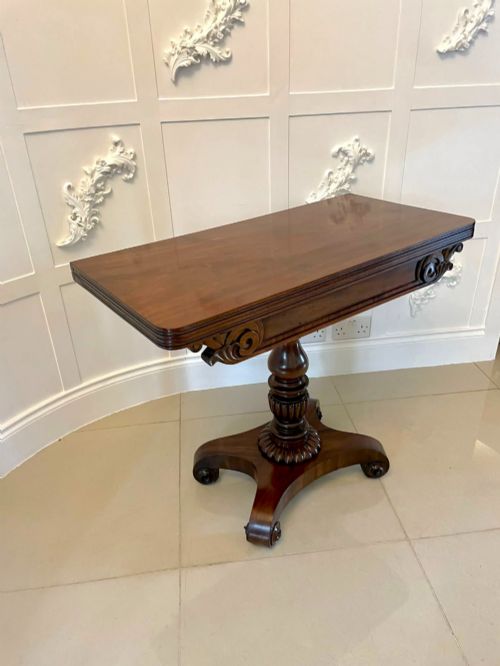
Surfaces frequently feature polished mahogany veneers selected for rich grain patterns, sometimes paired with marble tops or resting on brass feet.
The furniture spans from the 18th century through the Georgian, Regency, Victorian, and Edwardian eras into the early 20th century.
What varies in quality
Quality rests in the selection of figured mahogany timber and the crispness of the secondary inlay work, such as satinwood and boxwood details. Better examples display careful alignment of grain along curved surfaces and refined proportions.
The sophistication of the structural joinery and the integration of secondary materials like brass or marble distinguish finer pieces from simpler revival items.
The Curved Mahogany Console Table Glossary
- Demi-Lune
- A half-moon shape used for the tops and frames of console tables and sideboards. This profile allows the piece to fit flush against a wall while offering a curved front.
- Serpentine
- A gently undulating line curving outward in the centre and inward at the sides, or vice versa. It adds movement and complexity to mahogany furniture fronts.
- Bow Front
- A convex curved front that projects outward in a smooth arc. This form appears frequently on sideboards and console tables from the Georgian and later periods.
- Satinwood Inlay
- Contrasting light golden wood inserted into darker mahogany surfaces in decorative patterns. It defines borders and central motifs on revival and period pieces.
- Frieze
- The horizontal band running directly beneath the tabletop, sometimes fitted with drawers. On these tables, the frieze follows the curve of the piece.
Curved Mahogany Console Table: Frequently Asked Questions
Where should I place a curved console table?
These tables suit narrow entrance halls, living rooms, or dining spaces where a shallow footprint is necessary. Their curved profiles soften linear room layouts.
Because they sit flush against a wall, they provide a surface for lamps or decorative objects without obstructing pathways.
How do I identify a Georgian piece?
Look for construction traits such as hand-cut dovetails in drawer construction and timber choice like solid mahogany and subtle stringing. Period pieces often exhibit natural patination accumulated over centuries.
Revival pieces from later eras frequently incorporate similar forms but display different interior secondary woods and manufacturing uniformity.
What is the difference between a console and a side table?
Console tables are traditionally designed to stand against a wall, sometimes requiring fastening for stability depending on their leg configuration. Side tables are generally freestanding and can be moved around a room more easily.
In practice, curved variations of both types overlap significantly in how they are used within domestic interiors.
How do I care for mahogany furniture?
Keep mahogany pieces away from direct heat sources and strong sunlight to prevent the timber and polished finish from fading. Regular dusting with a soft, dry cloth preserves the surface lustre.
Avoid using silicone-based polishes, opting instead for traditional wax when the wood requires nourishment.