



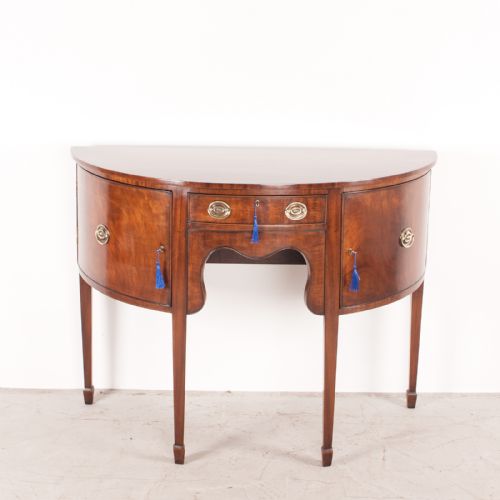


Curved Front Mahogany Table
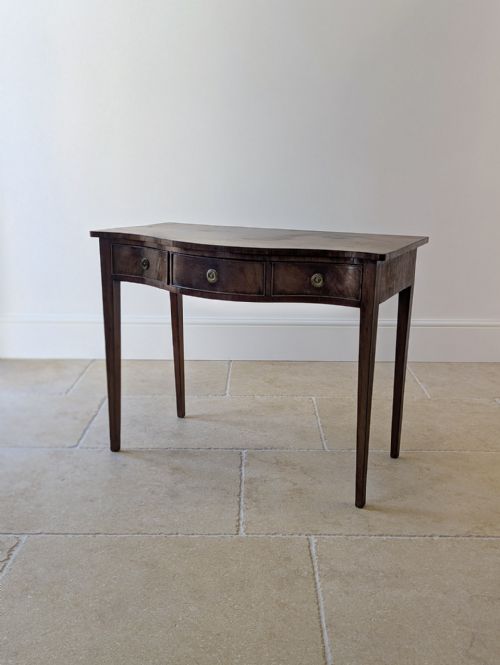
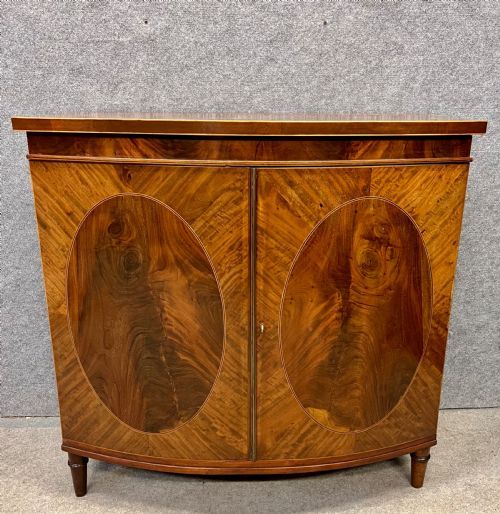
A curved front mahogany table is a piece of furniture defined by its rounded silhouette and rich timber, built for dining rooms, bedrooms and hallways alike.
Curved Front Mahogany Table
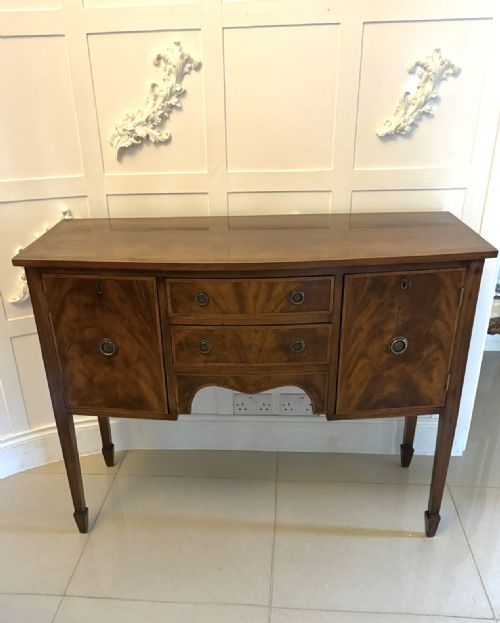
When you search for a curved front mahogany table, you are looking at a broad group of dining and serving furniture that includes sideboards, side tables, desks and bedside cabinets. The most frequent versions on this page take the form of bow front and serpentine sideboards dating from the Georgian, Regency and Edwardian eras.
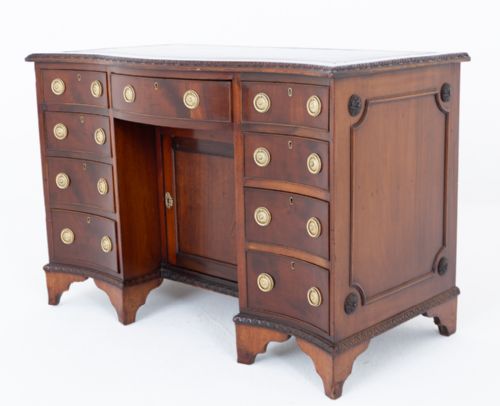
The selection ranges from large Georgian and Regency serving pieces down to smaller George III dressing tables, nightstands and side tables. Makers and workshops of the eighteenth and nineteenth centuries utilised the curved format to soften the geometry of rooms while providing practical surface area and storage.
Cabinet makers also applied the shape to writing desks, cylinder desks and corner cabinets, creating versatile furniture designed to fit snugly against walls or in corners. These pieces bridge the gap between formal dining rooms and private studies, showing various interpretations of the bow, serpentine and demi-lune outline.
Distinctions in quality
The standard of the timber itself sets the best examples apart from standard workshop production, particularly the depth of figure in flame mahogany veneer and the precision of the grain matching across curved drawers. Master cabinet makers selected prime cuts that caught the light, whereas lesser pieces relied on plain, flat-cut boards.
Detailing in the stringing and inlay also marks out superior pieces, with crisp boxwood and satinwood lines following the tight curves of the front without buckling or gaps. The integration of solid brass hardware and the neatness of the interior carcase joinery further separate standard utility furniture from pieces produced by notable makers.
The listings span the Georgian, Regency, Victorian and Edwardian periods, showcasing both solid mahogany construction and flame mahogany veneer.
Collinson and Lock·Gillows
The Curved Front Mahogany Table Glossary
- Bow front
- A convex curved cabinet front that projects outward in an arc, softening the linear profile of a sideboard or table. This shape proved popular in Georgian and Regency dining furniture.
- Serpentine
- A shaped front featuring a central convex curve flanked by two concave sweeps, or the reverse. It requires advanced carpentry to execute cleanly on mahogany carcases.
- Demi-lune
- A half-moon shape used for tables and cabinets designed to sit flat against a wall. These pieces often feature tambour doors or folding leaves.
- Flame mahogany
- A veneer cut from the fork of the mahogany tree where the branch meets the trunk, producing a rippling flame-like pattern. Cabinet makers reserved this timber for principal drawer fronts and doors.
- Stringing
- Fine inlay lines of contrasting wood, such as boxwood or satinwood, embedded into the mahogany surface to outline drawers, tops and borders.
Curved Front Mahogany Table: Frequently Asked Questions
What is a curved front mahogany table used for?
These tables served primarily as sideboards for serving food, side tables for display, or writing desks for correspondence. Their curved profiles allowed them to project into a room while saving corner space.
Today, they function well in dining rooms, hallways and living areas, offering surface display space alongside practical drawer and cupboard storage.
How do I tell a Georgian curved front table from a later copy?
Georgian and Regency pieces exhibit hand-cut dovetails, secondary timbers appropriate to the period, and subtle imperfections in the symmetry of the curved carcase. Later Edwardian and revival pieces often show more uniform machine-cut elements and standardised interior fittings.
Examining the backboards, drawer linings and the method used to construct the curved front helps determine the true age of the piece.
How do I care for mahogany furniture?
Protect mahogany from direct sunlight and excessive temperature changes to prevent the veneer from drying out or lifting. Dust regularly with a dry cloth and apply occasional high-quality beeswax to nourish the timber.
Avoid silicone-based sprays, as they build up over time and dull the natural lustre of the polished wood.
What is the difference between a bow front and a serpentine front?
A bow front curves outward in a simple convex arc from side to side. A serpentine front incorporates multiple directional changes, typically curving outward in the centre and inward toward the edges.
Both shapes were utilised on mahogany sideboards and tables to create visual movement and accommodate interior drawer configurations.