
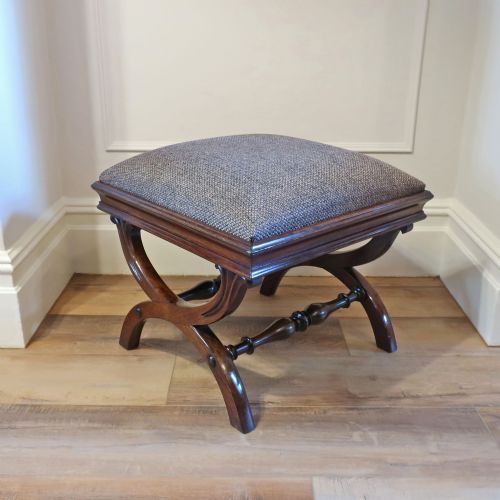
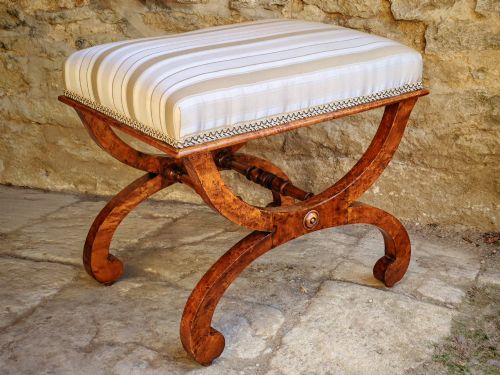


Curule Upholstered Stool
A curule upholstered stool brings classical curule form and X-frame lines into domestic spaces, offering both rigid architectural presence and portable seating.
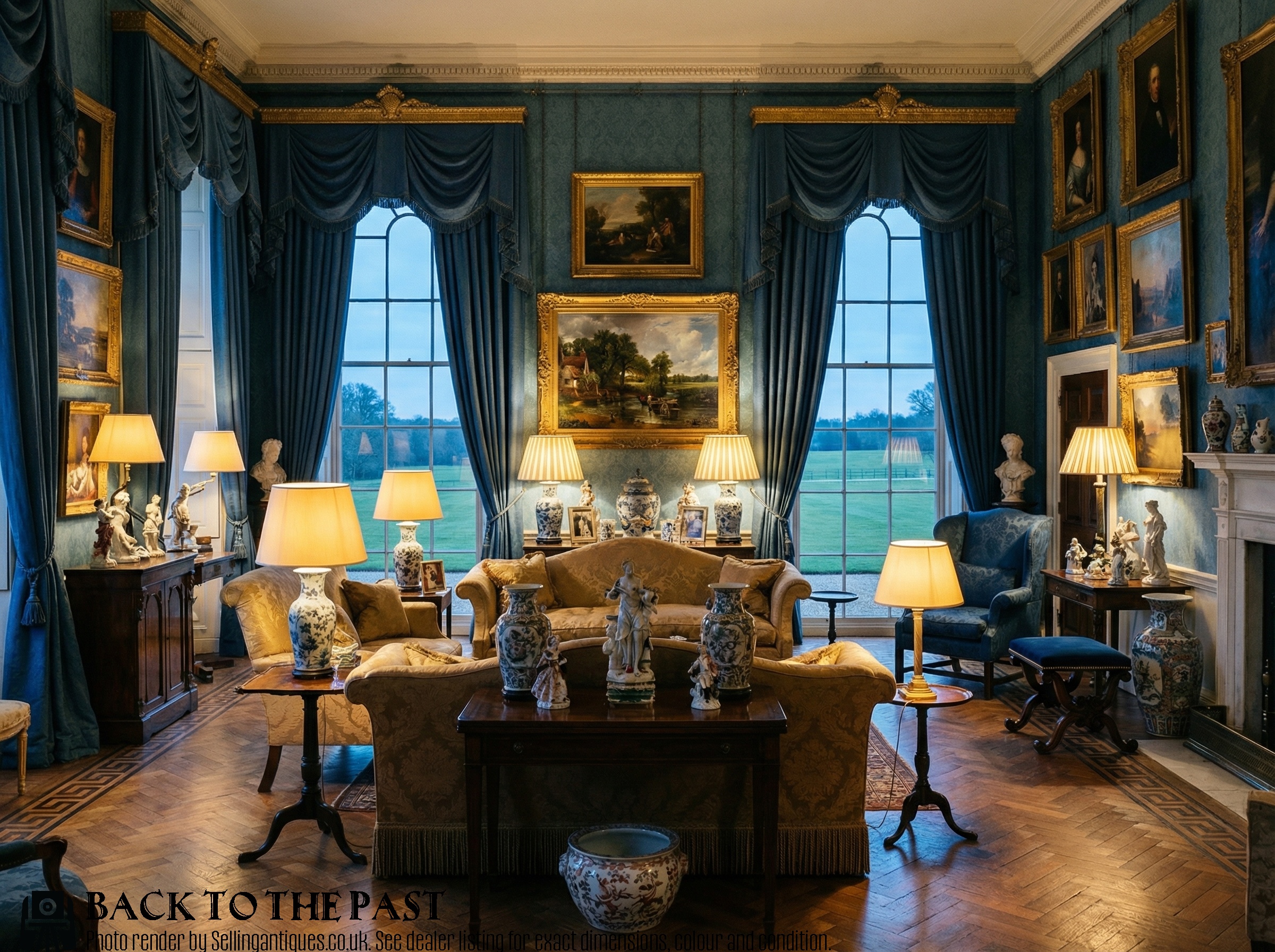
Curule Upholstered Stool
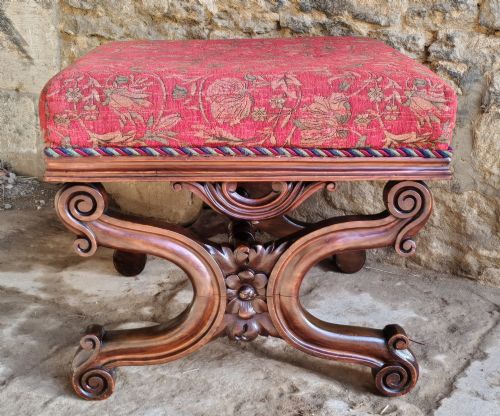
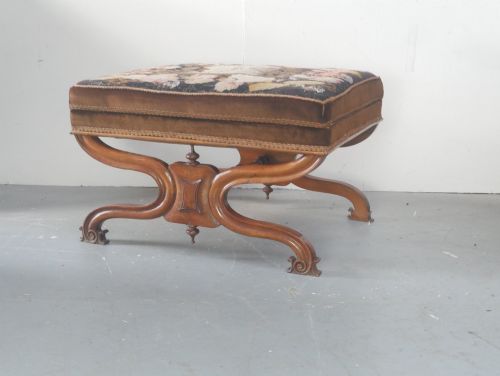
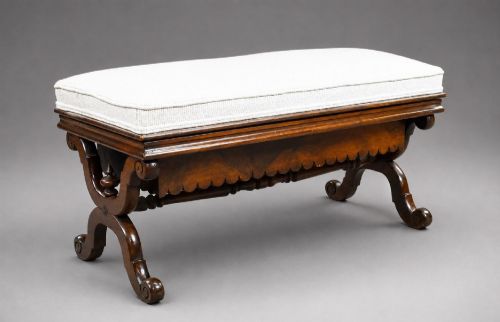
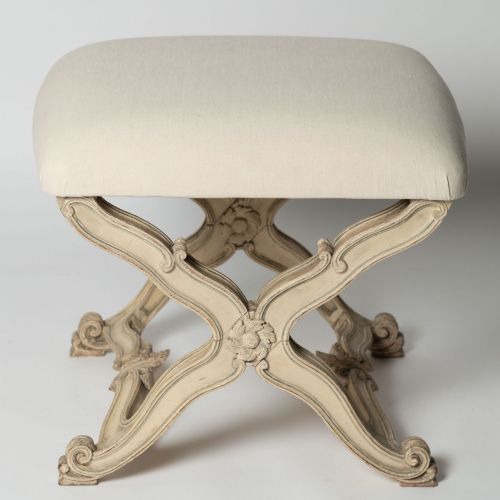
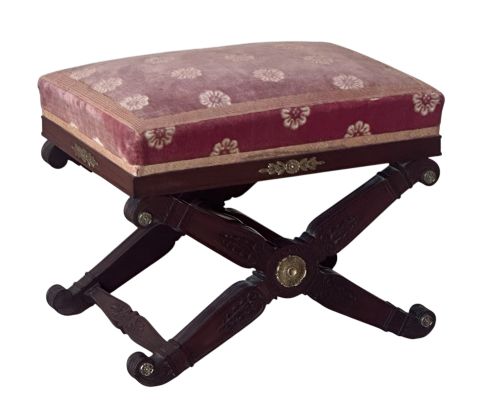
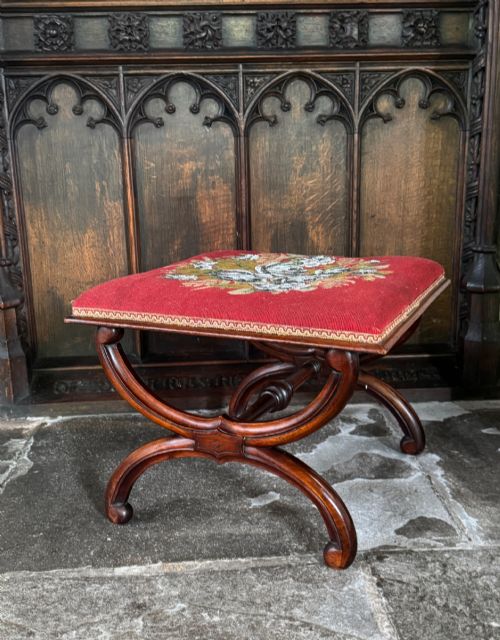
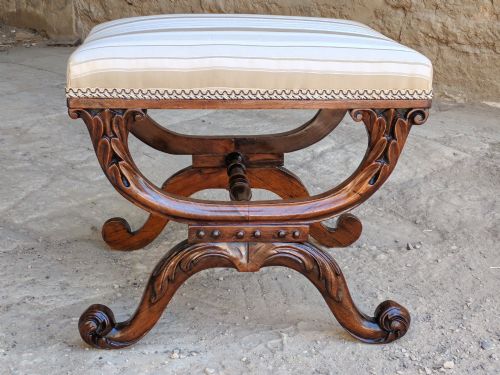
A curule upholstered stool follows a classical X-frame geometry that draws directly on ancient Roman magistral seats, evolving through the Regency, William IV, and Victorian periods. Buyers encounter mahogany, rosewood, and walnut frames supporting textile, beadwork, or leather seats across nineteenth-century examples.
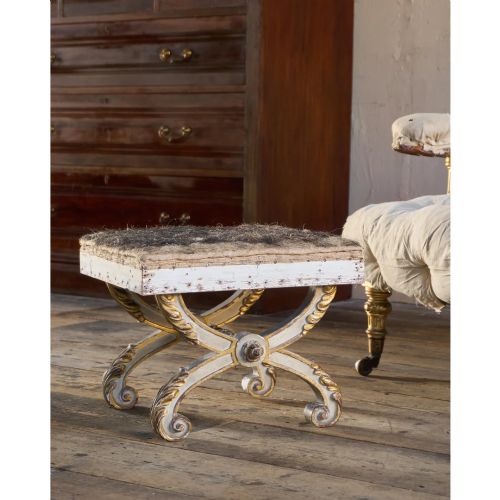
The selection ranges from restrained Georgian and Regency rosewood footstools to ornate Victorian walnut frames featuring carved hunting dog heads or gilt enrichment. French Empire and neoclassical influences appear frequently alongside Scottish Baronial and Edwardian interpretations.
Makers such as Miles & Edwards produced specific iterations of these X-frame stools during the nineteenth century, establishing high standards of cabinet work that collectors seek today. Pieces span from small footstools to broader window seats and dressing stools.
Woods and joinery
Frames rely on dense timbers including mahogany, rosewood, walnut, and burr maple, selected for their grain and structural stability under the stress of intersecting stretcher legs. Ebonised finishes and giltwood appear where makers sought a more dramatic, high-status surface treatment.
Upholstery techniques involve traditional webbing and stuffing finished with fabric, velvet, red damask, or specialised tapestry and beadwork seats. Brass mounts and carved wooden details, such as animal heads or neoclassical foliage, punctuate the primary timber structures.
Materials span mahogany, rosewood, walnut, and burr maple, alongside giltwood and ebonised timber.
Craft and timber selection
Quality rests in the crispness of the timber carving and the architectural proportion of the intersecting X-frames, where tight joints prevent lateral wobble. Superior examples utilise finely figured rosewood, burr maple, or carefully matched mahogany rather than plain secondary woods.
The integrity of the original upholstery platform and the retention of maker signatures or stamps elevate certain pieces above standard production work. Surviving decorative elements, whether gilding, brass highlights, or carved details like hunting dog heads, separate ordinary seating from notable workshop output.
Miles and Edwards
The Curule Upholstered Stool Glossary
- Curule stool
- A seat featuring a folding or fixed X-frame design derived from ancient Roman curule magistrate chairs. This architectural silhouette provides inherent structural strength.
- X-frame
- A form constructed from two intersecting curved or straight timber members that cross to form an X. It serves as the primary structural support for curule stools and window seats.
- Regency
- An English design period spanning the early nineteenth century defined by heavy classical revivalism, archaeological motifs, and dark timbers like rosewood. Pieces from this era often display clean lines and bronze mounts.
- Ebonised
- Wood treated with a dark chemical stain or paint to imitate expensive ebony. This finish became popular during Victorian revivals for creating high contrast against gilt details.
- Giltwood
- Timber coated with gold leaf or metallic paint over a prepared gesso ground. It creates a reflective surface frequently employed on French Empire and neoclassical seating.
Curule Upholstered Stool: Frequently Asked Questions
How do I date an X-frame stool?
Dating relies on timber choice, carving styles, and structural construction methods visible beneath the upholstery webbing. Regency and early nineteenth-century examples often favour rosewood and restrained classical lines.
Later Victorian versions introduce heavier walnut frames, ebonising, or elaborate carvings such as animal heads. Edwardian pieces generally show lighter scantlings and domestic dressing stool proportions.
Where should I place an X-frame stool?
These stools suit positions at the foot of a bed, beneath a dressing table, or serving as extra seating in a drawing room. Their compact footprint allows them to tuck neatly under windows or beside low tables.
Because the curved X-frame presents visual interest from every angle, they work well floating in open room spaces rather than pushed against walls.
Are these stools comfortable for daily use?
Most antique examples provide firm support due to traditional stuffing methods and dense upholstery foundations. They excel as footstools or short-term seats rather than lounging chairs.
When paired with generous padding or tapestry tops, they offer a stable and ergonomic surface for resting legs or sitting briefly while dressing.