
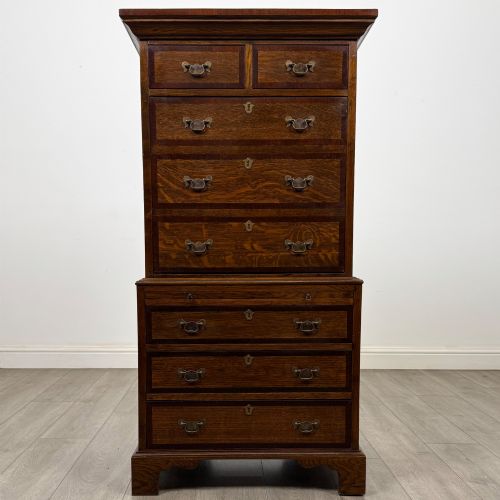
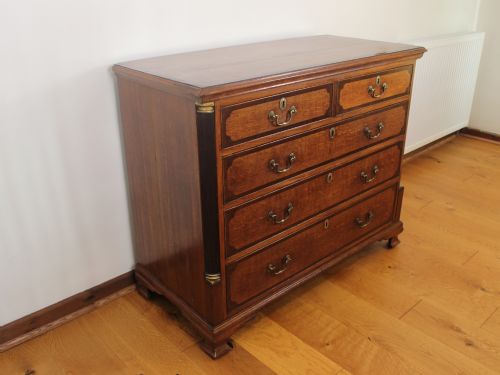


Crossbanded Oak Chest Drawers
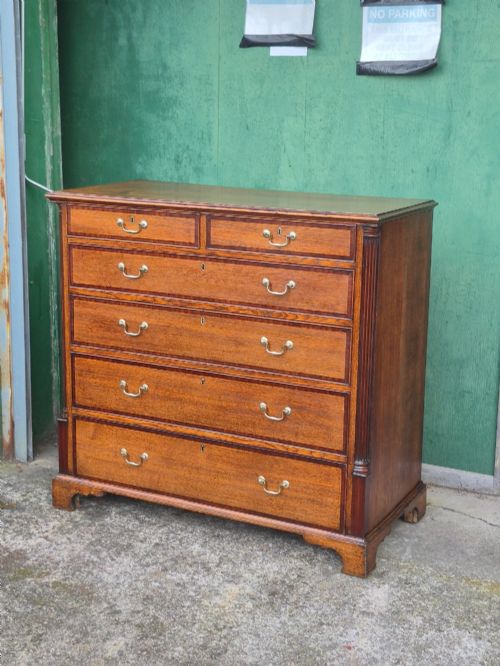
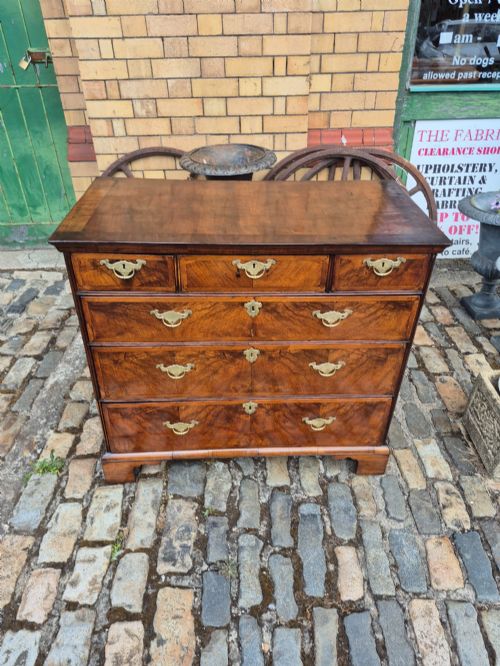
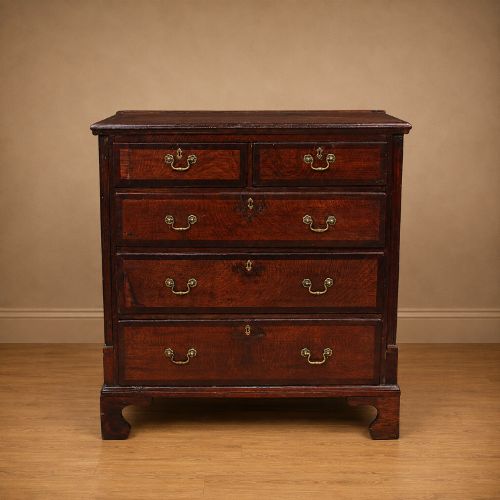
A crossbanded oak chest drawers brings the warm grain of provincial cabinet work together with the sharp border of contrasting timber.
Crossbanded Oak Chest Drawers
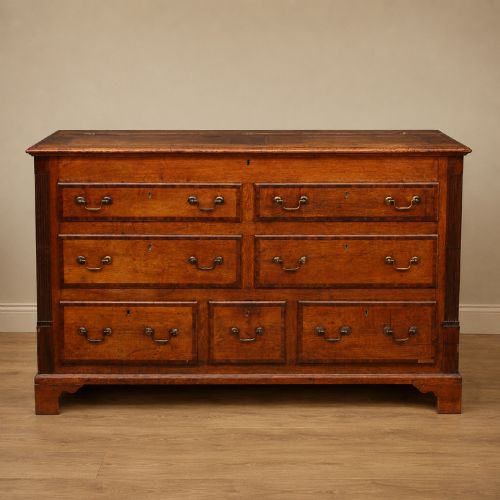
A crossbanded oak chest drawers combines sturdy native timber with decorative border banding, typically seen in Georgian pieces and 18th Century examples. Buyers examining crossbanded oak chest drawers will notice forms ranging from standard chests of drawers to mule chests and tallboys.
The layout most frequently encountered on this page pairs a golden or honey-toned oak carcase with distinct mahogany crossbanding around the drawer fronts. Pieces span the Georgian period, the Regency era, and later revival styles, offering substantial storage alongside crisp linear detail.
Materials and construction methods
Carpenters built the primary carcases using solid oak, often complemented by walnut, fruitwood inlay, or bleached oak surfaces. Drawer linings and secondary timbers frequently incorporate pine or oak.
Makers applied crossbanding by laying thin veneers of mahogany or walnut perpendicularly to the grain of the drawer front, creating a neat frame. Brass handles and escutcheons completed the fronts, secured with traditional iron or steel fixings.
Listings feature oak, walnut, and mahogany, spanning the 18th Century, Georgian period, and Edwardian era.
Assessing quality and proportion
The division between standard and superior pieces rests on the crispness of the crossbanding and the selection of the primary oak timber. Golden oak surfaces with well-matched mahogany borders demonstrate superior cabinet work compared to heavier, later revivals.
Proportion and original brass hardware elevate certain examples, particularly where serpentine fronts or finely figured walnut and oak are involved. Construction depth, such as cleanly dovetailed drawer boxes and intact carcase backs, dictates the lasting integrity of the piece.
The Crossbanded Oak Chest Drawers Glossary
- Crossbanding
- A border veneer applied around the edges of a drawer front so that the grain runs at right angles to the central panel. This technique frames the primary timber and adds visual contrast.
- Mule chest
- A storage piece combining the deep box storage of a blanket chest with one or two drawers at the base. These often feature oak construction with mahogany crossbanding.
- Tallboy
- A tall chest on chest arrangement providing extensive vertical drawer storage. Examples in this tradition pair oak carcases with detailed banding.
- Serpentine
- A curved front shape featuring a convex centre flanked by concave ends. This undulating profile requires skilled shaping of both the solid timber and the banding.
Crossbanded Oak Chest Drawers: Frequently Asked Questions
What periods do these pieces date from?
The selection includes pieces spanning the 18th Century and the Georgian era, alongside Regency examples and occasional Edwardian or 1930s revivals.
Most items date from the late 18th Century around 1780 to 1810, reflecting the height of provincial cabinet work.
How do I maintain an oak chest?
Keep the timber away from direct heat sources and sudden humidity shifts to prevent the solid oak panels from splitting or warping.
Apply a traditional wax polish occasionally to feed the grain and maintain the natural lustre of the crossbanded surfaces.
What is the difference between a mule chest and a standard chest?
A mule chest incorporates a hinged lid opening to a deep upper compartment, sitting above one or more functioning drawers at the base.
A standard chest of drawers relies entirely on a vertical stack of horizontal drawers from top to bottom.
Are the drawer linings original?
Many pieces retain their early oak or soft-wood drawer linings with hand-cut dovetails joining the sides to the fronts.
Later restorations can include repaired drawer bottoms or replaced runners, which remain common in furniture of this age.