
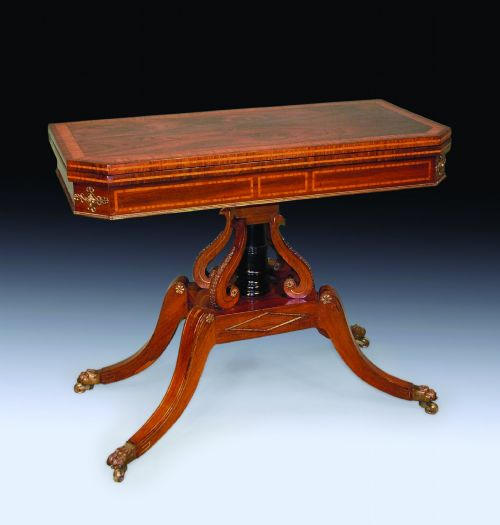
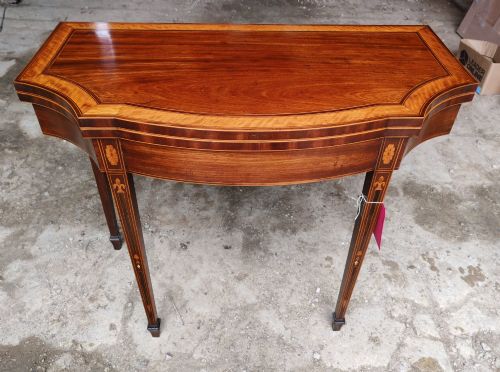


Crossbanded Games Table
A crossbanded games table brings folding tops and contrasting borders together, offering a versatile surface that adapts from card play to display.
Crossbanded Games Table
A crossbanded games table is a dual-purpose piece designed for card playing or board games, featuring a hinged top that folds open to reveal a baize-lined playing surface. When closed, it functions as a console or side table, making it a practical addition to period drawing rooms.
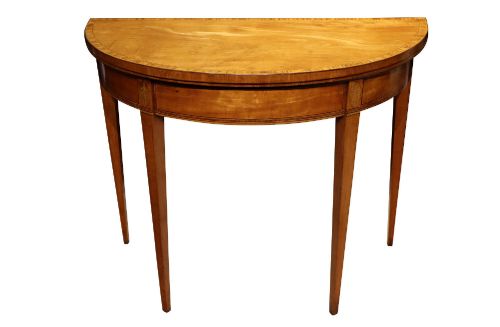
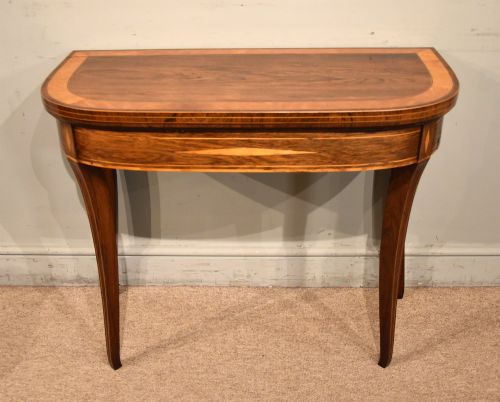
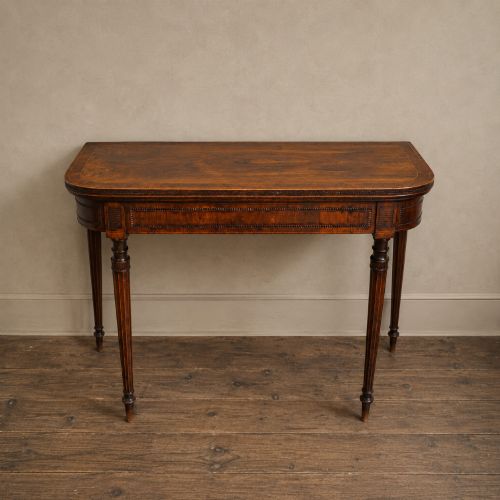
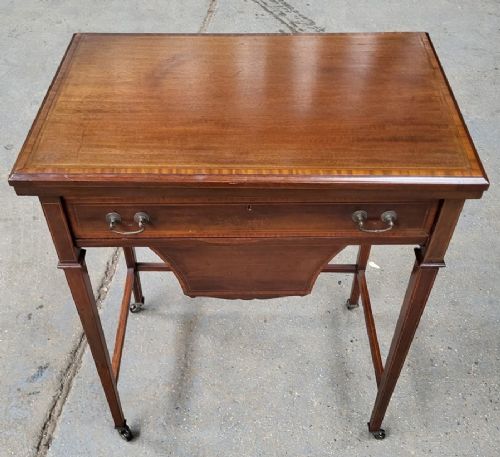
The pieces on this page span several distinct periods including Georgian, Regency, and Edwardian eras. Common forms encompass demi-lune card tables, fold-over tea tables, and combination games and sewing tables.
Makers utilised various silhouettes such as rectangular tops, serpentine shapes, and scroll pedestal bases. Timbers like mahogany, rosewood, and satinwood dominate the construction across these historical examples.
What varies in quality
The choice of secondary timbers and the precision of the veneer matching dictate the standard of execution. Superior examples display seamless grain alignment across the fold and crisp, contrasting borders that remain flush with the primary surface.
Underpinnings range from simple straight legs to elaborate scroll pedestal bases and turned columns. The carving detail on mounts and the smooth operation of folding mechanisms distinguish workshop output.
Some Edwardian sewing tables doubled as clandestine gambling spots, hiding card counters beneath compartments for cotton reels.
William Trotter of Edinburgh·Lamb of Manchester
The Crossbanded Games Table Glossary
- Crossbanding
- A border of veneer laid with the grain running perpendicular to the main panel. This frames the top surface of the table with a contrasting border.
- Demi-lune
- A half-moon shape with a curved front and a straight back edge. These tables fit flat against a wall when closed.
- Stringing
- Thin inlaid lines of contrasting timber used to outline panels and borders. It provides a linear accent alongside the broader crossbanding.
- Fold-over
- A hinged top design that doubles the surface area when opened. It conceals a concealed well or playing surface underneath.
- Baize
- A coarse woollen fabric traditionally used to line gaming surfaces. It provides a soft, durable texture for card play.
Crossbanded Games Table: Frequently Asked Questions
How do you open a games table?
Most fold-over tables utilise a hinged top that lifts and rotates on a pivoting pivot or swings out on a gate leg. The underlying framework supports the leaf when extended.
Care must be taken to support the weight evenly during movement to protect the original hinges and pivot joints.
What is crossbanding?
Crossbanding is a decorative technique where a border of veneer is applied to the perimeter of a table top with the grain running transversely to the centre panel. It creates a defined visual frame.
Cabinet makers often combined this with dark and light stringing lines to accentuate the geometric form of the piece.
Where were games tables placed?
These tables stood against drawing room walls as decorative console surfaces when not in use for entertainment. They moved into the centre of the room when guests gathered for cards.
Their dual functionality made them essential furniture for entertaining in period homes.
How do I date a games table?
Dating relies on observing the combination of primary timbers, leg styles, and inlay techniques. Georgian pieces often show straight tapered legs, while Regency examples feature pedestal bases and rosewood veneers.
Edwardian interpretations frequently adopt lighter satinwood finishes and revival proportions.