




Crimson Embroidered Textile
These crimson embroidered textile pieces range from Ottoman waistcoats to large Central Asian suzanis, bringing rich colour and historic needlework directly into your home.
Crimson Embroidered Textile
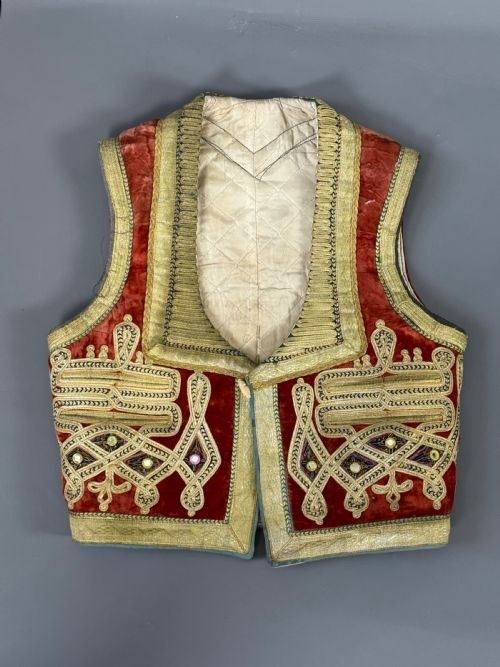
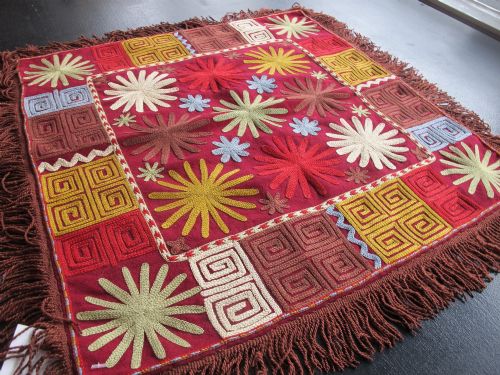
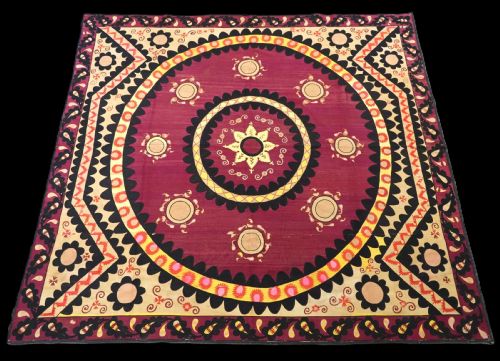
A crimson embroidered textile brings together centuries of hand needlework across diverse regional traditions, most frequently appearing here as Central Asian suzanis, Ottoman waistcoats, and decorative wall hangings. These items range from large, fully embroidered covers with central stars to smaller framed fragments, all unified by their distinctive red ground and decorative threadwork. You will encounter nineteenth-century examples alongside seventeenth-century fragments, demonstrating a rich continuity of textile arts.
The regional origins of these works span from Uzbekistan and Turkey to Greece, each bringing distinct cultural motifs and construction methods to the crimson palette. Central Asian pieces often showcase intricate floral or geometric arrangements, while Ottoman items utilise rich velvet and metal-thread embellishments. Buyers frequently select these textiles to serve as striking wall hangings, table covers, or mounted display panels.
How they were made
Makers constructed these textiles using foundational cloths of silk, cotton, wool, or velvet, onto which they applied extensive surface decoration. Silk thread and metallic thread provide the primary medium for the intricate needlework, often combined to create raised patterns and contrasting textures. Additional embellishments such as glass beads and brass elements frequently enhance specific regional types like bell pulls and waistcoats.
Stitching techniques vary according to origin, encompassing dense tambour work, flat couching, and intricate surface embroidery that covers the entire ground cloth. Artisans worked by hand to build up complex compositions of botanical and geometric motifs across large suzanis and smaller panel fragments alike. The durability of these pieces relies upon the quality of the base weave and the tightness of the historical stitching.
Some nineteenth-century waistcoats arrived carrying the personal hand-stitches of makers who clearly enjoyed experimenting with stray glass beads.
What varies in quality
Quality in a crimson embroidered textile rests upon the density of the needlework and the complexity of the design layout. Fully embroidered panels that completely cover the ground fabric require significantly more artisan labour than sparser compositions. The precision of the stitch work and the harmonious integration of secondary colours against the red background distinguish finer examples.
The preservation of the base materials, whether silk, velvet, or cotton, dictates the overall integrity of the piece. Superior items retain vibrant thread colours and secure beadwork or metal threads with minimal loss. The historical significance and clarity of regional motifs, such as those found on Tashkent palak suzanis or Ottoman coverlets, further elevate an example.
The Crimson Embroidered Textile Glossary
- Suzani
- A large, embroidered tribal hanging from Central Asia, traditionally made by brides as part of their dowry. These pieces typically feature bold floral and sunburst motifs worked in silk on a cotton or linen ground.
- Bell pull
- A long, narrow decorative strip suspended in Victorian homes to summon servants via a mechanical bell system. They frequently incorporate needlework, beads, and brass hardware.
- Palak
- A specific type of Tashkent suzani characterised by a fully embroidered dark ground, often featuring a central star surrounded by botanical medallions.
- Couching
- An embroidery technique where threads are laid across the surface of the fabric and secured in place by small transverse stitches using a secondary thread. This method efficiently utilises expensive metal or silk threads.
- Tambour work
- A form of chain stitch embroidery created using a fine hook rather than a needle, worked through stretched fabric to produce continuous, rapid loops.
Crimson Embroidered Textile: Frequently Asked Questions
How were antique suzanis used originally?
Central Asian families utilised large suzanis primarily as wall hangings, decorative covers, or wrapping cloths for household goods and bedding during transport.
Communities also prized them as ceremonial items, often commissioning them for weddings and family milestones as displays of wealth and needlework skill.
How do I hang a textile securely?
Mounting large textiles safely requires distributing the weight evenly across a padded wooden batten or conservation-grade Velcro system to prevent distortion.
Avoid piercing the antique fabric directly with nails or staples, instead using a gentle sleeve or archival stitching method to support the piece.
How do I distinguish regional styles?
Central Asian suzanis tend to display large, bold floral medallions and sunbursts, whereas Ottoman textiles often favour dense velvets and metallic thread embellishments.
Greek folk art and European Victorian pieces utilise entirely different palettes, motifs, and base materials like beadwork and wool.
How should I care for historic embroidery?
Protect delicate silk and metal threads by keeping antique textiles away from direct sunlight and high humidity, which cause fading and fibre degradation.
Surface dust should be removed very gently with low suction through a mesh screen, avoiding any traditional washing or immersion.