

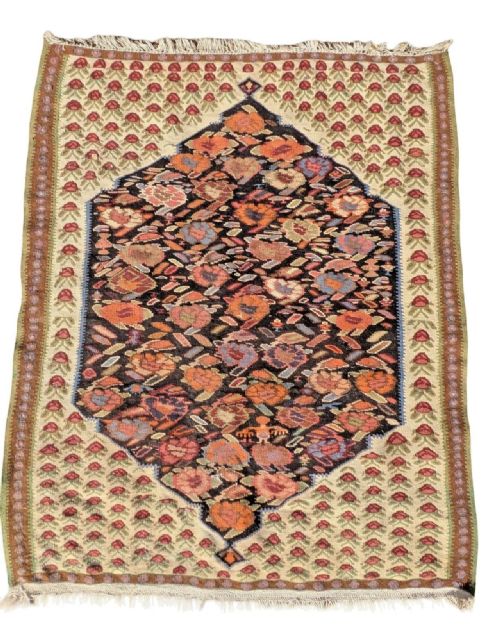


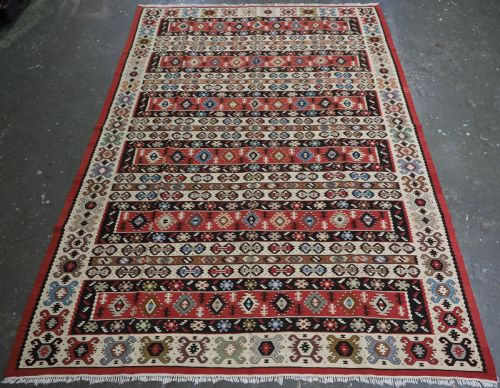

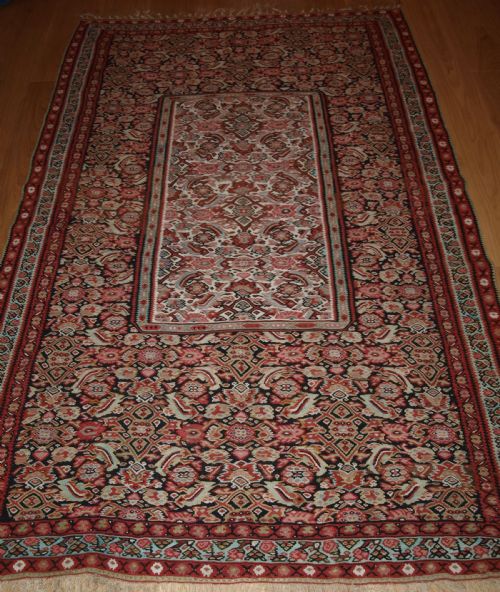


Cream Wool Tapestry Rug
These cream wool tapestry rug options bring tactile warmth and patterned historic charm to floors.
Cream Wool Tapestry Rug
When you search for a cream wool tapestry rug, you are looking at woven and needleworked floor coverings and wall hangings rooted in traditional European and Asian textile centres. These pieces span from the mid nineteenth century through the early twentieth century, showing distinct regional aesthetics.
You are most likely to meet flatweave kilims, needlepoint panels, and French woven carpets on this page. They combine wool with cotton, canvas, or silk elements to create decorative surfaces featuring geometric bands, floral motifs, or pictorial portraits.
How they were made
These textiles rely principally on wool and cotton foundations, utilising flatweave or needlepoint techniques. Artisans worked wool yarns across canvas or woven cotton backings, incorporating silk details in specific pictorial or fine regional examples.
The construction methods range from tightly knotted pile work in Persian pieces to flatweave slit-tapestry techniques in Balkan kilims and needlework stitches on Portuguese needlepoints.
Cream Wool Tapestry Rug Retail Price Guide 2026
Typical asking prices for cream wool tapestry rug among the pieces listed under this phrase on Sellingantiques today, from the lower quarter to the upper quarter. They describe what is for sale here now, not the wider market.
The selection includes Persian kilims, French neoclassical carpets, and Portuguese needlepoint panels.
What varies in quality
Quality rests in the precision of the weave, the tightness of the wool knotting or needlepoint stitching, and the complexity of the design. Finer examples display intricate pictorial details or complex banded patterns rather than simpler repetitive motifs.
The condition of the wool and the integrity of the original edges or borders heavily influence the standing of each piece. Superior items retain their structural firmness and clear colour definition across the textile surface.
The Cream Wool Tapestry Rug Glossary
- Kilim
- A flatwoven carpet or rug lacking a pile, produced mainly in regions such as the Balkans and Persia. These textiles rely on tightly interlocking weft threads to form flat geometric designs.
- Needlepoint
- A type of embroidery stitched onto a canvas mesh backing using wool or silk yarns. This technique allows for detailed pictorial and floral compositions.
- Flatweave
- A textile constructed by interweaving warp and weft threads without creating a raised pile surface. This method produces a thin, flexible rug suitable for floors or walls.
- Crewelwork
- A form of embroidery utilising wool yarn on a linen or cotton foundation to create textured wall hangings or carpets. It provides a dense, decorative surface.
Cream Wool Tapestry Rug: Frequently Asked Questions
How do I clean a wool tapestry rug?
Vacuum gently using a suction-only attachment without a rotating brush to protect the weave.
Professional specialist cleaning is recommended for any deeper maintenance to preserve the wool and silk fibres.
Can these rugs be used on the floor?
Many of these pieces function well as floor coverings in areas with moderate foot traffic.
Fragile needlepoint panels or wall hangings are better suited to vertical display to reduce physical wear.
How do I date a vintage rug?
Dating relies on examining the materials, regional weaving characteristics, and stylistic design markers.
Comparing structural details against known production periods from the nineteenth and twentieth centuries helps narrow the origin.
Where were these rugs made?
The pieces originate from diverse centres including Persia, Portugal, France, and the Balkans.
Each region developed distinct techniques, from French Aubusson weaves to Balkan banded kilims.