
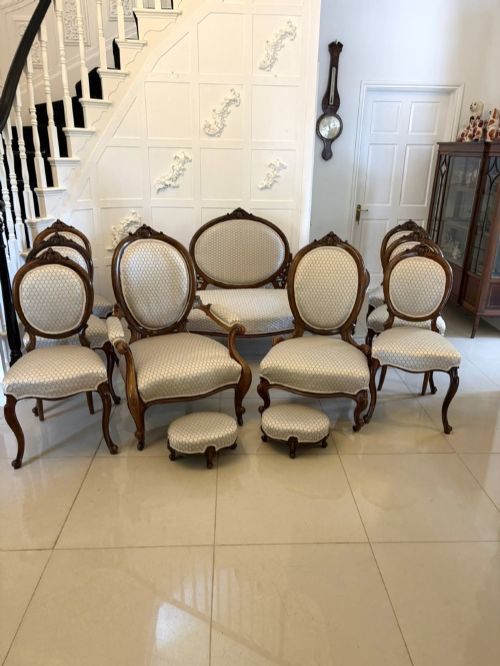


Cream Upholstered Salon Suite
A cream upholstered salon suite brings period elegance to a drawing room through matching carved frames and sumptuous fabric.
Cream Upholstered Salon Suite
When you search for a cream upholstered salon suite, you are looking at matched seating arrangements designed for formal entertaining in nineteenth-century and early twentieth-century drawing rooms. These groupings typically comprise a two-seater sofa alongside armchairs and side chairs, sharing identical timber frames and textile coverings.
The versions you are most likely to meet on this page date from the Victorian and Edwardian eras, alongside French revival styles such as Louis XVI and French Empire. These suites range from large eleven-piece assemblages down to intimate three-piece settings.
Makers fashioned these groupings from woods including mahogany, walnut, satinwood, hardwood, and giltwood. The frames feature carved details such as lion paw feet, while the upholstery relies on fabrics like damask and velvet.
How they were made
Cabinetmakers shaped dense hardwoods like mahogany and walnut to form the structural frames of each sofa and chair. Carvers then applied intricate ornamentation by hand, including the lion paw feet seen on Victorian examples and the refined giltwood details of Louis XVI revival pieces.
Upholsterers finished the frames using traditional stuffing techniques and covered the springs with durable textiles. Damask and velvet fabrics in pale tones completed the seating, secured neatly with brass tacks or gimpe trim.
The listings show pieces spanning from the 1850s Victorian era through to Edwardian and early 20th-century French revival styles.
What varies in quality
The distinction between standard production and superior craftsmanship lies in the depth and crispness of the timber carving. Suites featuring hand-carved walnut or giltwood display sharper relief and greater fluidity in their ornament than simpler turned frames.
The integrity of the timber framing and the scale of the suite dictate its standing within the period. Larger settings comprising eleven pieces demand substantial matching timber stock, whereas smaller three-piece suites rely on the cohesion of their upholstery and frame design.
The Cream Upholstered Salon Suite Glossary
- Salon suite
- A matched set of seating furniture designed for a formal entertaining room. It typically includes a sofa and multiple chairs sharing identical woodwork and fabric.
- Damask
- A reversible figured fabric traditionally woven on a jacquard loom with patterns visible in the matte and lustrous weave. It provides a formal texture suitable for period upholstery.
- Giltwood
- Timber treated with a thin layer of gold leaf or gilt preparation to create a brilliant metallic surface. This finish is frequently found on French revival salon pieces from the nineteenth century.
- Louis XVI Revival
- A style popular in the nineteenth century that mimics the neoclassical restraint, straight tapered legs, and carved architectural motifs of eighteenth-century France.
- Lion paw feet
- Carved furniture terminals shaped to resemble the foot of a lion, frequently seen resting upon the floor in substantial Victorian seating.
Cream Upholstered Salon Suite: Frequently Asked Questions
What pieces comprise a salon suite?
A salon suite typically includes a central two-seater sofa accompanied by matching armchairs and side chairs. Some larger groupings also incorporate footstools to complete the arrangement.
These coordinated sets were designed to furnish nineteenth-century drawing rooms with a unified decorative theme across all seating elements.
Where were salon suites used?
These seating groups were placed in the formal drawing rooms or salons of large homes for receiving guests. They provided comfortable yet formal seating for conversation and entertaining.
Today, they function well in similarly proportioned living spaces or reception rooms where period character is desired.
How do I identify a Victorian suite?
Victorian suites often feature rich dark timbers such as walnut and mahogany with deep hand-carved ornamentation. Details like lion paw feet and robust frames point directly to this nineteenth-century British aesthetic.
Upholstery on these pieces frequently utilises heavy damask or velvet fabrics secured with traditional methods.
What is Louis XVI style?
Louis XVI style pieces draw inspiration from neoclassical French design characterised by straight lines and restrained classical motifs. On this page, you will find this aesthetic expressed through gilt-wood finishes and refined frames.
These suites offer a lighter, more ornate appearance compared to heavier Victorian walnut alternatives.
How do I care for antique upholstery?
Protect delicate period textiles like damask and velvet by avoiding direct sunlight and using gentle vacuum attachments for dust removal. Professional cleaning is recommended for antique fabric to preserve the integrity of the fibres.
Treat the exposed timber frames with suitable wax polish to maintain the finish of the mahogany or walnut.