
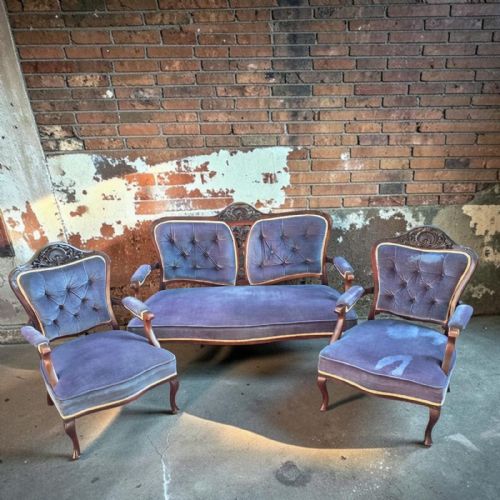


Edwardian Mahogany Sofa Set
An edwardian mahogany sofa set brings formal parlour seating together through matching wood and fabric.
Edwardian Mahogany Sofa Set
An edwardian mahogany sofa set typically comprises a settee paired with matching armchairs, designed for drawing rooms and formal reception spaces. These groupings appear across the late Victorian and Edwardian periods, frequently taking the form of three-piece suites or larger parlour arrangements.
The pieces on this page span salon suites, tub-shaped settees, and matching armchairs. Buyers most commonly encounter three-piece configurations that combine a two-seater sofa with two companion chairs.
How they were made
Makers constructed these frames primarily from mahogany, often enhancing the timber with boxwood inlay and marquetry details. Structural elements frequently rest on brass fittings or distinct support feet.
Upholstery forms a vital component of the construction, utilising fabric, velvet, damask, and cane panels. Many examples incorporate deep seating or specialised framework designed for traditional textile coverings.
Some chairs are labelled as his-and-her seats, offering distinct proportions for different sitters.
What varies in quality
Quality separates through the crispness of carved details and the precision of inlaid boxwood lines across the mahogany framework. Superior suites maintain structural integrity in the joints and retain balanced proportions between the settee and companion chairs.
The choice of original or period-appropriate textiles, such as damask and velvet, distinguishes standard production from finer bespoke workshop output. Suites retaining matching cane work or specialised upholstery demonstrate higher original grade manufacture.
Howard and Sons·J. S. Kinsey
The Edwardian Mahogany Sofa Set Glossary
- Bergere
- A closed-arm upholstered chair or sofa featuring cane panels on the back and sides. This French-inspired form appears frequently in Edwardian suites.
- Salon suite
- A matched set of seating furniture comprising a settee and several armchairs designed for formal reception rooms. These suites share identical wood and upholstery materials.
- Marquetry
- Decorative veneer work forming pictorial or geometric patterns on furniture surfaces. Craftsmen used contrasting woods set into the mahogany base.
- Tub sofa
- A curved armchair or settee featuring an enclosed semicircular backrest. This form provides a wraparound seating profile common in Edwardian design.
- Boxwood inlay
- Narrow strips of pale wood inserted into flush channels within darker timber. This technique creates contrasting geometric or linear borders on mahogany.
Edwardian Mahogany Sofa Set: Frequently Asked Questions
What pieces comprise an edwardian mahogany sofa set?
These groupings generally include a settee matched with one or two armchairs. Some larger parlour suites expand to five pieces for formal reception rooms.
Individual configurations range from two-seater settees with companion chairs to tub-shaped designs and curved cane bergere suites.
How were these sets used originally?
These suites furnished formal sitting rooms, drawing rooms, and ladies' salons where families received guests. They provided coordinated seating arrangements designed for polite conversation.
Individual chairs and settees allowed hosts to arrange matching seating throughout a reception space while maintaining a unified decorative scheme.
How do I live with one today?
These suites suit traditional drawing rooms or spacious living areas where matching wood tones can anchor the room. Proper placement protects the mahogany frames from direct sunlight and extreme temperature fluctuations.
Many examples feature upholstered surfaces that accommodate everyday sitting, though some boudoir suites require specialised re-upholstery to match modern interiors.
How do I tell periods apart?
Late Victorian pieces often display heavier carved ornamentation and darker timber tones. Edwardian versions frequently introduce lighter inlaid details and more streamlined forms.
Material choices also help differentiate eras, with transitional pieces bridging late nineteenth-century styles and early twentieth-century inlay techniques.