
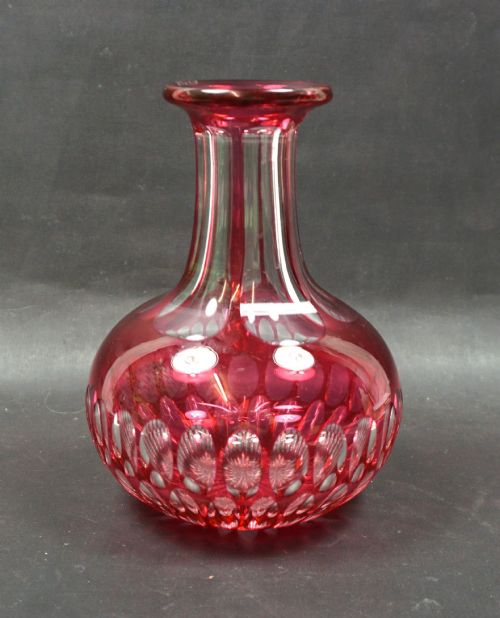


Cranberry Glass Wine Glasses
These cranberry glass wine glasses bring deep pink colour and rich Victorian character to any table set for dinner.
Cranberry Glass Wine Glasses
Cranberry glass wine glasses are principally found in Victorian and Edwardian sets, often shaped as matched groups of six or twelve for formal dining. The pieces span the nineteenth century and the early twentieth century, originating from English, French, and Bohemian makers.
Buyers will frequently encounter complete sets of hand-blown stemware alongside individual decanters, carafes, and champagne coupes sharing the same distinctive pink hue. These items range from plain blown bowls to heavily engraved vessels decorated with birds and fruiting vines.
The material appears in various depths of colour, from pale pink tones to deep ruby shades, sometimes overlaid on clear crystal. Many examples survive from the eighteen-eighties and eighteen-nineties, reflecting the height of domestic glassware production.
Methods and materials
Makers produced these objects using blown glass and cut crystal techniques, introducing gold chloride to the molten batch to achieve the characteristic pink colour. Artisans then shaped the vessels by hand, creating delicate stems and bowls.
Decoration often involved wheel-engraving or cutting through an outer layer of cranberry glass to reveal clear crystal underneath. Silver plate and sterling silver mounts were occasionally added to decanters and serving bottles.
Victorian dinner guests occasionally sipped claret from glasses so deeply ruby-tinted that nobody could guess what vintage was actually poured.
Judging the work
Quality rests upon the depth and evenness of the colour throughout the glass, alongside the precision of any wheel-engraved botanical or avian motifs. Fine examples display crisp cutting that exposes the clear crystal layer cleanly beneath the cranberry surface.
The weight and balance of the stemware distinguish finer sets from simpler commercial output, with well-proportioned bowls and smooth pontil marks indicating skilled execution. Matching sets with uniform height and tone command particular attention.
Baccarat
The Cranberry Glass Wine Glasses Glossary
- Cranberry Glass
- Glass coloured with gold chloride to produce shades ranging from pink to deep red. This specific chemical process gives the material its signature rich tone.
- Overlay
- A technique where a layer of coloured glass is fused over a clear crystal base. Cutting through the top layer reveals the contrasting clear glass beneath.
- Hock Decanter
- A tall decanter specifically designed for serving white wine or hock. These vessels often feature colour-over-crystal construction.
- Champagne Coupe
- A broad, shallow-bowled stemmed glass used for sparkling wine. Victorian examples frequently paired cranberry bowls with clear glass feet.
- Pontil Mark
- The scar left on the base of blown glassware where the punty rod was attached. Its presence indicates traditional hand-blown manufacturing methods.
Cranberry Glass Wine Glasses: Frequently Asked Questions
How do I clean antique cranberry glass?
Wash these pieces gently by hand using warm water and mild washing-up liquid. Avoid abrasive sponges and sudden temperature changes to protect the historic material.
Dry them immediately with a soft lint-free cloth to prevent water spots from forming on the surface.
Were these glasses used for red or white wine?
Victorian dining practices often utilised these coloured bowls for various dessert wines and claret. The intense hue helped mask the appearance of the wine.
Today, many buyers repurpose them for modern table settings or display them within cabinet collections.
How can I tell Victorian pieces from later ones?
Nineteenth-century examples frequently show slight variations in hand-blown form and hand-finished pontil marks on the base. Edwardian production tended toward greater uniformity.
Engraving styles and specific registry marks also help date individual pieces within the broader Victorian era.
Are harlequin sets authentic?
Harlequin sets consist of individual glasses gathered together that share the same cranberry colour family but vary slightly in pattern or shade. Collectors assembled these groups over time rather than buying them as a single factory batch.
They offer a vibrant, varied display for a dining table while remaining entirely period-correct.