



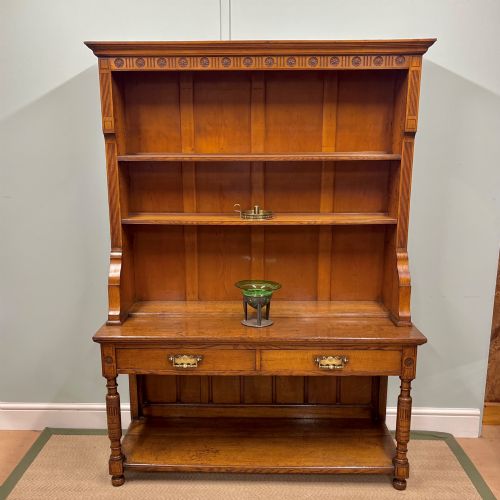


Country House Pot Board
A country house pot board is a sturdy timber base designed to hold everyday kitchenware, offering enduring utility and rustic character.
Country House Pot Board
A country house pot board typically appears as a dresser base or serving table equipped with a low, open lower shelf beneath the main surface. The pieces on this page span the eighteenth and nineteenth centuries, taking the form of oak and painted dressers rooted in Georgian and rustic farmhouse traditions.
Buyers will most frequently encounter sturdy oak examples alongside painted softwood variations originating from English, Welsh, and Scottish workshops. These sturdy forms served domestic storage needs in historic kitchens and sculleries before finding a place in modern dining spaces.
Materials and construction methods
Makers relied primarily on solid oak, pine, and painted timber, pairing heavy planks for the main surface with slatted lower pot boards. Iron and brass fittings such as hinges and drawer pulls appear across various examples, while bone sometimes surfaces in detailed escutcheons.
Joinery methods reflect traditional vernacular woodworking, utilising pegged mortise and tenon joints to withstand heavy domestic use. Surfaces often show the natural grain of unpolished oak or layers of historic paint applied in regional workshops.
Country House Pot Board Retail Price Guide 2026
Typical asking prices for country house pot board among the pieces listed under this phrase on Sellingantiques today, from the lower quarter to the upper quarter. They describe what is for sale here now, not the wider market.
Current listings feature oak and painted pine materials applied across eighteenth and nineteenth-century forms.
Distinctions in craftsmanship and survival
Quality rests upon the integrity of the timber selection and the retention of original surfaces, whether unpolished oak or historic paint. Heavier proportions and thoughtful scaling separate master vernacular pieces from simpler utilitarian work.
The degree of original hardware survival and the tightness of the structural joinery also define the standing of a piece. Well-preserved lower pot boards that retain their original supporting stretchers indicate careful historical stewardship.
The Country House Pot Board Glossary
- Pot board
- A low open shelf fitted beneath a dresser base or serving table, traditionally used for storing pots and pans. This lower tier defines the core utility of the furniture.
- Dresser base
- The lower section of a kitchen dresser featuring drawers and cupboards, often functioning independently as a sideboard. These pieces provide substantial surface area and storage.
- Vernacular
- Architecture or furniture built by local craftsmen using regional materials and traditional methods rather than high academic styles. Such pieces reflect the practical needs of their local communities.
- Escutcheon
- A protective plate surrounding a keyhole, often fashioned from brass or bone. It prevents the timber around the lock from splintering through repeated use.
Country House Pot Board: Frequently Asked Questions
What is a pot board used for?
A pot board provides an open lower shelf beneath a dresser or serving table designed for stacking heavy kitchenware. In historic domestic spaces, it kept large pots and ceramic vessels accessible yet tidy.
Today, buyers utilise this lower tier to display large platters, books, or baskets in a dining room or kitchen setting.
How do I date an oak dresser?
Dating relies on observing construction marks, timber characteristics, and the style of the mouldings and hardware. Eighteenth-century examples often display hand-planed surfaces and pegged joinery unique to period workshops.
Comparing the timber patination and drawer construction helps distinguish Georgian pieces from later nineteenth-century revivals.
Are these pieces made of solid oak?
Many listings feature solid oak throughout the frame, top, and drawers, particularly those following Georgian vernacular traditions. Other examples utilise pine or mixed timbers beneath painted finishes.
Checking the drawer linings and board thickness reveals the specific timber composition of each individual piece.
Where were these dressers made?
These utility pieces originate from various regional workshops across England, Wales, Scotland, and France. Welsh and Scottish examples often display distinct proportions and local timber choices.
Regional furniture makers adapted standard forms to suit the domestic requirements of their specific local households.