


Country House Footstool
These country house footstool pieces are substantial seats built for comfort in large English interiors, prized for their sturdy timber frames and deep upholstery.
Country House Footstool
When you search for a country house footstool, you encounter low seating designed to sit before large armchairs or serve as centre tables in domestic settings. The pieces listed here span the 18th century, 19th century, Edwardian era and into the 20th century, capturing a tradition of domestic comfort.
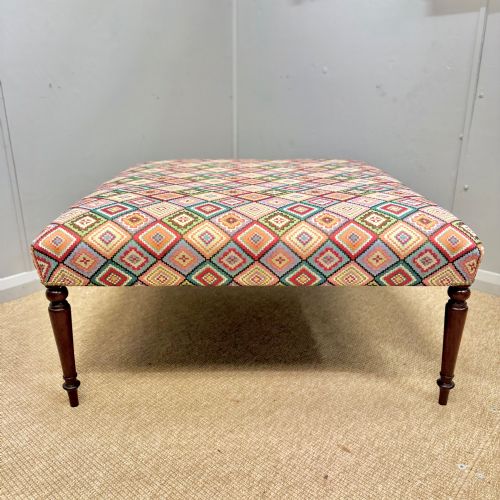
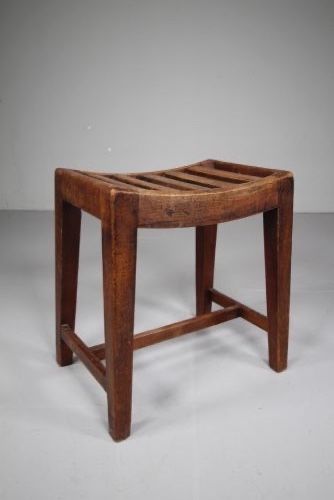
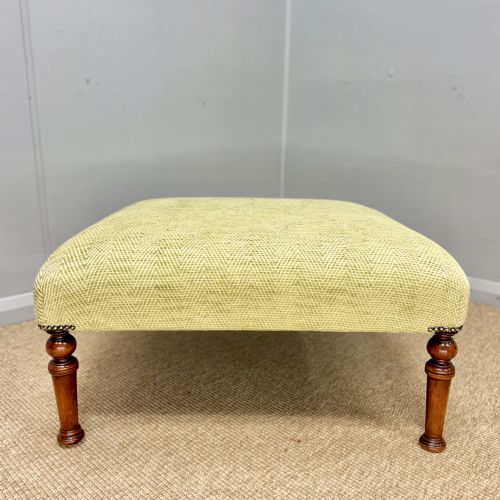
The most frequent form you meet on this page is a large upholstered ottoman or footstool covered in leather, tapestry or geometric fabric, resting on timber frames of mahogany, oak or walnut. Alongside these, simpler rustic rush-seated stools appear from Edwardian and later periods.
Makers and workshops range from Harrods and Howard & Sons to Hallett & Sons, alongside unassigned country pieces in mahogany and oak. They vary from buttoned leather centre stools to slatted Georgian designs.
Materials and construction
Frames are constructed from dense hardwoods including mahogany, oak and walnut, utilising traditional joinery to support heavy daily use. Slatted designs and solid timber legs underpin the structure beneath the top.
Upholstery relies on durable coverings such as woven fabric, tapestry, herringbone textiles and leather. Rush is employed for traditional woven seats on simpler oak frames.
Finishes highlight the natural grain of the wood, whether left as a rustic country surface or polished to a formal mahogany sheen.
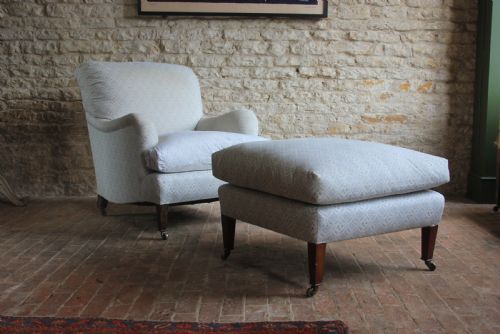
Some stools come paired with matching armchairs, proving that furniture likes to have company.
Assessing quality and character
The distinction between items rests in the integrity of the timber frame and the ambition of the upholstery. Pieces bearing maker attributions or complex tapestry work sit at the higher end of the range.
Simpler rush-seated oak stools represent a more utilitarian domestic tradition, where the tightness of the woven seat and the condition of the timber define the piece.
Howard & Sons·Hallett & Sons·Harrods
The Country House Footstool Glossary
- Ottoman
- A low upholstered seat or bench without a back or arms, often built on a large scale for country houses. They serve dual purposes as footrests and casual seating.
- Rush
- Dried marsh grass woven into tight seats for wooden stools and chairs. It offers a resilient, textured surface seen on traditional country seating.
- Tapestry
- Heavy hand-woven or machine-woven fabric depicting pictorial scenes or geometric patterns. It frequently covers the top of 19th century footstools.
- Slatted
- Constructed with narrow strips of wood spaced at intervals, often seen in Georgian stool bases. This technique reduces weight while maintaining frame strength.
- Buttoned
- An upholstery technique where leather or fabric is pulled deep into the padding with buttons, creating a patterned diamond effect. It provides structural tension and a formal appearance.
Country House Footstool: Frequently Asked Questions
What is a country house footstool?
A country house footstool is a low, sturdy seat designed for domestic comfort in large rooms. These pieces often feature generous proportions and substantial upholstery.
They function as footrests before armchairs or stand alone as centre stools in reception rooms.
How do I date a footstool?
Dating relies on examining the timber frame, upholstery style and construction methods. Georgian pieces display slatted mahogany work, while 19th century examples often feature buttoned leather or tapestry.
Edwardian and later pieces introduce different proportions and simpler rush seating, reflecting changing domestic tastes.
Where were these stools placed?
These stools sat before large armchairs in drawing rooms and libraries. Larger ottoman versions stood in the centre of rooms as auxiliary surfaces or seating.
Their robust construction suited heavy daily use in busy country residences.
How do I care for leather upholstery?
Leather upholstery requires gentle cleaning and regular conditioning to prevent the hide from drying out. Keep antique leather away from direct sunlight and heat sources.
Proper maintenance preserves the suppleness of buttoned and plain leather surfaces.