


Country House Earthenware
Country house earthenware brings tactile warmth to a room through centuries of utilitarian domestic pottery.

Country House Earthenware
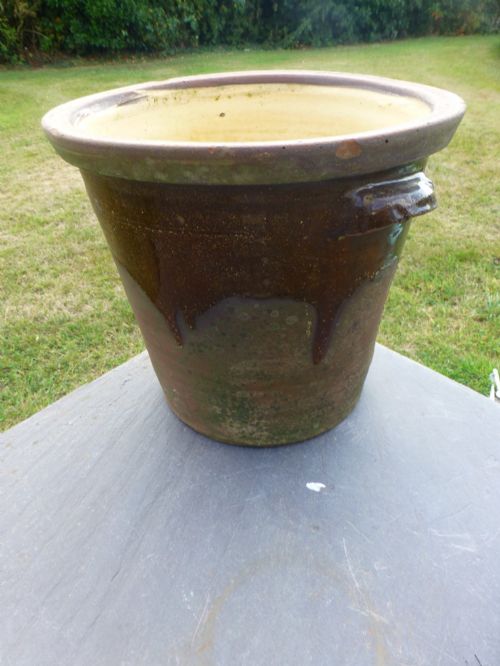
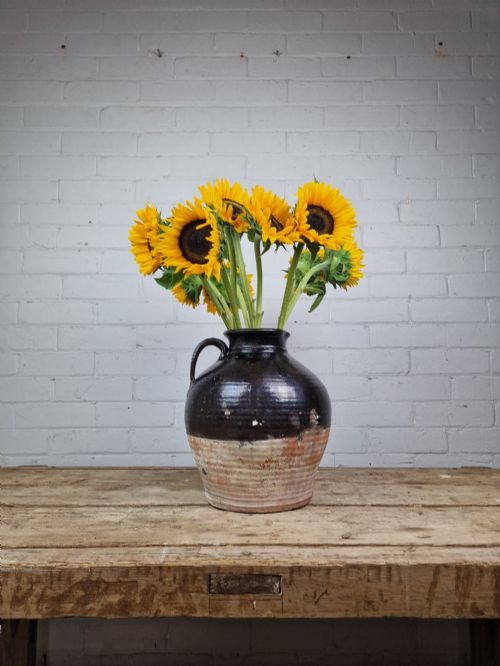
When you search for country house earthenware, you are looking at practical domestic ceramics shaped from clay and finished with lead glazes or slip. These pieces range from substantial dairy salting crocks and utilitarian ale jugs to decorative Staffordshire figures and transfer-printed plates.
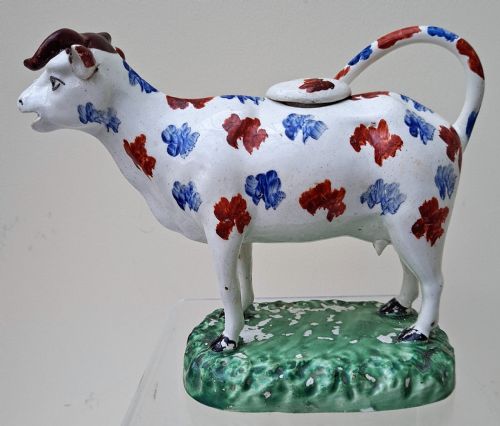
The versions most likely to meet you on this page belong to the nineteenth century, reflecting the domestic routines of Victorian and Georgian households. You will also encounter vernacular planters, utilitarian pitchers, and cow creamers that show the enduring appeal of rustic country pottery.
Makers in Leeds and Staffordshire produced much of this utilitarian and decorative ware, balancing everyday utility with vernacular charm. Each vessel carries the marks of hand-forming, from slipware decoration to blue and white transfer printing.
How they were made
Potters shaped local clay by hand or on the wheel, creating thick-walled vessels designed to withstand heavy daily use in farmhouses and estate kitchens. Earthenware bodies remained porous until coated with lead glazes, which provided a smooth, waterproof surface for holding liquids and dairy.
Makers applied liquid slip over the base clay for surface decoration, scratching through to reveal the contrasting colour underneath, or brushed on cobalt oxides for transfer-printed scenes. Firing took place in traditional kilns, leaving natural variations in the glaze and surface texture.
Listings feature earthenware from the seventeenth century through to the Edwardian period, spanning utilitarian dairy crocks and decorative Staffordshire figures.
What varies in quality
The quality of country house earthenware rests on the crispness of the modelling and the stability of the glaze during firing. Superior pieces display confident handling of the clay, whether in the sharp relief of a Staffordshire figure or the smooth, even sweep of a lead glaze over a dairy crock.
Porters and potters achieved greater visual depth through skilful application of slip trails and transfer printing, distinguishing everyday kitchenware from finer display pottery. Wear should look honest and appropriate for age, leaving the form and decorative details intact.
The Country House Earthenware Glossary
- Slipware
- Pottery decorated with a liquid clay mixture called slip, applied to the unfired body by trailing, dipping, or brushing. This technique created bold linear patterns on early jugs and crocks.
- Earthenware
- Porous pottery fired at lower temperatures than stoneware or porcelain, requiring a glaze to hold liquids. It forms the foundation of most domestic country house ceramics.
- Lead glaze
- A glossy coating containing lead oxide applied to earthenware before firing to seal the porous clay. It gives older utility vessels their characteristic warm, reflective surface.
- Flatback
- A Staffordshire figure modelled with a finished front and a flat, unglazed or minimally painted back intended for display against a wall. These figures often depicted historical personalities and royalty.
- Cow creamer
- A hollow ceramic vessel in the shape of a cow, filled through a hole in the back and poured from the mouth. They were used on tea tables to serve cream during the Georgian and Victorian periods.
Country House Earthenware: Frequently Asked Questions
Can I use these jugs for liquids?
Many nineteenth century jugs retain functional lead glazes that handle water or ale without leaking.
Check the interior for stability and hairline fractures before putting any antique vessel back into daily service.
What is a Staffordshire flatback?
Staffordshire flatbacks are decorative ceramic figures designed to sit neatly on mantelpieces against cottage walls.
Potters left the backs unpainted to save time and materials during mass production for Victorian homes.
How do I spot genuine slipware?
Genuine slipware shows raised trails of coloured clay sitting naturally upon the darker body beneath the glaze.
Look for the soft contours and minor kiln imperfections typical of hand-thrown seventeenth and eighteenth century earthenware.