



Country Cottage Oil Canvas
Country cottage oil canvas paintings capture rural idylls through layered brushwork on woven supports, offering collectors a tangible window into nineteenth and twentieth-century pastoral life.
Country Cottage Oil Canvas
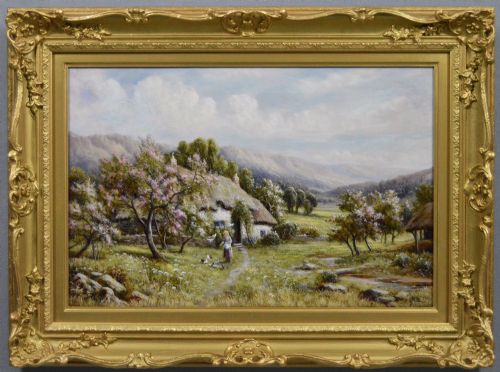
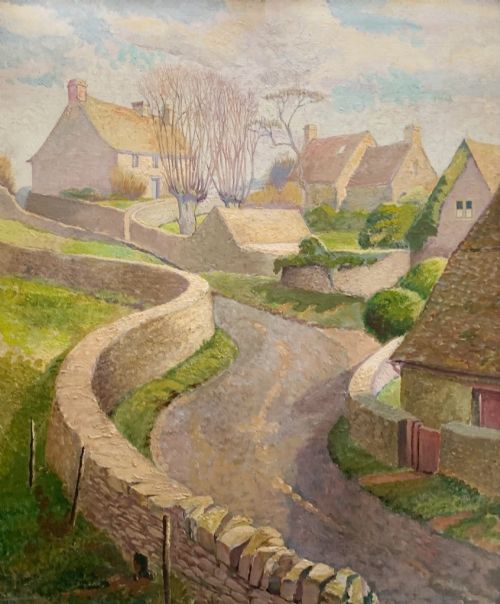
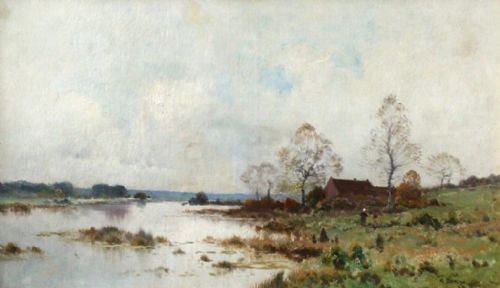
A country cottage oil canvas presents rustic scenes, farmsteads, and rural dwellings executed in oil paint upon woven canvas supports. These works span the nineteenth and twentieth centuries, encompassing Victorian landscapes, British Impressionism, and English School naïve traditions.
The most prevalent examples on this page are nineteenth-century and early twentieth-century oil paintings featuring thatched cottages, gardens, and figures by rivers or farm tracks. Painters captured these rural subjects within framed canvases, utilising wood and gesso structures to house the works.
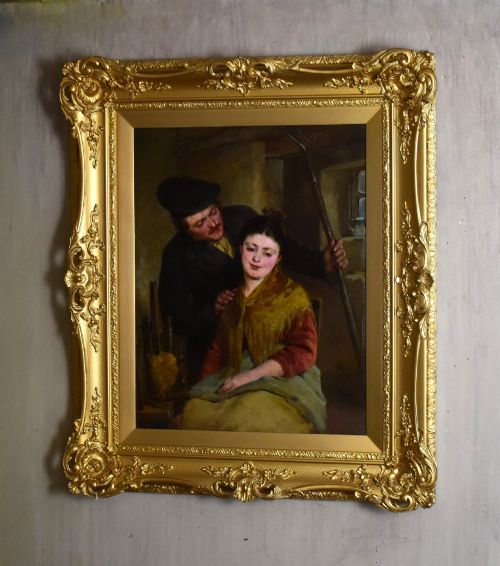
Buyers encounter both signed works by known artists and unsigned pieces from regional English and European schools. The imagery ranges from intimate domestic scenes with animals to expansive countryside vistas containing rustic architecture.
Materials and Technique
Artists painted primarily with oil paint applied to stretched canvas supports, sometimes reinforced with board backing. Pigments were mixed with binding oils to achieve varying opacity, allowing for textured impasto or smooth tonal transitions.
Frames incorporated wood, gesso, and gold leaf or giltwood finishes to complement the painted scenes. These traditional framing techniques protected the canvas edges while enhancing the visual depth of the landscape.
Several country cottage canvases include unexpected farmyard occupants, recording guinea pigs alongside traditional horses, hens, and geese.
Factors of Quality
Quality rests in the handling of light, brushwork confidence, and compositional balance across the canvas. Superior paintings demonstrate an adept capture of atmospheric perspective and natural illumination rather than rigid adherence to detail.
The integrity of the original canvas and paint layer dictates preservation standards. Works retaining stable oil paint without extensive overpaint or structural canvas relining command greater interest from discerning collectors.
Robert John Hammond·Howard Helmick·Frederick James Knowles·William Greaves·Ernest Higgins Rigg·John Falconar Slater·Abraham Hulk Junior·Pierre Emmanuel Eugene Damoye·Harry Pennell·Ernest Walbourn·Herbert Royle·James William Stamper·Henry Singleton·George Morland·Robert Gallon·Thomas Thomas·Charles Hunt Jnr·John F Pasmore·Arthur Herbert Rigg·Walter Meegan·James Edwin Meadows·G R Vaughan·Georgina Lara·Amy Antill
The Country Cottage Oil Canvas Glossary
- Oil on Canvas
- Pigment suspended in a drying oil applied to a woven fabric support. This combination provides durability and allows artists to build rich surface textures.
- Impasto
- Paint applied thickly to a canvas, standing out in relief from the surface. This technique adds tactile dimension and captures light dynamically across the rustic scene.
- Gesso
- A plaster-like mixture applied to wooden frame mouldings as a base for gilding or paint. It provides a smooth foundation for decorative surface finishes.
- Giltwood
- Wood carved and covered with a thin layer of gold leaf or metallic powder. Frames finished in this manner were standard for framing fine nineteenth-century paintings.
- Barbizon School
- A mid-nineteenth-century French art movement emphasising direct observation of nature and rustic landscapes. Painters in this tradition focused on atmospheric rural scenes and farmsteads.
Country Cottage Oil Canvas: Frequently Asked Questions
What is a country cottage oil canvas?
These works are paintings executed in oil on canvas that depict rural cottages, farmsteads, and countryside life. They document vernacular architecture and agricultural landscapes from the nineteenth and twentieth centuries.
Artists ranged from formally trained academicians to regional English school painters. Each canvas preserves a specific historical view of rural habitation.
How do I date an antique oil painting?
Dating relies on stylistic evidence, artist signatures, framing materials, and the preparation of the canvas support. Canvas weave and wooden stretcher construction often provide clues to the period of creation.
Costume details and architectural elements within the cottage scenes also help narrow down the decade in which the artist worked.
Where should I hang a landscape oil painting?
These paintings suit spaces with controlled natural light, away from direct sunlight and damp conditions. Proper placement protects both the oil pigment and the wooden gilt frame from environmental stress.
Displaying them at eye level in principal rooms allows the textures of the canvas and brushwork to be appreciated clearly.