


Counter Call Bell
These counter call bells are practical Victorian and Edwardian devices in polished brass, silver plate and sterling silver that summon attention with a crisp ring.
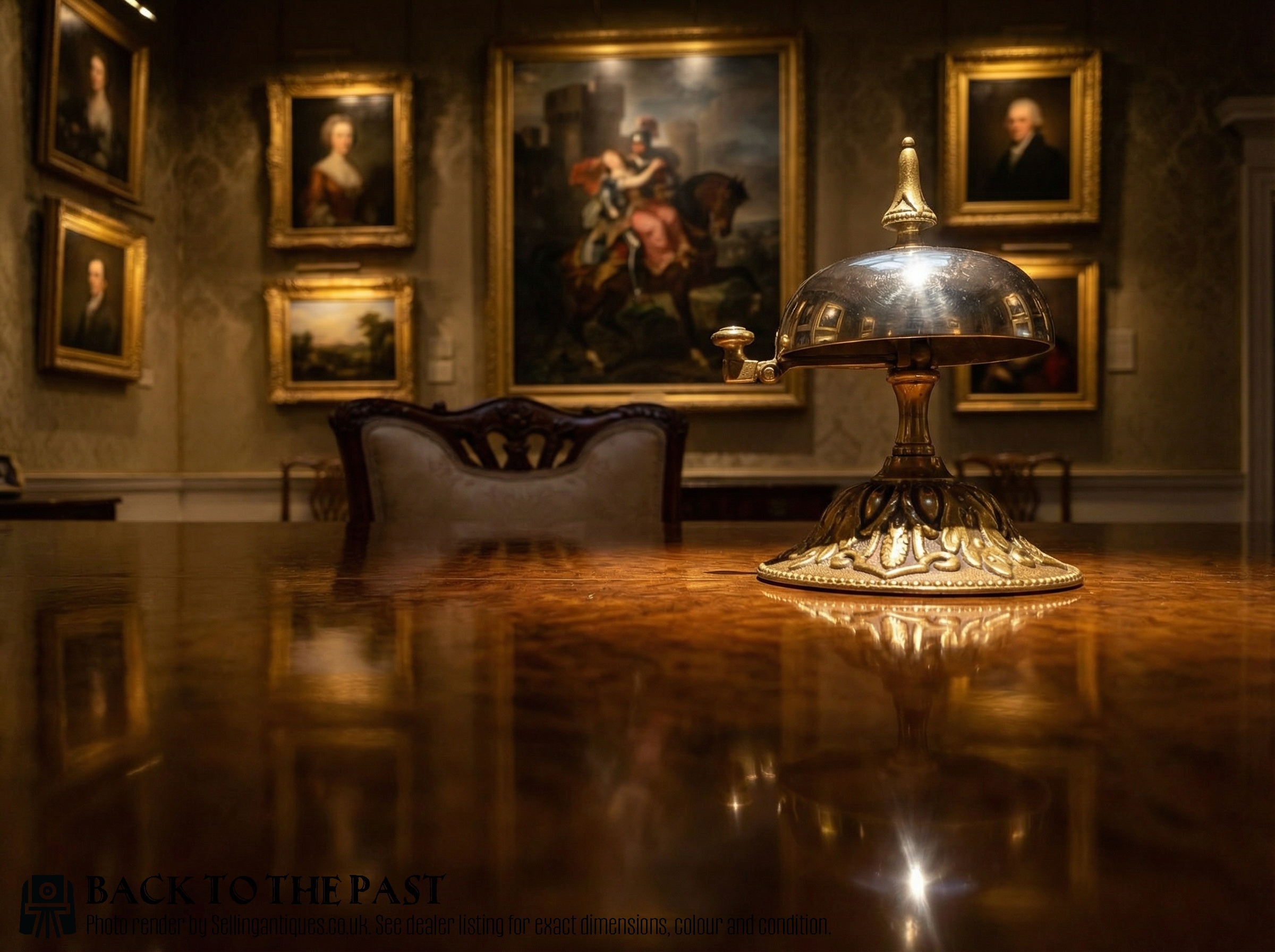
Counter Call Bell
A counter call bell sits on a desk, shop counter or reception table to summon service with a sharp mechanical ping. When you search for a counter call bell, you find utilitarian objects that doubled as smart desk accessories in country houses, shops and hotels.
The pieces on this page span the Victorian and Edwardian eras, including the late nineteenth century and the early twentieth century. You encounter standard desk bells alongside novelty mechanical versions shaped as animals.
Most examples rely on heavy brass or bronze bases to stay steady during use, while finer domestic models utilise sterling silver or silver plate. Forms range from simple turned wooden bases with brass plungers to ornate cast pieces with decorative surrounds.
Materials and construction
Makers utilised cast brass, bronze and steel for the functional working parts and structural bases to ensure durability under daily service. Brass is polished or left with a warm aged tone, while steel provides the internal spring mechanisms.
Finer domestic and hotel pieces incorporate sterling silver or silver plate over a sturdy base metal core. Wooden components, including ebonised wood, appear in turned handles and bases that contrast against the metal bells.
Victorian ingenuity produced mechanical desk bells shaped like realistic pigs and hogs that pinged when you pressed their snouts.
Judging quality in counter call bells
Quality rests in the weight of the metal casting and the crispness of the mechanical action inside the dome. A heavier brass or bronze base indicates a superior domestic or commercial piece that stays firm when pressed.
Novelty and silver-plated examples show quality through the detail of the modelling, particularly in animal forms like pigs and hogs, and the uniform coverage of the precious metal over the base material.
The Counter Call Bell Glossary
- Counter bell
- A bell designed to sit flat upon a shop counter, hotel desk or reception table. These pieces feature a plunger or top button that strikes an internal or external dome.
- Ebonised wood
- Timber treated with a dark finish to imitate expensive ebony. This material often forms the contrasting handle or base of a Victorian bell.
- Silver plate
- A layer of fine silver bonded to a base metal such as copper or brass. This technique offered the visual appeal of solid silver at a lower production cost.
- Sterling silver
- A silver alloy containing a high proportion of pure silver by weight. British pieces from this era carry hallmarks to verify the metal standard.
Counter Call Bell: Frequently Asked Questions
How do mechanical desk bells work?
An internal spring and hammer mechanism strikes the inside of the metal dome when the top plunger is pressed down. This creates a sharp ring without needing a traditional swinging clapper.
Most mechanisms are housed securely within the brass or silver casing, designed to withstand frequent daily use on a busy counter.
What is the difference between a counter bell and a hand bell?
Counter bells remain stationary on a flat surface and operate via a top plunger or push button. Hand bells feature a handle so the user can lift and shake them.
While both appear in Victorian and Edwardian settings, counter bells were specifically intended for fixed reception points.
How do I date an antique brass bell?
Dating relies on the manufacturing style, the specific shade and finish of the brass, and any engraved hallmarks or registration numbers. Victorian pieces often display heavier casting and simpler utilitarian forms than later Edwardian versions.
Silver models frequently carry assay office marks and date letters that pinpoint the exact year of production.
Where were these bells originally used?
These bells served in hotel reception desks, Victorian country houses, retail shops and offices to summon staff or service. Novelty pieces often sat on private writing desks in wealthy homes.
Their sturdy construction reflects their role in daily commercial and domestic environments.