


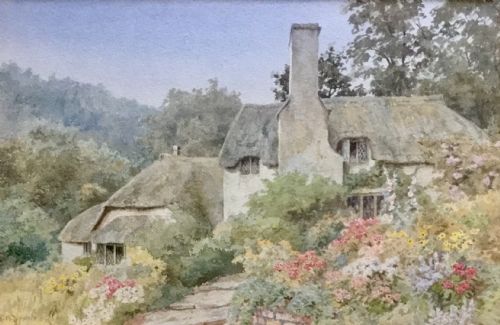


Cottage Garden Wall Art
Cottage garden wall art brings the charm of pastoral plots and rural blooms into your interior through period oils and watercolours.
Cottage Garden Wall Art
When you search for cottage garden wall art, you find historical depictions of rural domestic spaces, floral plots, and pastoral scenes created across the nineteenth and early twentieth centuries. These works record traditional English country life through media such as oil paint, watercolour, and mixed media on canvas or paper. The subjects focus on domestic exteriors, walled gardens, and floral borders set around rural cottages.
The pieces you meet most often on this page date from the Edwardian era and the 1920s, alongside late Victorian examples and individual pieces from the 1930s and 1940s. Many works present named locations or specific rural properties, while others capture anonymous pastoral scenes executed in British Impressionist or English School styles. The framing typically consists of period wood, frequently protected by glass in the case of watercolours.
How they were made
These works rely on traditional painting media applied to paper, canvas, or prepared panels, using watercolour pigment or oil paint. Watercolours utilise fluid washes on paper to capture the soft light of rural scenes, often finished with delicate pencil work or bodycolour highlights. Oil paintings employ layered pigments on canvas or wood, building texture and depth across floral beds and cottage masonry.
The physical construction includes wooden stretchers for canvases and card supports or wooden backing boards for works on paper. Many surviving watercolours and paintings retain their original or period wooden frames, occasionally protected beneath glass.
Several garden scenes capture quiet moments of domestic life, from knitting outside the cottage to feeding the hens.
What varies in quality
The distinction between ordinary and exceptional cottage garden wall art rests on the handling of light, brushwork, and composition by the artist. Stronger examples display confident handling of pigment that captures atmospheric conditions and floral detail with immediacy, rather than rigid illustration. The fidelity of the perspective and the naturalism of the garden flora further separate routine decorative paintings from accomplished fine art.
Condition and originality also determine the character of each piece. Works that retain their vibrant pigments without excessive fading or paper discolouration preserve their intended visual impact. Similarly, pieces housed in original period wooden frames maintain a more complete historical integrity.
Owen Bowen·Ernest Higgins Rigg·Kershaw Schofield·Lilian Stannard·David Woodlock·Thomas Nicholson Tyndale·Benjamin D. Sigmund·Theresa Sylvester Stannard·George Frederick Nicholls·Arthur H Buckland·John F. Pasmore·Minnie Smythe
The Cottage Garden Wall Art Glossary
- Watercolour
- A painting method where fine pigment is suspended in a water-soluble binder and applied to paper. This technique produces translucent washes of colour well suited to pastoral and floral subjects.
- Oil paint
- A slow-drying medium composed of pigments suspended in a drying oil, typically linseed. It allows for thick impasto application and rich, blended tones.
- British Impressionism
- A late nineteenth and early twentieth-century painting movement focusing on natural light, loose brushwork, and everyday subjects. It heavily influences many pastoral garden scenes of the period.
- Mixed media
- An artwork combining two or more distinct artistic materials or techniques on a single support. In this context, it often involves watercolour augmented with bodycolour or ink.
Cottage Garden Wall Art: Frequently Asked Questions
What periods do these pieces date from?
The works span from the nineteenth century through the Edwardian period and into the nineteen-twenties, thirties, and forties. Victorian and late Victorian examples sit alongside significant numbers of nineteen-twenties watercolours and oils.
Stylistic shifts reflect this timeline, moving from Victorian pastoral traditions towards British Impressionist and Edwardian pastoral approaches.
How should I hang watercolours?
Works on paper require protection from direct sunlight to prevent the fading of watercolour pigments over time. Glass fronts shield the delicate paper surfaces from atmospheric moisture and dust.
Positioning them away from direct heat sources ensures the paper and period wooden frames remain stable.
What subjects appear most frequently?
The primary subjects involve rural cottages, walled gardens in summer, floral borders, and domestic exterior scenes. Figures occasionally appear engaged in quiet daily tasks such as knitting or feeding hens.
Specific regional locations in England provide the setting for many identified watercolours and oil paintings.
Are these works painted on canvas or paper?
The support depends entirely on the medium chosen by the artist. Oil paintings are typically executed on canvas or wood panels.
Watercolours and mixed media works are executed on paper, frequently mounted and framed behind glass.