



Cornish Maritime Oil Painting
A cornish maritime oil painting brings the grey Atlantic light and sheltering harbours of the south-west directly into a room.
Cornish Maritime Oil Painting
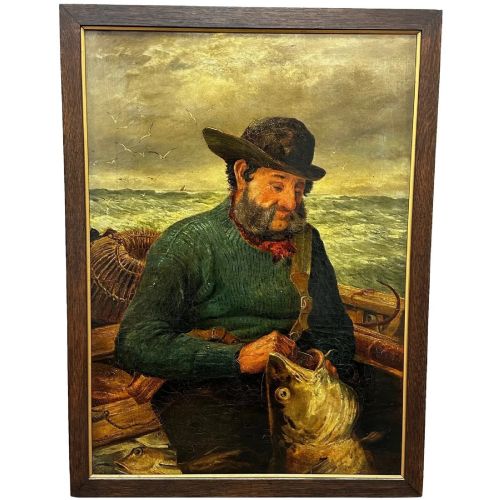
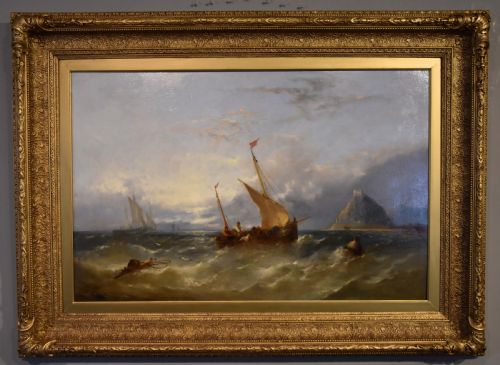
A cornish maritime oil painting records the working harbours, rocky coves and fishing fleets of Cornwall across the nineteenth and twentieth centuries. These works range from late Victorian coastal scenes to mid-century depictions of St Ives, Mevagissey and Polperro.
Most examples found here combine canvas supports with traditional oil paint, frequently set within original gilt wood or gesso frames. The subjects focus closely on local maritime life, capturing fishing trawlers, shipwrecks and safe anchorages along the rugged coastline.
Materials and technique
Artists applied oil paint directly onto woven canvas stretched over wooden frames, building up pigment to capture the shifting moods of the sea and sky. This technique allowed painters to work both en plein air along the cliffs and finish larger compositions within studio settings.
Many works retain their period frames constructed from carved wood and finished with gesso and gilt. These surrounds provide structural support and historical context, often showing the distinct framing choices of regional framers and Victorian or Edwardian picture makers.
Cornish Maritime Oil Painting Retail Price Guide 2026
Typical asking prices for cornish maritime oil painting among the pieces listed under this phrase on Sellingantiques today, from the lower quarter to the upper quarter. They describe what is for sale here now, not the wider market.
Listings span from Victorian maritime scenes of the 1880s through to mid-twentieth-century Newlyn School works on canvas.
Distinctions in quality
Quality rests upon the artist's ability to render atmosphere, coastal light and maritime architecture with conviction rather than mere formula. Stronger examples display confident brushwork and precise tonal control over sea and sky, whereas weaker pieces rely on generic formulas.
Condition of both the oil paint surface and the original gilt frame significantly influences the standing of a piece. Works retaining undisturbed original varnish and well-preserved canvas tension command greater appreciation than those with extensive past restoration.
William Henry Williamson·Edward Matthew Elliott·Charles Napier Hemy·Gyrth Russell·Charles Sim Mottram·William Pitt·William Lambert Bell·Hendrik Yan Wolter·William Edward Webb
The Cornish Maritime Oil Painting Glossary
- Canvas
- A heavy woven fabric stretched tightly across a wooden frame to serve as the foundation for oil paintings. It provides a durable and textured surface that absorbs oil medium effectively.
- Gesso
- A plaster mixture applied to wooden frames as a smooth base before gilding or painting. It creates a crisp surface for decorative mouldings.
- Newlyn School
- An art colony established in Cornwall during the late nineteenth century focused on naturalistic plein air painting. Members recorded local fishing communities and coastal life directly from observation.
- Seascape
- A work of art depicting the sea, coastal views, ships or maritime activity. These subjects formed a central focus for artists working along the Cornish coast.
Cornish Maritime Oil Painting: Frequently Asked Questions
Where were these painted?
Artists painted these scenes directly along the Cornish coastline, focusing on specific harbours and fishing communities such as St Ives, Mevagissey, Polperro and St Michael's Mount. They worked on the spot to capture local conditions.
Many of these locations supported active fishing fleets, providing painters with immediate access to working boats, tides and maritime trades.
How do I date them?
Dating relies on stylistic clues, clothing styles in figures, framing methods and signatures recorded by the artist. Victorian pieces often show heavier brushwork and elaborate gilt frames.
Twentieth-century works frequently adopt lighter palettes and looser brush techniques associated with the Newlyn School and British Impressionism.
Are original frames important?
Original gilt wood and gesso frames provide historical context and complement the aesthetic balance of the painting. They often feature makers' stamps or labels from period framers.
Retaining the original frame preserves the integrity of the piece as a complete historical object from the nineteenth or twentieth century.
How should I care for them?
Keep oil paintings away from direct sunlight, high humidity and sudden temperature fluctuations to protect the canvas and paint layer. Dust the gilt frame gently with a dry, soft brush.
Avoid using water or chemical cleaners on the painted surface or gesso frame to prevent permanent damage to the historic materials.