

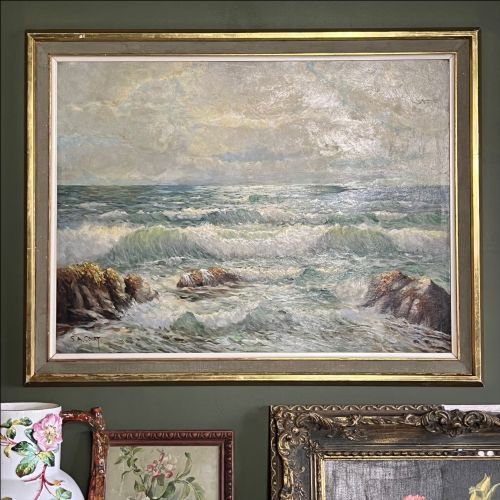


Antique Cornwall Oil Painting
An antique Cornwall oil painting captures the rugged cliffs, bustling harbours, and luminous light of the southwestern peninsula.
Antique Cornwall Oil Painting
An antique Cornwall oil painting brings the maritime atmosphere and coastal scenery of the region into an interior through historical depictions of locations such as St Ives, Polperro, and Penzance. These works range from peaceful Victorian coastal views to expressive canvases produced by artists associated with the Newlyn and St Ives schools.
The selection on this page spans from the eighteenth century through the nineteenth and twentieth centuries, including Victorian, Edwardian, and post-impressionist periods. Subjects frequently focus on local harbours, maritime vessels navigating coastal waters, and dramatic cliff landscapes rendered by named British artists.
Materials and Technique
The works recorded here are executed primarily in oil paint applied to canvas supports, utilising the rich medium to capture shifting coastal light and sea spray. Brushwork ranges from tight academic realism to the looser, textured application characteristic of British impressionism.
Many of these paintings retain their period frames, constructed from wood and embellished with gesso or giltwood. These original surrounds complement the depth of the palette and protect the edges of the canvas.
Antique Cornwall Oil Painting Retail Price Guide 2026
Typical asking prices for cornwall oil painting among the pieces listed under this phrase on Sellingantiques today, from the lower quarter to the upper quarter. They describe what is for sale here now, not the wider market.
Several artists braved the unpredictable Cornish sea spray to paint harbour tides directly from the rocks.
Factors of Quality
Quality in these coastal works rests upon the fidelity of the atmospheric depiction, the strength of the artist's brushwork, and the clarity of the composition. Superior examples convey the particular quality of Cornish light and water with confident handling rather than formulaic repetition.
The preservation of the original paint surface and the survival of a fitting period giltwood or wood frame elevate the standing of a piece. Well-documented provenance linking the canvas to recognised regional schools adds further distinction.
Edward Matthew Elliott·Charles Napier Hemy·George Turland Goosey·William Pitt·Joseph Farquharson·William Lambert Bell·Hendrik Yan Wolter·Herbert James·William Edward Webb·Arthur Joseph Meadows·Allen G Folliott Stokes·Frank Hider·John Holland Senior
The Antique Cornwall Oil Painting Glossary
- Canvas
- A heavy woven fabric stretched across a wooden frame to serve as a support for oil paint. It provides the foundational texture visible beneath many historical coastal landscapes.
- Gesso
- A plaster-like mixture applied to wooden frames before gilding or painting. It creates a smooth surface capable of holding crisp moulded ornament.
- Giltwood
- Wood carved and coated with a thin layer of gold leaf or metallic powder. It frames traditional artworks with a warm, reflective border.
- Newlyn School
- An artist colony based in Cornwall during the late nineteenth and early twentieth centuries. Painters in this group focused on plein-air realism and local maritime life.
Antique Cornwall Oil Painting: Frequently Asked Questions
How do I identify a Cornish school painting?
Look for specific regional landmarks such as St Ives harbour, Newlyn cottages, or Mount's Bay recorded in the canvas title or inscription.
Signatures linked to known artists of the local colonies provide additional confirmation of origin.
Are these paintings supplied with frames?
Most listings include the historical frame accompanying the canvas, often constructed from wood with gesso or giltwood finishes.
These surrounds are selected to complement the period of the artwork.
What periods do these artworks cover?
The available pieces span from eighteenth-century maritime scenes through Victorian and Edwardian coastal landscapes up to mid-twentieth-century post-impressionist works.
Nineteenth-century and early twentieth-century examples form the majority of the selection.
How should I care for an oil painting on canvas?
Keep the canvas away from direct sunlight and steady fluctuations in room temperature to prevent the paint surface from drying or cracking.
Dust the frame and canvas gently with a soft, dry brush without applying moisture or cleaning solutions.